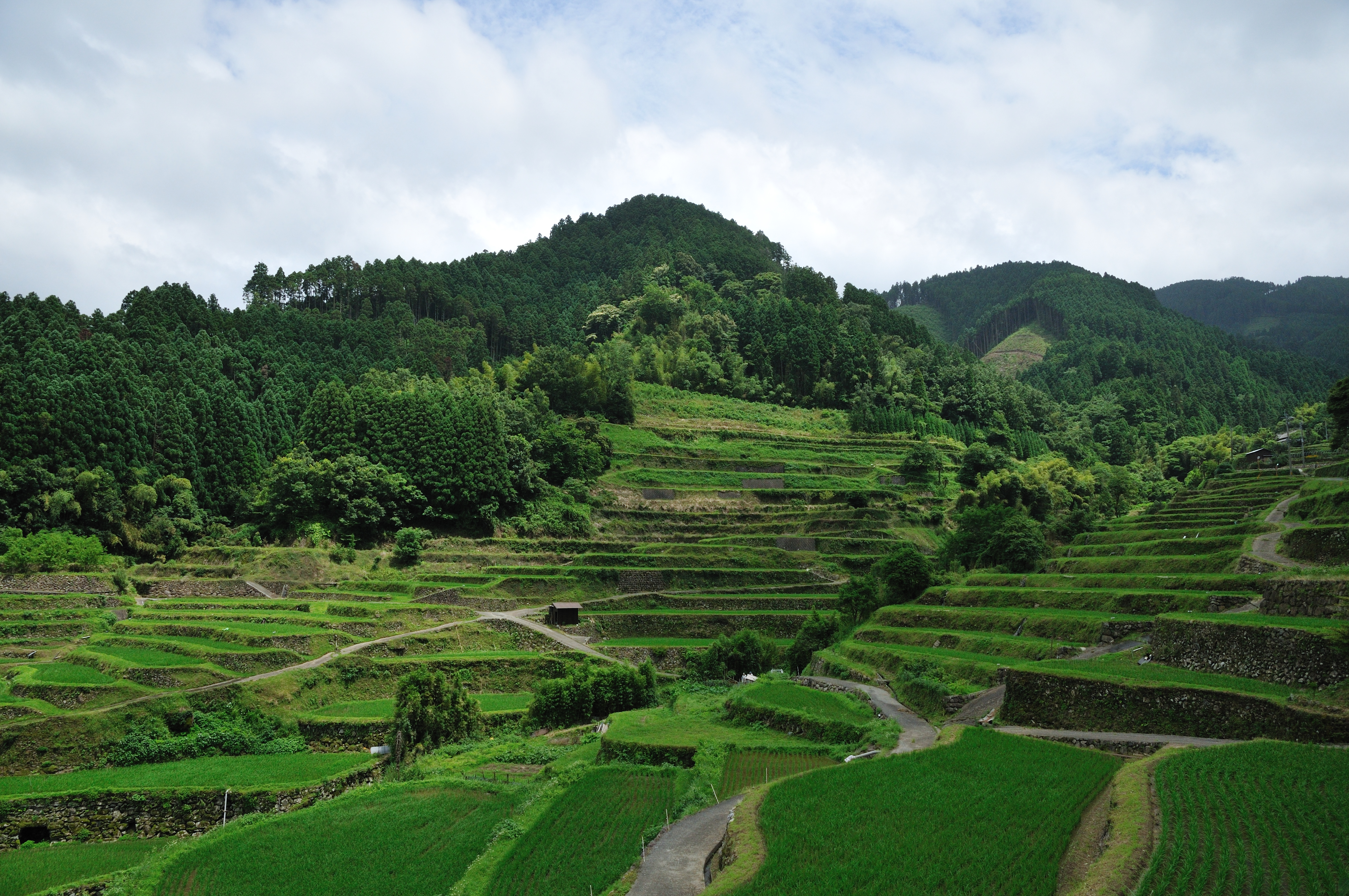
100 Terraced Rice Fields of Japan
The Japanese word for terraced rice field is tanada, and the word for a thousand of them is senmaida. Stand at the edge of a mountainside covered in senmaida and the arithmetic becomes physical: hundreds of narrow paddies descending in steps toward a valley floor, each one carved by hand, each one holding a thin mirror of water that reflects the sky. In 1999, the Japanese Ministry of Agriculture, Forestry and Fisheries looked at these landscapes, realized they were disappearing, and did something about it. They selected 134 terraces across 117 municipalities, from the Tohoku region in the north to Kyushu in the south, and declared them the 100 Terraced Rice Fields of Japan.
Fourteen Hundred Years of Carving Mountains
Rice terracing in Japan stretches back roughly 1,400 years, though the word tanada first appears in documents from the Muromachi period in the fourteenth century. The logic was simple and the labor was not: where flat land was scarce, farmers carved steps into hillsides, built stone or earthen retaining walls, and channeled water downward from terrace to terrace. Each paddy was small, sometimes no wider than a few meters, shaped to follow the natural contour of the slope. The result was an agricultural system that turned steep, otherwise unusable terrain into productive rice land. Over centuries, entire mountainsides were transformed into cascading stairways of green and water, maintained by communities that passed the knowledge and the responsibility from generation to generation.
More Than Paddies
Terraced rice fields do far more than grow rice. They function as natural dams, retaining water across hillsides that would otherwise shed rainfall too quickly. The paddies slow erosion, filter runoff, and create microhabitats for frogs, insects, and aquatic plants that would vanish if the terraces were abandoned. In a country prone to landslides, the retaining walls and water management systems of tanada serve as quiet infrastructure, stabilizing slopes that might otherwise collapse during heavy rains. The terraces also shape the visual identity of rural Japan in ways that no other agricultural practice matches. In spring, the flooded paddies become mirrors stacked up a mountainside. In summer, they glow with the dense green of young rice plants. By autumn, the fields turn gold before harvest, and in winter some terraces are illuminated with thousands of small lights, turning the hillsides into spectacles of lantern and shadow.
The 1999 Selection
By the late twentieth century, Japan's terraced rice fields were in trouble. Rural depopulation had drained the countryside of the labor needed to maintain them. Young people moved to cities, and aging farmers could not keep up with the constant work of repairing walls, managing water channels, and planting and harvesting on steep ground that no machine could easily reach. The Ministry of Agriculture, Forestry and Fisheries responded in 1999 by commissioning a panel of academics to identify the nation's most significant terraces. Each prefecture submitted nominations. The committee selected 134 sites across 117 municipalities, spanning the length of the country from Tohoku to Kyushu. The official list was called the 100 Terraced Rice Fields of Japan, though the actual number exceeded one hundred because some sites were grouped together. The designation brought national attention and, crucially, public funding for preservation.
Senmaida by Name
The selected terraces read like a tour of rural Japan's most dramatic landscapes. Maruyama Senmaida in Mie Prefecture spreads 1,340 small paddies across a mountainside, often called the finest view of tanada in the country. Shiroyone Senmaida in Ishikawa Prefecture drops its terraces directly to the edge of the Sea of Japan, where the paddies seem to pour into the ocean. Hoshitoge no Tanada in Niigata Prefecture is a cluster of more than 200 terraces nestled among forested hills, famous for the morning mist that fills the valleys and turns each flooded paddy into a floating mirror. These are not museum pieces. They are working farms, maintained by local communities and increasingly by urban volunteers who travel to the countryside for planting and harvest weekends, drawn by the beauty and the desire to keep something ancient alive.
Holding the Hillside
The 100 Terraced Rice Fields list did not solve the problem of rural decline, but it slowed the bleeding. Tourism increased at designated sites. Volunteer programs brought city dwellers into the paddies. Some terraces began producing premium rice marketed under their own names, commanding higher prices that made the difficult labor more economically viable. The list also inspired a broader cultural conversation about what Japan stood to lose if its countryside emptied entirely. The terraces are living artifacts, landscapes that exist only because someone maintains them. Left alone for even a few years, the walls crumble, the channels clog, and the forest reclaims the slope. Every tanada on the list is a statement that a community decided, at least for now, to keep carving water into the side of a mountain.
From the Air
The geohash coordinates (39.03N, 141.39E) place this article's reference point in the Tohoku region of northern Honshu, though the 134 designated terraces span the length of Japan from Tohoku to Kyushu. Notable sites visible from the air include Maruyama Senmaida in Mie Prefecture (34.17N, 135.98E), Shiroyone Senmaida along the Noto Peninsula coast in Ishikawa Prefecture (37.40N, 136.73E), and Hoshitoge no Tanada in Niigata Prefecture (37.05N, 138.76E). From altitude, terraced rice fields appear as fine parallel lines or concentric curves etched into hillsides, most visible when flooded in spring or golden before autumn harvest. Recommended viewing altitude: 2,000-5,000 feet to appreciate the terracing patterns against the surrounding forest.