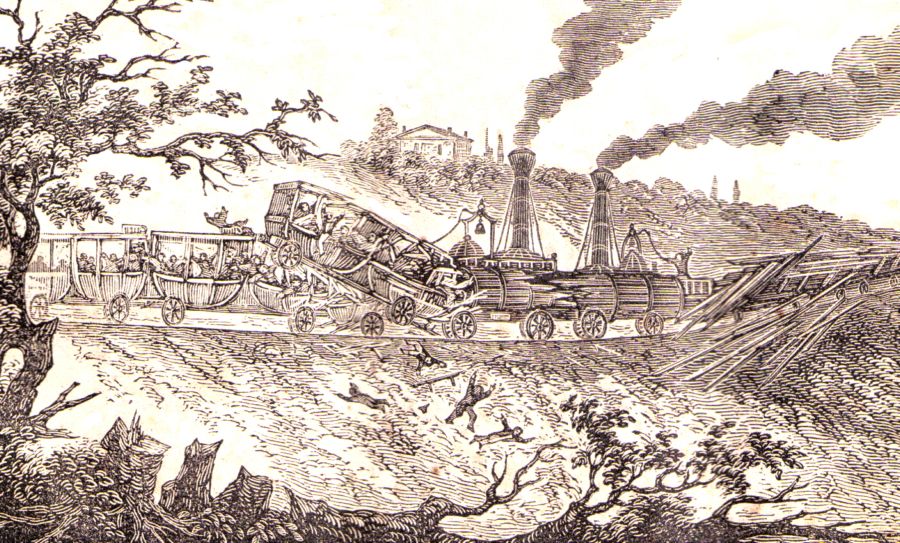
1837 Suffolk Head-On Collision
Two hundred passengers packed into thirteen stagecoach-like rail coaches had no reason to worry. They were returning from a pleasant steamboat trip, rolling eastbound along the Portsmouth and Roanoke Railroad through the flat tidewater country near Suffolk, Virginia. It was August 11, 1837, and American railroading was barely a decade old. The concept of a scheduled right-of-way, of one train yielding to another at a designated turnout, was still being written in real time. That afternoon, the rules failed. A lumber train carrying fifteen cars came barreling downhill around a blind, curved embankment, and the two engines met head-on in what would become the first fatal head-on train collision in recorded history.
Iron Rails Through Tobacco Country
The Portsmouth and Roanoke Railroad had threaded its line through Suffolk just two years earlier, in 1835. Later renamed the Seaboard Railroad, the route served the dual purpose of hauling freight, primarily tobacco and lumber, and carrying a growing number of passengers eager to try the new mode of travel. Rail technology was still in its infancy. There were no standardized signals, no telegraph dispatching, and single-track lines required careful coordination at turnouts where one train would pull aside to let another pass. Speeds rarely exceeded twenty miles per hour, and most prior collisions had amounted to little more than jarring bumps. A head-on crash on the Camden and Amboy line in 1836, caused by heavy fog, had produced only minor bruises. The prevailing assumption was that low speeds made catastrophic wrecks unlikely. Suffolk would shatter that assumption.
The Blind Curve at Goodwin's Landing
The passenger express had just stopped near Goodwin's Landing, a local residence along the route, before approaching a curved, upward embankment about thirty-five feet high. Coming the other direction, the lumber freight with its fifteen loaded cars was rolling downhill, having already passed the turnout where it was supposed to yield. There was no time. The two trains were traveling at an estimated twelve to twenty miles per hour when they collided. Only the engineer of the passenger train managed to brake before impact. The first three passenger coaches absorbed the worst of the collision. The lead coach telescoped into the second, the wooden walls splintering and crushing inward, trapping passengers in a mass of shattered timber. The newspaper The Native American reported the dead as Elizabeth McClenny, Margaret Roberts, and Jemima Ely. The injured and dying were carried back to Goodwin's Landing, filling every room of the house.
Tragedy Compounded
As if the collision itself were not enough, the aftermath brought a grim coda. A rescue train, already headed toward Suffolk, was dispatched to assist with the wreckage. But in a cruel turn, this relief train struck two more people along the tracks, killing one of them. The final toll, as recorded in the 1840 book Steamboat Disasters and Railroad Accidents, stood at four dead, thirteen severely wounded, and more than thirty with lesser injuries. An engraving of the scene was later published in that same volume, one of the earliest visual records of a rail disaster in America. The official inquiry placed blame squarely on the freight engineer for his failure to yield at the turnout, a simple procedural lapse that had cascading, lethal consequences.
A Grim First in Railroad History
The Suffolk collision holds a sobering distinction: it was the first head-on train crash in the world to kill passengers. The disaster forced early railroad operators to confront the reality that their new technology, however promising, carried mortal risks that could not be managed by gentleman's agreement alone. The wreck became a cautionary reference point in the years that followed, cited in safety discussions as railroads expanded across the American landscape. Today, Suffolk has grown into a sprawling independent city in Virginia's Hampton Roads region, and the precise location of the crash along the old Portsmouth and Roanoke right-of-way has faded from the visible landscape. But the collision's legacy endures in every signal, switch, and dispatching protocol that modern railroads take for granted. Those systems exist, in part, because of what happened on a blind curve near Goodwin's Landing on a summer afternoon in 1837.
From the Air
Located at 36.72N, 76.61W near Suffolk, Virginia, in the Hampton Roads region. The area is flat tidewater coastal plain with no significant terrain obstacles. The nearest major airports are Norfolk International (KORF) approximately 20nm northeast, and Suffolk Executive Airport (KSFQ) nearby. Fly at 2,000-3,000 feet AGL for good views of the railroad corridors threading through the area. The modern Norfolk Southern rail lines roughly follow the old Portsmouth and Roanoke Railroad alignment.