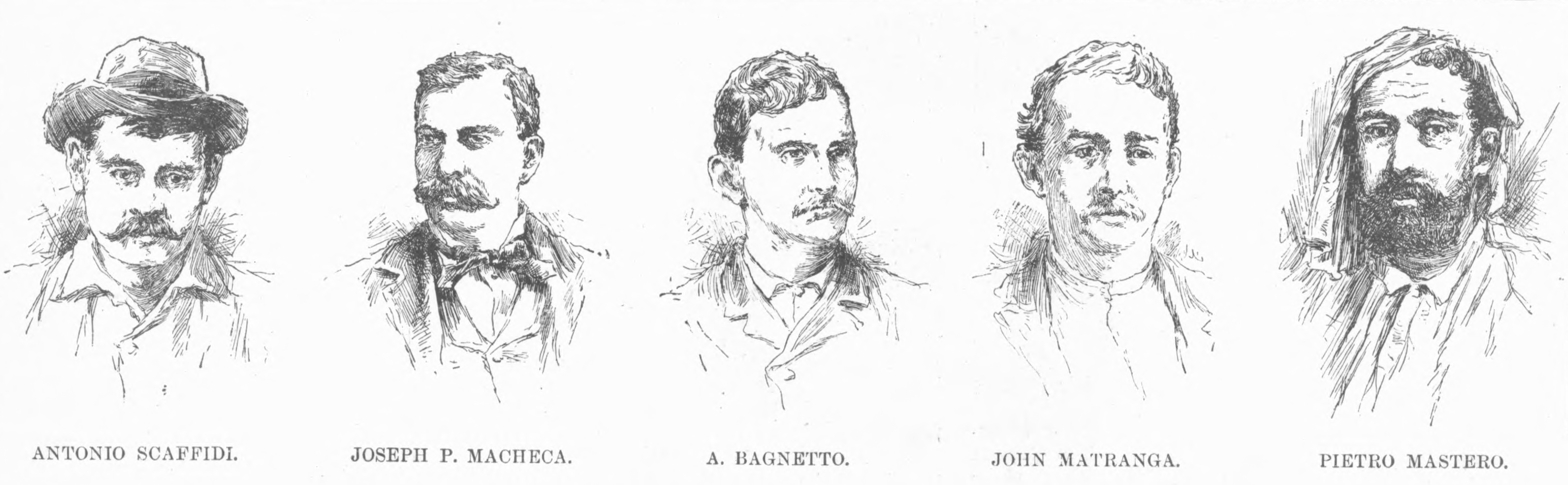
1891 New Orleans Lynchings
On the morning of March 14, 1891, an advertisement appeared in New Orleans newspapers calling citizens to gather at the statue of Henry Clay near the parish prison. The ad told them to "come prepared for action." By the time attorney William S. Parkerson finished his speech denouncing the jury that had acquitted several Italian immigrants of murdering the city's police chief, the crowd numbered in the thousands. They marched to the prison chanting, "We want the Dagoes." Within hours, eleven men lay dead, most of them shot inside the jail. It was the largest single mass lynching in American history, and its reverberations would strain diplomatic relations between two nations, reshape immigration law, and etch the word "Mafia" permanently into the American imagination.
The Chief Falls on a Damp October Night
On the evening of October 15, 1890, New Orleans police chief David Hennessy was shot by several gunmen as he walked home from work. He returned fire and chased his attackers before collapsing. Asked who had shot him, Hennessy reportedly whispered a single word to Captain William O'Connor: "dagos." He lingered in the hospital for hours but never named his assailants. He died the next day. The city erupted. An ongoing feud between the Provenzano and Matranga families, rival operators on the New Orleans waterfront, provided a ready narrative. Mayor Joseph Shakspeare ordered police to "arrest every Italian you come across." Within twenty-four hours, forty-five people were in custody. By some accounts, as many as 250 Italians were rounded up. Nineteen men were ultimately charged with murder or conspiracy. The accused included fruit peddlers, stevedores, a cobbler, and a fourteen-year-old boy.
A Trial Built on Shadows
The trial of nine defendants began on February 16, 1891. The evidence was weak from the start. The shooting had occurred on a poorly lit street on a damp night in a notoriously corrupt city. Witnesses identified suspects not by their faces but by their clothing. Captain O'Connor, the only person who claimed to have heard Hennessy blame Italians, was never called to testify. Shotguns found at the scene were claimed to be Sicilian lupare; they had actually been manufactured by the W. Richards Company. When the jury delivered its verdicts on March 13, six defendants were acquitted and mistrials were declared for three others. But none were released. All nineteen prisoners were returned to the parish jail. Federal district attorney William Grant later reported that the evidence was "exceedingly unsatisfactory" and found no link between the accused and the Mafia.
The Mob at the Gates
The acquittals enraged the city. A group calling itself the Committee on Safety met that evening and placed the newspaper advertisement calling citizens to the Clay statue. The Italian consul, Pasquale Corte, begged Louisiana governor Francis T. Nicholls to intervene. The governor declined without a request from Mayor Shakspeare, who had gone out to breakfast and could not be reached. Inside the prison, as the mob battered down the door, warden Lemuel Davis released the nineteen Italian prisoners from their cells and told them to hide as best they could. The killing was carried out by a disciplined execution squad led by Parkerson and three other city leaders. Emmanuele Polizzi, who appeared to be mentally ill, was dragged outside, hanged from a lamppost, and shot. Antonio Bagnetto, a fruit peddler, was hanged from a tree and shot. Nine others were shot or clubbed to death inside the prison. The bullet-riddled bodies of Polizzi and Bagnetto were left hanging for hours.
A Word Enters the Vocabulary
The aftermath reshaped American politics and culture. Italy severed diplomatic relations with the United States, and rumors of war circulated on both sides of the Atlantic. President Benjamin Harrison eventually paid an indemnity of $2,211.90 to the family of each victim. Theodore Roosevelt, then serving on the Civil Service Commission, privately called the lynching "a rather good thing." The New York Times ran the headline "Chief Hennessy Avenged...Italian Murderers Shot Down." Massachusetts representative Henry Cabot Lodge used the incident to push for immigration restrictions, and the Hennessy case thrust the word "Mafia" into the American lexicon. Journalists used it loosely to link any crime by an Italian to organized conspiracy, and newspapers circulated wild rumors of Italian-American plots to attack New Orleans and wreck railroads in New York and Chicago.
Justice Deferred, History Revisited
A grand jury convened three days after the lynching. The judge presiding was a personal friend of several mob leaders. No one was indicted. The mob was described in the official report as "several thousands of the first, best, and even the most law-abiding, of the citizens of this city." Among the participants were John M. Parker, later elected governor of Louisiana, and Walter C. Flower, later elected mayor of New Orleans. For decades, the accepted narrative held that the lynched men were guilty mafiosi who deserved their fate. It was not until the 1970s that historians Humbert Nelli and Richard Gambino challenged this view. Gambino noted that shortly after the lynching, the city gave control of all dock work to a corporation headed by several of the mob's leaders, effectively eliminating the Italian waterfront workers who had been their economic competitors. Fourteen-year-old Gaspare Marchesi, who survived by hiding in the prison while his father was murdered, successfully sued the city of New Orleans in 1893 and was awarded five thousand dollars. The incident remains largely forgotten in America but is well remembered in Italy.
From the Air
The site of the Orleans Parish Prison where the lynchings occurred was located in downtown New Orleans at approximately 29.963N, 90.071W, in the Treme neighborhood near the French Quarter. From the air, the area is identifiable by the dense urban grid of the French Quarter and the prominent curve of the Mississippi River. The nearest airport is New Orleans Lakefront Airport (KNEW), about 5 miles northeast. Louis Armstrong New Orleans International Airport (KMSY) is approximately 15 miles west. Best viewed at 2,000-3,000 feet AGL. The French Quarter, Jackson Square, and the Superdome are useful visual landmarks for orientation.