1906 Salisbury Rail Crash
Steam locomotives in 1906 had no speedometers. A driver judged his speed by experience, by the sound of the wheels on the rails, by the feel of the engine beneath him. On the night of 1 July 1906, the driver of a London and South Western Railway boat train misjudged catastrophically. His express, carrying passengers from Plymouth to London Waterloo, entered a sharp curve at the eastern end of Salisbury station at more than 70 miles per hour. The speed limit was 30. Twenty-eight people died in the wreckage.
The Transatlantic Express
Boat trains were the connecting thread between ocean liners and London. Wealthy passengers, many of them Americans returning from transatlantic crossings, disembarked at Plymouth and boarded expresses that would deliver them to Waterloo without a single stop. This particular service ran non-stop from Plymouth to London with only a locomotive change at Templecombe, making it one of the fastest and most prestigious services on the LSWR network. The passengers that night were mostly affluent New Yorkers. Rumors later circulated that some had bribed the driver to run at speed, though no evidence supported the claim.
Rivalry on the Rails
The crash occurred at a charged moment in railway competition. The Great Western Railway was opening a shorter route that threatened to capture the lucrative transatlantic passenger traffic. LSWR drivers, it was said, were running fast to demonstrate their railway's ability to compete. Whether this driver was racing the clock or simply underestimating his risk remains unclear. What is known is that this was the first time he had taken a non-stopping train through Salisbury. The engine, a new L12 class 4-4-0 numbered 421, had a higher centre of gravity than the older T9 class locomotives, making it less stable at speed. Without a speedometer to consult, the driver likely had no precise idea how fast he was going as he approached the curve.
The Moment of Impact
At more than twice the permitted speed, the train left the rails entirely on the curve. It crashed into a stationary milk train and a light engine, and the destruction was total. The driver, two firemen, the guard, and twenty-four passengers were killed. The violence of the derailment left wreckage strewn across the tracks at a station that, until that moment, trains had been permitted to pass through without stopping. In the immediate aftermath, authorities reduced the speed limit on the Salisbury curve from 30 to 15 miles per hour, a restriction that remains in force today, over a century later. All subsequent trains were required to stop at Salisbury station.
A Pattern of Night Disasters
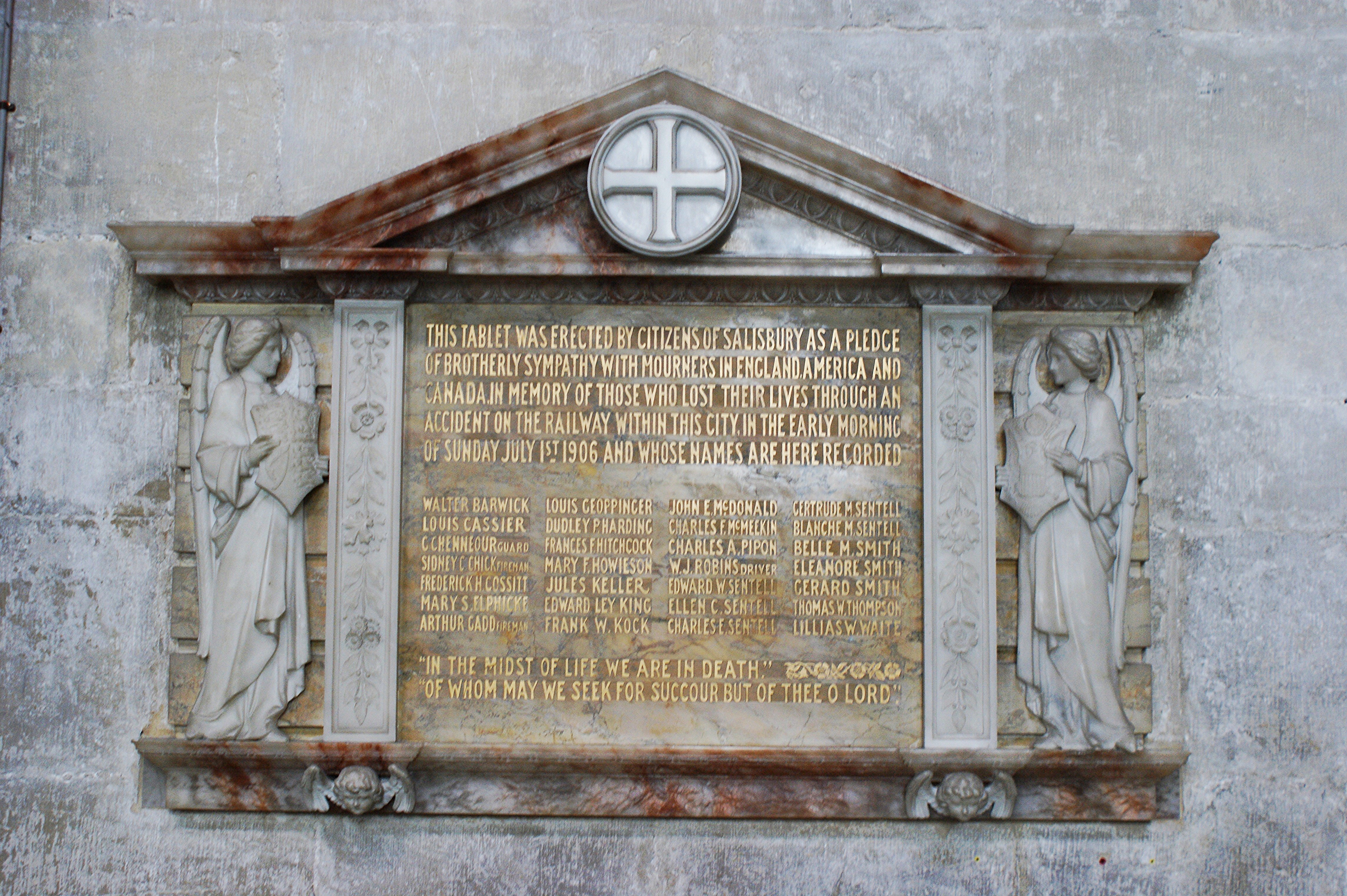
The Salisbury crash was the first of three fatal derailments caused by excessive speed at night within a sixteen-month period. Similar disasters struck at Grantham in September 1906 and at Shrewsbury in October 1907. In all three cases, the footplate crews were killed, making definitive explanations impossible. The official verdict in each case was driver error, but the pattern raised deeper questions about the pressures placed on drivers in an era of fierce railway competition. A memorial tablet in Salisbury Cathedral commemorates the 28 people who died. The crash changed railway safety practice at Salisbury permanently, turning what had been a through station into a mandatory stop, a reminder etched into every timetable that speed and curves do not forgive.
From the Air
Located at 51.071N, 1.804W at Salisbury railway station, Wiltshire. The sharp curve at the eastern end of the station where the crash occurred is visible from the air. Salisbury Cathedral's spire (the tallest in England) serves as an unmistakable landmark nearby. Nearest airports: EGLS (Old Sarum, 2 nm north), EGHI (Southampton, 20 nm southeast). The railway line threading through the city is clearly visible from 2,000-3,000 ft.