1906 San Francisco Earthquake
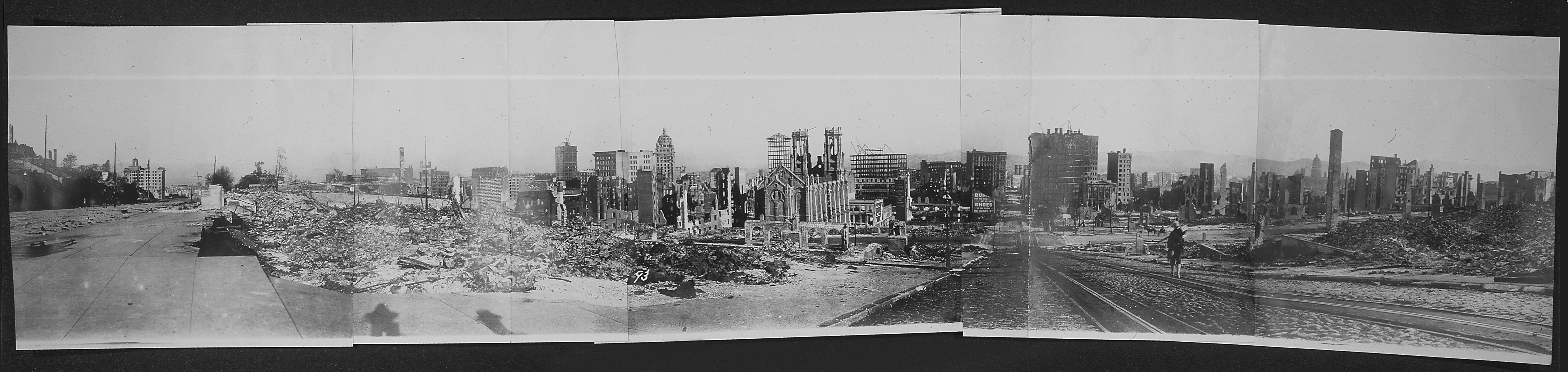
A woman lit her stove to make breakfast on the morning of April 18, 1906, unaware that her chimney had been shattered minutes earlier by the most devastating earthquake in American history. The resulting 'Ham and Eggs' fire would consume 30 city blocks, including City Hall. It was just one of more than 30 fires that burned for four days, destroying 25,000 buildings across 490 blocks. By the time the flames died, over 80% of San Francisco lay in ruins, and the trajectory of the American West had been permanently altered.
The Moment the Earth Moved
At 5:12 a.m. on April 18, the San Andreas Fault ruptured along nearly 300 miles of California coastline. In San Francisco, the shaking lasted between 45 and 60 seconds. Buildings collapsed. Water mains shattered throughout the city. Fire Chief Dennis T. Sullivan, the one man who might have coordinated an effective response, lay dying in the rubble of his own fire station, crushed when the California Hotel next door collapsed onto him. The earthquake itself claimed hundreds of lives directly, but it was only the beginning.
A City in Flames
The fires proved far more destructive than the earthquake. Ruptured gas mains ignited throughout the city. With water mains broken, firefighters stood helpless as blazes merged into a firestorm. Some fires were started deliberately by property owners desperate to claim insurance policies that covered fire damage but excluded earthquake damage. Untrained soldiers from the Presidio, attempting to create firebreaks with dynamite, succeeded mainly in spreading flames to buildings that had survived the initial shock. The Palace Hotel, where Enrico Caruso had performed Carmen the night before, burned to the ground. The tenor fled the city clutching an autographed photo of President Theodore Roosevelt, vowing never to return. He died in 1921 without breaking that promise.
Tent Cities and Green Cottages
Between 227,000 and 300,000 people, more than half the city's population, found themselves homeless. Golden Gate Park, the Presidio, and beaches from Ingleside to North Beach became vast tent cities. The Army built 5,610 small relief houses, painted green to blend into the parks where they were located. Residents paid two dollars monthly rent until they could purchase their cottage for fifty dollars. The last refugee camp closed on June 30, 1908, more than two years after the disaster. At least 30 of these earthquake cottages survive today, some now worth over $600,000 as treasured pieces of San Francisco history.
Reshaping the West
In 1906, San Francisco was the ninth-largest city in America and the undisputed capital of the West, operating the busiest port on the Pacific Coast. The earthquake changed everything. Trade, industry, and population growth shifted south to Los Angeles, which would become the dominant western metropolis of the twentieth century. Yet San Francisco rebuilt with remarkable speed. The Bank of Italy, later Bank of America, immediately chartered ships to bring lumber from Oregon and Washington mills. By 1915, the city hosted the Panama-Pacific International Exposition, celebrating its 'rise from the ashes.' The Chinese community, which city fathers had tried to relocate to the county's edge, rebuilt Chinatown in the modern Western form that exists today. When City Hall burned along with the Hall of Records, thousands of Chinese immigrants claimed citizenship through records that could no longer be verified, creating an unexpected backdoor through the Chinese Exclusion Act.
The Lesson That Was Suppressed
Political and business leaders worked to minimize the earthquake's significance, fearing that acknowledging seismic risk would drive away investment. Governor George Pardee's first public statement emphasized rebuilding without mentioning the earthquake at all. Death tolls were deliberately understated. Geologists were discouraged from publishing research. In 1913, Stanford professor John C. Branner complained that public discussion was being 'stifled by fears that acknowledgement of earthquakes would drive away business.' Yet the 1908 Lawson Report, the first comprehensive study of the disaster, confirmed that the same San Andreas Fault ran close to Los Angeles. The science of seismology was born in the rubble, even as civic boosters tried to bury the lessons alongside the dead. Every April 18 since 1915, survivors have gathered at Lotta's Fountain, the meeting point where desperate families searched for loved ones during the disaster. The last known survivor, William Del Monte, attended the centennial in 2006 and died in 2016, eleven days short of his 110th birthday.
From the Air
The 1906 earthquake's epicenter lies offshore near Mussel Rock (37.67N, -122.49W), where the San Andreas Fault enters the Pacific. From the air, the fault's path is visible as the linear valley containing Crystal Springs Reservoir south of San Francisco. The rebuilt city itself occupies the 7-mile peninsula between the Pacific Ocean and San Francisco Bay. Approach from the east to see how the urban grid rebuilt atop the destruction. San Francisco International Airport (KSFO) and Oakland International (KOAK) provide modern access to a city that rose from ashes in less than a decade.