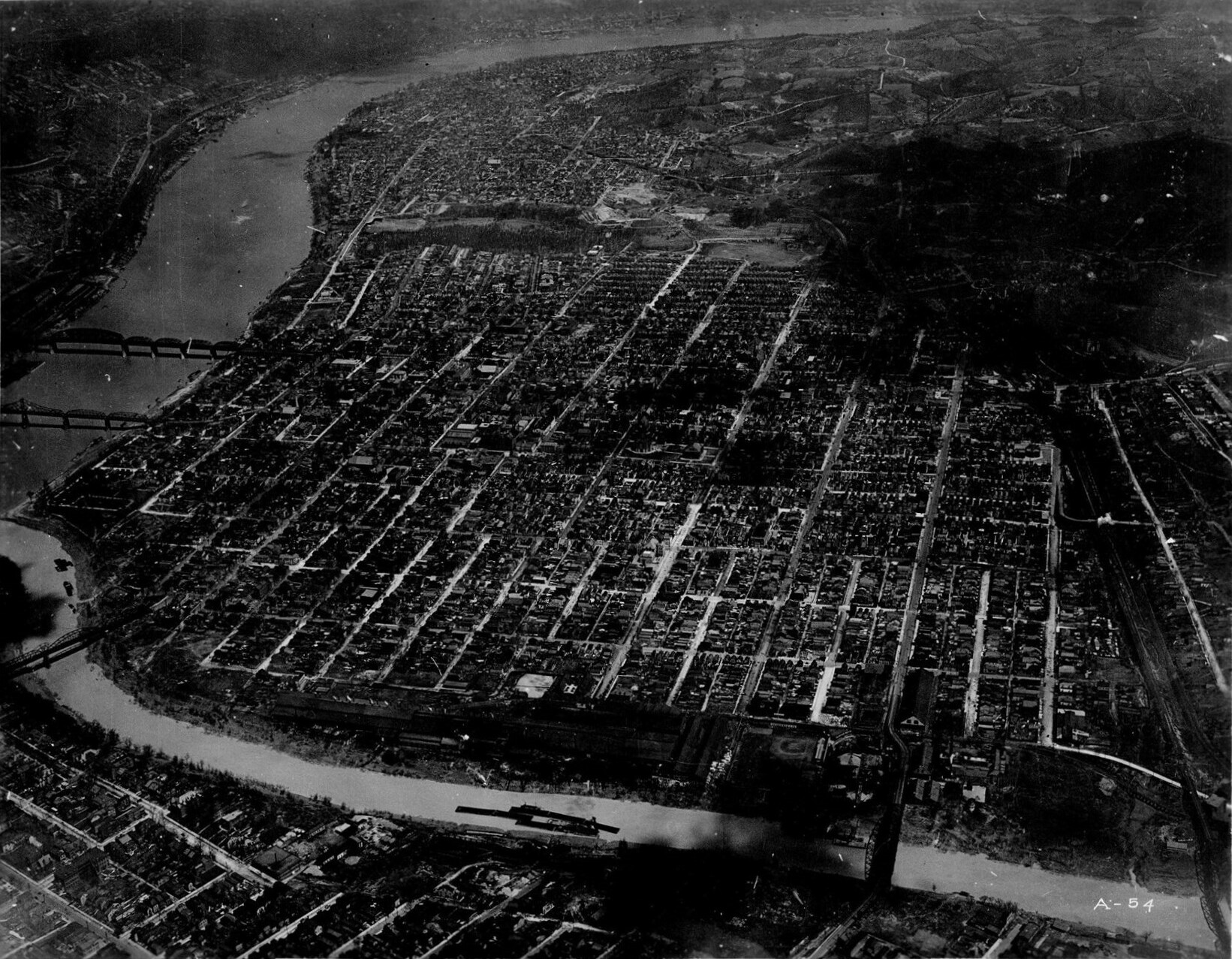
1921-1928 Newport, Kentucky Steel Strike
A few days before Christmas 1921, the Andrews Steel Company installed thirty-six machine guns inside its Newport, Kentucky plant and hired a private armed force described by witnesses as "gray-eyed mountaineers with rifles." On Brighton Street, the neighborhood that butted up against the Newport Rolling Mill, residents found bullet holes in their homes -- fired not by strikers, but from inside the mill. This was not a labor dispute in the abstract. One in five workers in the entire town had walked off the job, and what followed would last seven years, draw in tanks, the governor, Samuel Gompers, and the American Federation of Labor, and ultimately help create the Kentucky State Police.
The Walk That Shook a River Town
On October 5, 1921, workers at Andrews Steel Company began their strike after voting in favor the day before. The issue was not wages -- it was the company's refusal to recognize the union locals representing unskilled laborers at the Newport Rolling Mill. The two mills together employed more than 2,000 workers, and the walkout gripped the small city on the south bank of the Licking River, directly across from Covington and just upriver from Cincinnati. By December, violence had escalated sharply. Strikebreakers were shot at while leaving the plant. Workers Chester Starnes and Stanley Leifheit were shot on 9th and Brighton streets. Company owner W.N. Andrews demanded the governor send protection, even as nearby residents reported that the bullets hitting their homes were coming from inside the steel plant.
Tanks on Brighton Street
On Christmas Eve 1921, 250 state troopers under Colonel H. H. Denhardt marched into Newport. What followed was an escalating military occupation. On New Year's Eve, strikers and supporters built bonfires on the Covington bank of the Licking River and fired revolvers into the air at midnight -- then turned them toward the mill. On January 6, militia fired a machine gun at rowboats on the river, claiming they carried IWW saboteurs. A petition signed by 5,000 to 6,000 Newport citizens demanded the troops leave. Governor Morrow attempted personal mediation at the courthouse but failed. When militia finally withdrew in late January, the violence surged again. On February 2, the Covington Tank Corps rolled into the mill zone without warning -- five tanks equipped with machine guns and one-pound rapid-fire guns. At midnight, a single shot triggered a rattle of machine gun fire from the mill into the surrounding neighborhood, sending civilians and Newport police diving behind buildings.
When the Colonel Stopped a Baseball Game
Colonel Denhardt's militia did not limit their authority to the strike zone. They ordered workers out of their labor hall, arrested six picketers on dubious prohibition charges, and hit union leaders and even a state legislator with conspiracy charges. They raided an African American dance hall. They forced the closure of all saloons and poolrooms on a Sunday, citing an old blue law. On April 9, Denhardt stationed a tank in front of Andrews Park to shut down a baseball game between the Odd Fellows club and the North Bend team. An editorial captured the city's mood: "And now comes the suppression of two ball games by Newport's military governor... Such acts of military suppression do not sit well with Americans." Courts later ruled that militia raids conducted without search warrants violated citizens' constitutional rights, and charges against the mayor, county attorney, and a judge were dismissed.
Gompers Comes to the Hippodrome
The strike drew national labor solidarity. Green Line streetcar conductors and motormen pledged $800 to the strike fund. Union railroad employees raised additional funds. In June 1922, the American Federation of Labor moved its convention from Cincinnati to Newport for a day. Samuel Gompers, president of the AFL, addressed a crowd of more than 2,000 at the Hippodrome Theater. John L. Lewis of the United Mine Workers, Daniel J. Tobin of the Teamsters, and James P. Holland of the New York Federation of Labor all attended. It was one of the largest labor meetings ever staged in Northern Kentucky. Union chairman James Phillips declared confidently: "The strike is won. Places left vacant by the union workers cannot be filled. Men skilled in the iron industry are scarce."
Seven Years to Defeat
Phillips was wrong. On July 7, 1928 -- seven years to the day after the initial walkout -- the strike was officially called off. Union officials said they saw no hope for victory and were abandoning the effort "for the benefit of citizens of Newport." The company refused to make room for any of the remaining strikers. Colonel Denhardt parlayed his role in suppressing the strike into a successful run for lieutenant governor of Kentucky. Governor Morrow was appointed to the United States Railroad Labor Board, a move critics attributed to his willingness to deploy militia against workers. But the strike's longest legacy was institutional: the chaotic use of National Guard troops in Newport fueled calls for a standing state police force, leading eventually to the establishment of the Kentucky State Police. The defeat in Newport, combined with the 1919 General Steel Strike and the Great Railroad Strike of 1922, marked the beginning of a half-decade decline for American labor.
From the Air
Located at 39.08N, 84.49W in Newport, Kentucky, on the south bank of the Licking River where it meets the Ohio River, directly across from Cincinnati, Ohio. The former mill zone centered on Brighton Street near the Licking River. Nearby airports: KLUK (Cincinnati Municipal Lunken, 5nm southeast), KCVG (Cincinnati/Northern Kentucky International, 10nm southwest). Best viewed at 2,000-3,000 ft AGL. The confluence of the Licking and Ohio Rivers is the dominant visual landmark. Fort Thomas, where federal soldiers were garrisoned, is visible 3nm to the southeast on the bluffs above the Ohio River.