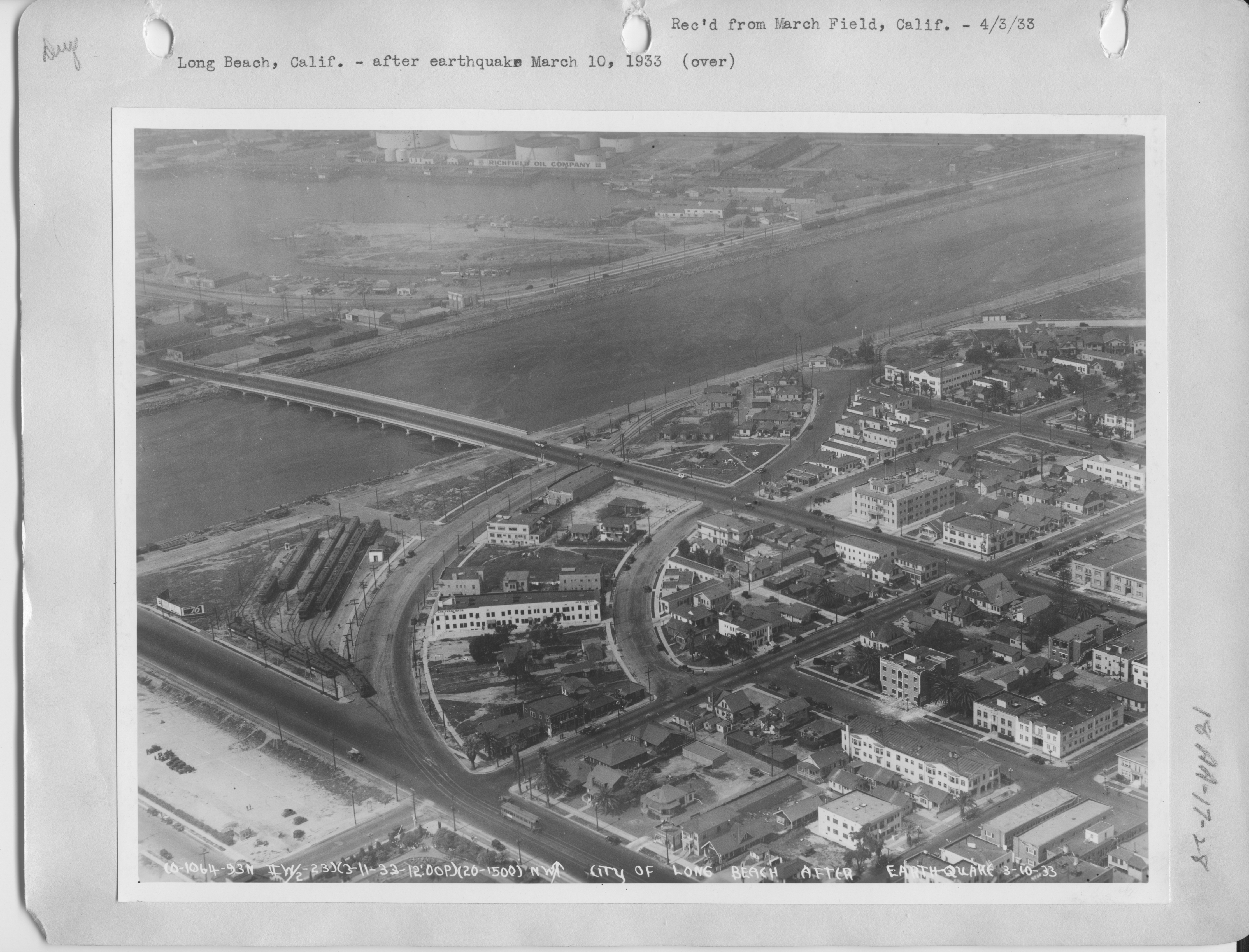
1933 Long Beach Earthquake
At 5:54 p.m. on March 10, 1933, the clocks in Long Beach classrooms had been silent for just over two hours. Children were at home, eating dinner or doing homework, when the Newport-Inglewood Fault ruptured fifteen miles beneath the Pacific Ocean. Within seconds, 120 schools across Long Beach crumbled. Seventy were destroyed outright. Had the magnitude 6.4 earthquake struck a few hours earlier, thousands of students would have been buried beneath walls of unreinforced brick. The timing was pure luck. What followed was anything but.
When the Ground Betrayed Them
The shaking radiated outward from an epicenter offshore, southeast of Long Beach, along a fault that runs for 46 miles through the Los Angeles Basin. In the densely populated neighborhoods along the coast, buildings collapsed onto sidewalks. Water tanks crashed through roofs. Houses lurched off their foundations. The ground itself seemed to liquefy in areas built on landfill and water-soaked alluvium. The earthquake reached Mercalli intensity VIII, classified as 'Severe,' and was felt across an area of 75,000 square miles, from the San Joaquin Valley to Northern Baja California. Between 115 and 120 people died that evening. Ironically, most fatalities came not from staying inside collapsing buildings, but from running out into the streets, where brick facades and masonry rained down upon them.
The Children Who Were Spared
In the days after, as engineers picked through the wreckage, one truth emerged with terrible clarity: the schools had been death traps waiting to happen. More than 230 school buildings were destroyed, severely damaged, or deemed unsafe. The unreinforced masonry bearing walls, so common in school construction of that era, had shattered like eggshells. Photographs from the aftermath show classrooms open to the sky, chalkboards still visible among heaps of broken brick. Students who would have been seated at those desks just hours earlier instead found themselves attending classes in tents while adults debated what had gone wrong and what must change.
Thirty Days That Changed Everything
Governor James Rolph Jr. signed the Field Act exactly thirty days after the earthquake. It was a landmark piece of legislation that mandated rigorous building standards for all public school construction in California, enforced through independent plan review and inspection. A Joint Technical Committee on Earthquake Protection, chaired by CalTech physicist Robert Millikan and including prominent architects like John C. Austin and Sumner Hunt, released recommendations for stronger building codes across all structures. The federal government, too, stepped into disaster relief with unprecedented involvement, establishing the Reconstruction Finance Corporation to provide loans for rebuilding. The very landscape of Los Angeles shifted. The damaged La Grande Station, the main Santa Fe Railroad terminal, was eventually abandoned. In its place rose Los Angeles Union Station, built on the site of the old Chinatown.
The Oil Beneath the City
For decades, the 1933 earthquake was attributed solely to natural tectonic activity along the Newport-Inglewood Fault. But in 2016, United States Geological Survey research suggested a more unsettling possibility: the earthquake may have been man-made. During the peak years of the Los Angeles oil boom, extraction methods removed millions of barrels of petroleum without replacing the removed volume with other liquids. This practice, scientists now believe, induced stress on the fault system. Studies found that the epicenters of several early twentieth-century Los Angeles earthquakes correlated with areas where unproductive wells had been drilled much deeper. Man-made earthquakes remain an issue today, particularly in Oklahoma and Texas, where wastewater injection has been linked to increased seismic activity.
Echoes in Culture and Memory
The Long Beach earthquake rippled through American culture in ways both obvious and subtle. Newsreel footage played in theaters across the country. F. Scott Fitzgerald wrote the earthquake into his final novel, The Last Tycoon, as the moment when his protagonist meets the woman he will love. John Fante included the disaster in his 1939 novel Ask the Dust, and decades later, a public art installation in Pershing Square commemorated that scene. Spencer Tracy starred in a 1934 film that intercut actual newsreel footage with dramatic recreations. The earthquake even appears in a 2020 video game, The Last of Us Part II, where the Catalina Casino, visible across the water from Long Beach, serves as a symbol of hope and reunion. The schools rebuilt after 1933 stand stronger today, monuments to a disaster that taught California, and the nation, that the earth demands respect and that building codes are written not in ink but in lives.
From the Air
Located at 33.63N, 118.00W, offshore southeast of Long Beach. The epicenter lies in the Pacific Ocean, visible from aircraft approaching LAX or Long Beach (KLGB). The Newport-Inglewood Fault traces a line of low hills from Culver City through Signal Hill. Nearby airports: KLGB (Long Beach), KSNA (John Wayne), KLAX (Los Angeles International). Best viewed at 3,000-5,000 feet when flying along the coast.