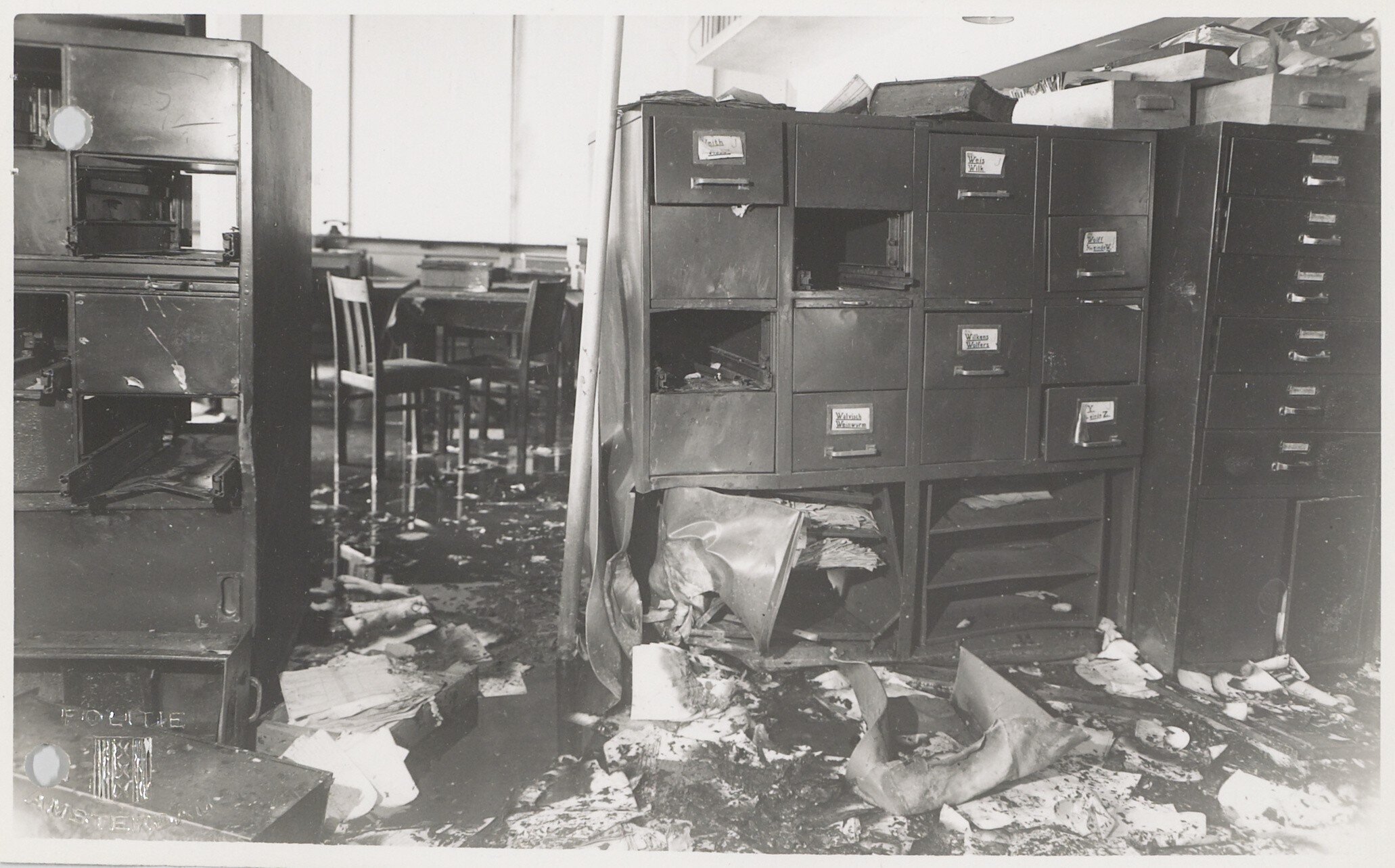
1943 Amsterdam Civil Registry Office Bombing
Before they shot him, Willem Arondeus asked his lawyer to carry a message out of the prison. He wanted the world to know that homosexuals were no less courageous than anyone else. He had reason to believe people might forget. He was a painter and a novelist and openly gay in a country under Nazi occupation, and he had just helped lead a sabotage operation that almost certainly saved lives he would never meet. On 27 March 1943, he and a small band of resistance fighters bombed the Amsterdam civil registry office at Plantage Kerklaan 36. Three months later, the Germans executed twelve of the conspirators. The records they tried to destroy were paper, but the people those records named were not.
The Weapon Was a Filing Cabinet
The Nazis did not invent surveillance, but they were exceptionally good at it. After the 1940 occupation, every Dutch person aged fifteen and older had to carry a persoonsbewijs, an identification card. Jews carried versions stamped with a large black J. Resistance forgers got astonishingly good at faking these cards. Gerrit van der Veen, a sculptor by training, ran an operation that produced roughly 80,000 of them. But a forged card was only as useful as the registry it would be checked against. The bevolkingsregister at Plantage Kerklaan held the original entries, and as long as it stood, a false card could be unmasked by a single bureaucrat with a question. The civil registry was a weapon. The resistance decided to disarm it.
The Plan and the Night
Van der Veen and Arondeus assembled a team that ran on improvisation and nerve. A medical student named Willem Beck sedated the guards. Others arrived dressed as Dutch police, complete with confiscated uniforms and forged papers. Lawyer Lau Mazirel helped prepare the assault. Once inside, they pulled drawers from cabinets, piled the records on the floor, and poured benzene over them. Explosives from a smuggled cache at the Naarden fortress had been rigged to timed fuses. The point was destruction without bloodshed; the guards had to live. When the charges went off, the office burned, but only partially. The fire department arrived faster than anyone expected, and far too much paper survived. The action saved lives. The estimates vary. The exact number is unknowable, which is its own kind of grief.
The Cost
The Gestapo unraveled the cell within weeks. Twelve participants were tried, convicted, and shot at the dunes of Overveen on 2 July 1943. Among them were Arondeus and his partner Sjoerd Bakker. At Bakker's trial, his lawyer tried to win mercy by arguing that he had only joined out of love, that Arondeus had pulled him into the plot. Bakker refused to be saved on those terms. He insisted he had acted of his own conviction, and was sentenced to die with the others. In his cell before the execution, Arondeus asked Lau Mazirel to deliver the message that would outlive him: homosexuals were no less courageous than anyone else. It was 1943. The world had given him little reason to assume his courage would be remembered without a fight. He fought for it anyway.
A Plaque, a Documentary, a Door
The building at Plantage Kerklaan 36 still stands. In 1946, the designer Willem Sandberg, himself a resistance veteran, made a plaque to mount beside the front door. It is small, dark, and easy to walk past. In 2023, Stephen Fry presented a Channel 4 documentary called Willem and Frieda: Defying the Nazis, which finally placed Arondeus and the cellist Frieda Belinfante, another queer resistance figure who survived in disguise, in front of a large public. For decades after the war, the Dutch state honored the dead of the registry assault while quietly skipping the part about who Arondeus loved. It took a long time for the message he sent through Mazirel to arrive in full. From the air, the building is just another corner of the Plantage neighborhood, a few blocks from the zoo. From the sidewalk, the plaque is at shoulder height. Stand close enough and you can read it.
From the Air
Plantage Kerklaan 36 sits at 52.3669°N, 4.9121°E in central Amsterdam, on the eastern edge of the canal ring and a short walk from Artis Zoo and the Hortus Botanicus. Best viewed at low altitude in clear weather. Nearest airport is Amsterdam Schiphol (EHAM), roughly 14 km southwest. Hilversum (EHHV) lies about 30 km southeast for general aviation traffic.