1955 Le Mans Disaster
At 6:26 on a Saturday evening in June, with 300,000 spectators lining the Circuit de la Sarthe, Pierre Levegh's Mercedes-Benz 300 SLR became airborne. The car struck the rear of Lance Macklin's Austin-Healey at over 200 km/h, rode up like a stone skipping water, cleared a protective earthen berm, and disintegrated in the packed grandstand area. Levegh died instantly. So did at least 82 people who had come to watch the greatest sports car race in the world. The 1955 Le Mans disaster remains the deadliest event in the history of motorsport, a catastrophe so profound it prompted Switzerland to ban circuit racing for 67 years.
Three Giants and a Doomed Circuit
The 1955 24 Hours of Le Mans carried extraordinary anticipation. Ferrari, Jaguar, and Mercedes-Benz had each won the race before, and all three arrived with formidable machinery. Mercedes fielded its revolutionary 300 SLR, a car whose body was made from Elektron, an ultra-lightweight magnesium alloy. Its driver roster read like a hall of fame: Juan Manuel Fangio, Stirling Moss, Karl Kling, and the veteran Frenchman Pierre Levegh, who had nearly won the 1952 race solo before mechanical failure struck in the final hour. But the Circuit de la Sarthe itself had barely changed since 1923, when top speeds hovered around 100 km/h. By 1955, leading cars exceeded 270 km/h. There were no barriers between pit lane and the racing line, only an earthen bank separating the track from spectators. The cars carried no seat belts. Speed had evolved dramatically; the infrastructure had not.
Six Seconds of Chain Reaction
The sequence that killed over 80 people lasted mere seconds. On lap 35, Jaguar's Mike Hawthorn was signaled to pit. He had just passed Levegh and pulled sharply right, braking hard with his Jaguar D-Type's superior disc brakes. Lance Macklin, in a slower Austin-Healey directly behind, swerved left to avoid the decelerating Jaguar. Levegh's Mercedes, closing at over 200 km/h, had nowhere to go. His front wheel rode up the rear of Macklin's car as though launching from a ramp. The Mercedes sailed over the berm, tumbling end over end for 80 meters through the spectator enclosure. When it hit the embankment, the rear fuel tank exploded. The magnesium bodywork ignited in white-hot flames that rescue workers, unfamiliar with metal fires, intensified by pouring water onto the blaze. In his final conscious moment, Levegh raised his hand to warn his teammate Fangio, who threaded through the wreckage and survived.
The Race That Refused to Stop
What followed compounded the horror. Race director Charles Faroux kept the race running. His justifications ranged from practical to cynical: a mass exodus of spectators would block emergency vehicles; participating firms might sue; and, as Faroux put it, "the rough law of sport dictates that the race shall go on." Mercedes team manager Alfred Neubauer wanted to withdraw immediately but lacked the authority. After an emergency telephone vote among Mercedes directors in Stuttgart, approval came just before midnight. At 1:45 a.m., when crowds had thinned, Neubauer stepped onto the track and quietly called his cars in from first and third positions. Chief engineer Rudolf Uhlenhaut asked Jaguar to withdraw in solidarity. Team manager Lofty England declined. Hawthorn won the race. A photograph of him smiling with champagne on the podium drew a bitter French caption: "To your health, Mr. Hawthorn!"
The Shadow That Changed Everything
More than 80 spectators and Levegh were dead, with 120 to 178 more injured. The official inquiry blamed the outdated track layout rather than any individual driver. The consequences rippled across the continent. Multiple European countries banned motorsport. France reinstated racing in September 1955 under strict new regulations, but Switzerland's ban endured until May 2022, forcing Swiss racing promoters to organize events abroad for nearly seven decades. Mercedes-Benz withdrew from all motorsport, not returning until 1985. The broader effect took longer. Track safety evolved slowly until Formula 1 driver Jackie Stewart launched a sustained campaign for better protections in the mid-1960s, galvanized by the deaths of Lorenzo Bandini and Jim Clark. American driver John Fitch, who had been Levegh's co-driver that day, became a lifelong safety advocate and invented the sand-filled highway crash barrels that now line roads worldwide.
A Memorial in Motion
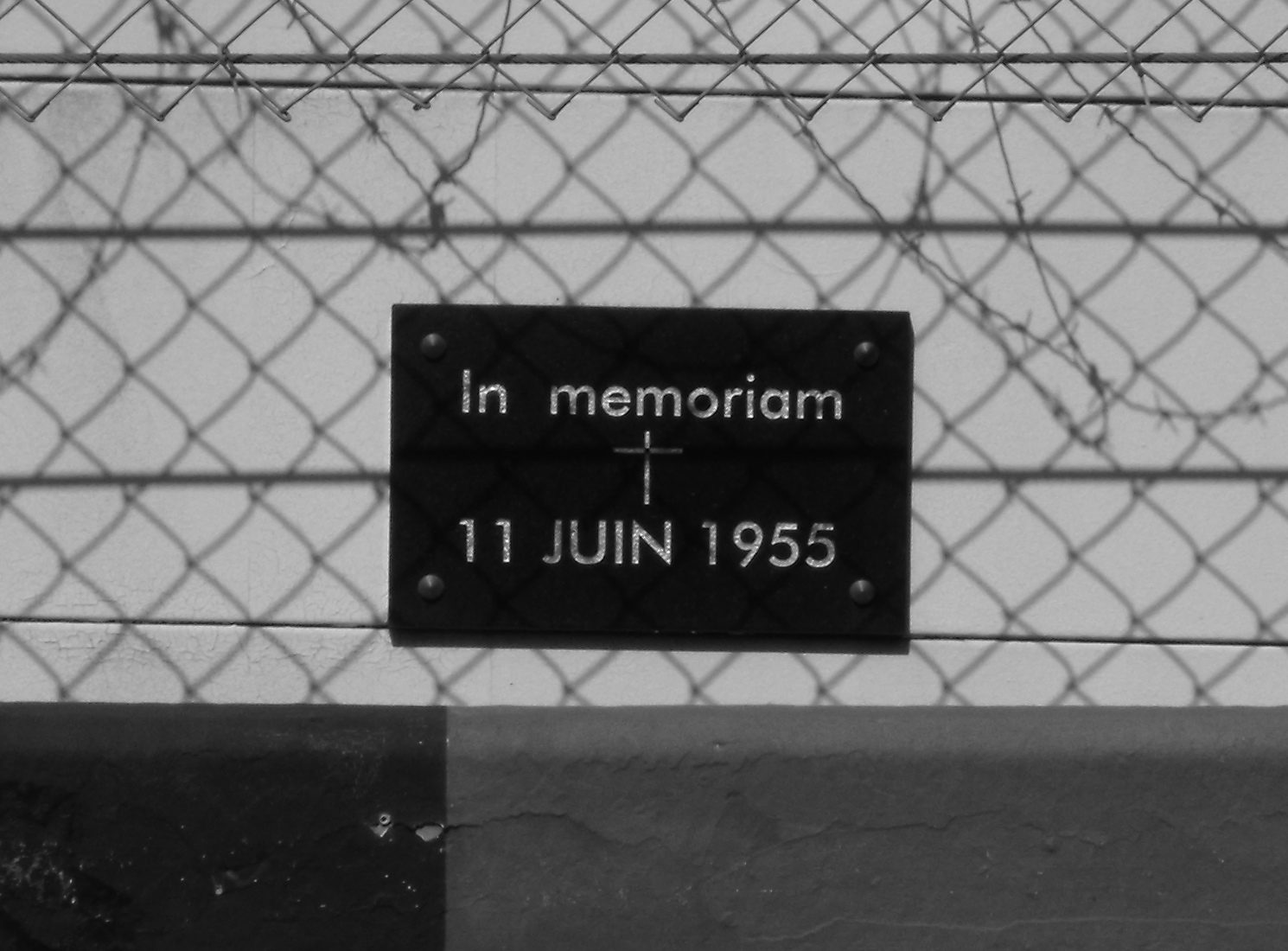
The Circuit de la Sarthe was eventually redesigned with modern safety barriers, run-off areas, and separated pit lanes. A memorial plaque at the circuit marks the site of the disaster. Macklin's Austin-Healey, battered but intact, passed through several owners before selling at auction in December 2011 and being restored to its original condition. The Le Mans disaster forced the racing world to confront an uncomfortable truth that speed and spectacle had outpaced every safety measure meant to contain them. In the decades since, motorsport has transformed from an endeavor where drivers rejected seat belts to one of the most safety-conscious sports on earth. That transformation began, in the most terrible way, on a summer evening in Sarthe.
From the Air
Located at 47.95°N, 0.21°E near the city of Le Mans in the Sarthe department of northwestern France. The Circuit de la Sarthe is visible from the air as a large motorsport complex south of the city. Nearest airport is Le Mans-Arnage (LFRM). Best viewed from 3,000-5,000 feet AGL. The long Mulsanne Straight is a distinctive feature visible even from higher altitudes.