The Collision That Created the FAA
At 10:32 on the morning of June 30, 1956, a United Air Lines DC-7 and a Trans World Airlines Super Constellation collided over the Grand Canyon at 21,000 feet. Both aircraft had departed Los Angeles International Airport just three minutes apart -- the TWA flight bound for Kansas City, the United flight for Chicago. They entered uncontrolled airspace over the Arizona desert, maneuvered around towering cumulus clouds at the same altitude and nearly the same speed, and emerged from opposite sides of the same cloud bank into each other. All 128 people on both aircraft died. It was the deadliest commercial aviation disaster in American history at that time, and the shock of it demolished public confidence in a system that was essentially flying blind.
See and Be Seen
The collision was a product of a system built on assumptions that no longer held. TWA Flight 2, a Lockheed L-1049 Super Constellation named Star of the Seine, carried 70 people under Captain Jack Gandy. United Flight 718, a Douglas DC-7 named Vancouver, carried 58 under Captain Robert Shirley. Both flew under instrument flight rules but entered uncontrolled airspace after leaving the Los Angeles area. Captain Gandy had requested a climb to 21,000 feet to avoid thunderheads. Air traffic control denied it -- they could not guarantee separation at that altitude. So Gandy requested '1,000 on top' clearance, which placed responsibility for avoiding other traffic squarely on his cockpit crew. The principle was called 'see and be seen.' Over the Grand Canyon, with clouds towering all around, seeing was exactly what they could not do.
Impact at 25 Degrees
The two aircraft converged at an angle of about 25 degrees. Post-crash analysis showed the United DC-7 was banking right and pitching down at the moment of collision, suggesting one or both United pilots spotted the Constellation and attempted to evade. They were too late. The DC-7's upraised left wing clipped the Constellation's vertical stabilizer, and its number one propeller chopped gashes into the Constellation's fuselage. The tail assembly broke away. The Constellation entered a near-vertical dive and slammed into Temple Butte inside the canyon. The DC-7, its left wing mangled and engine destroyed, spiraled into Chuar Butte. Neither aircraft left survivors. The wreckage was spotted late that day by Palen Hudgin, a local air taxi pilot who had earlier dismissed the dense black smoke rising from Temple Butte as a brush fire sparked by lightning.
Recovery in the Abyss
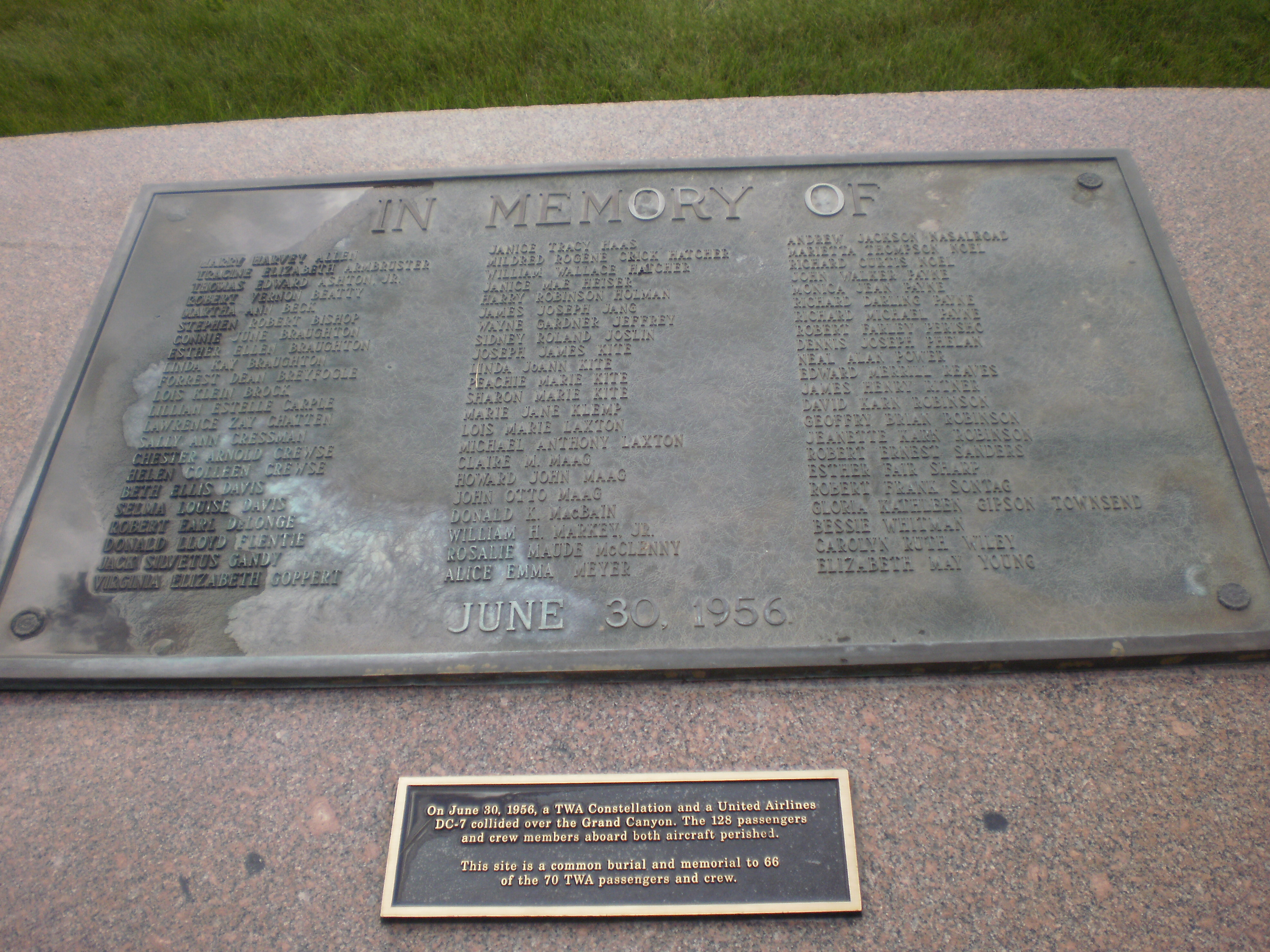
The crash sites lay in some of the most rugged terrain on the continent -- deep inside the Grand Canyon near the confluence of the Colorado and Little Colorado Rivers. The airlines hired Swiss mountain climbers and the Swiss Air-Rescue to reach the wreckage. No bodies were recovered intact. Only four of the 70 people aboard the TWA flight could be identified; 66 were buried in a mass grave at Citizens Cemetery in Flagstaff. Twenty-nine of the 58 United victims were identified; the remaining 29 were interred in four caskets at the Grand Canyon Pioneer Cemetery. A mass funeral was held on July 9, 1956, at the canyon's south rim. Pieces of both aircraft remain at the crash sites to this day, in a remote portion of the canyon closed to the public since the 1950s.
The System That Failed
The public outcry was immediate and furious. Americans learned that air traffic control in 1956 essentially operated with 1930s methods. Pilots flying in uncontrolled airspace were responsible for their own separation. The controller who cleared TWA to '1,000 on top' was vilified in the press, though he was cleared of wrongdoing -- he was not required to issue a traffic conflict advisory. But the revelation that two airliners full of passengers could fly into the same patch of sky with no one tracking them shattered confidence in commercial aviation. Congressional hearings followed. In 1957, increased funding was allocated to modernize air traffic control and procure radar. But the real transformation came in 1958, when the Federal Aviation Act dissolved the old Civil Aeronautics Administration and created the Federal Aviation Agency -- later renamed the Federal Aviation Administration. The FAA was given authority over all American airspace, including military activity.
Landmark in the Air
On April 22, 2014, the crash site was declared a National Historic Landmark -- the first landmark designated for an event that happened in the air rather than on the ground. The wreckage, scattered across remote canyon walls accessible only to hikers, remains undisturbed. The collision killed 128 people and remained the deadliest U.S. commercial aviation disaster until the 1960 New York mid-air collision, which coincidentally also involved United and TWA aircraft and also killed 128 people in the air. But the Grand Canyon disaster's true legacy is structural: it forced the creation of the modern air traffic control system. Every flight tracked by radar, every controller monitoring separation, every rule governing controlled airspace exists in part because two propeller airliners met over the grandest canyon on Earth on a summer morning in 1956.
From the Air
The collision occurred at approximately 36.175N, 111.833W, over the eastern Grand Canyon near the confluence of the Colorado and Little Colorado Rivers, at 21,000 feet. The TWA Constellation crashed into Temple Butte; the United DC-7 struck Chuar Butte. Both sites are visible from the air in the remote eastern section of Grand Canyon National Park. Nearest airports include Grand Canyon National Park Airport (KGCN) and Flagstaff Pulliam (KFLG). The area is known for turbulence and rapidly building cumulus, particularly during summer monsoon season -- the same conditions that contributed to the 1956 disaster. Scenic overflights are restricted within the national park.