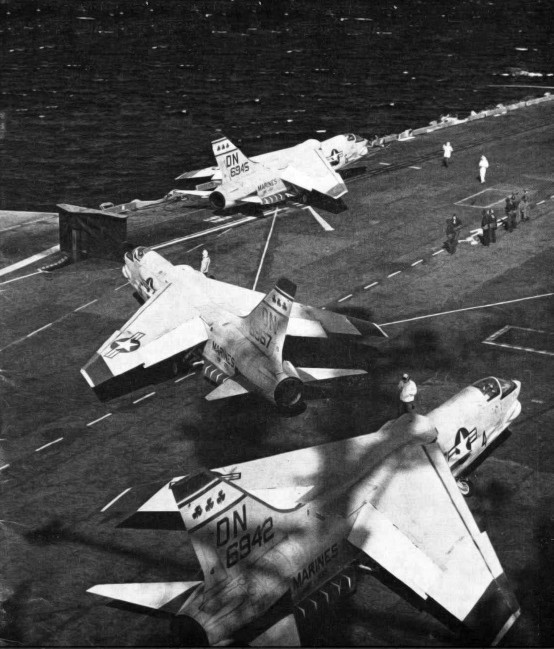
1964 Machida F-8 Crash
The pilot landed on a car. Captain R. L. Bown of Seattle, Washington, ejected from his failing Vought RF-8A Crusader at approximately 5,000 feet, rode his parachute down over a western Tokyo suburb, and came to rest on top of an automobile. He suffered minor bruises. Below him, in the Hara-Machida neighborhood of Machida City, his aircraft had just destroyed seven houses, killed four people, and injured 32 others. It was April 5, 1964, and the crash was neither the first nor the last time an American military jet fell out of the sky over a Japanese residential area.
Two Planes, One Return
The RF-8A Crusader -- Bureau Number 146891 -- was a reconnaissance variant of the Vought F-8, a supersonic carrier-based fighter that served as one of the U.S. Navy and Marine Corps' primary aircraft throughout the late 1950s and 1960s. On April 5, 1964, the jet was flying as one half of a two-plane formation returning from Kadena Air Base on Okinawa to its home station at Naval Air Facility Atsugi in Kanagawa Prefecture, about 25 miles southwest of central Tokyo. Somewhere on the approach, the aircraft suffered a mechanical malfunction. The second Crusader in the flight landed safely at Atsugi. Captain Bown's aircraft did not make it. The jet came down in the Hara-Machida area of Machida City, near what is today JR Machida Station, crashing into a densely packed residential neighborhood.
Seven Houses Gone
The impact destroyed seven homes. Four people on the ground were killed -- three crushed by debris from their collapsing houses, the fourth struck by wreckage from the aircraft itself. Thirty-two others suffered injuries. The destruction was concentrated in a small area, the kind of tightly built Japanese residential block where houses stand close together and a single falling object can cascade damage across multiple structures. Captain Bown, the pilot, had ejected successfully and escaped with only minor bruises. The asymmetry of the outcome -- one American airman walking away from a car roof while Japanese civilians died in their homes -- would become a focal point for public anger.
A Pattern in the Sky
The Machida crash was not an isolated event. U.S. military aviation accidents over Japanese territory formed a recurring pattern throughout the postwar decades. The 1959 Okinawa F-100 crash had killed 17 people, including 11 schoolchildren, when a North American F-100 Super Sabre slammed into a residential area near Kadena. Thirteen years after the Machida incident, in 1977, a U.S. Navy F-4 Phantom crashed into a neighborhood in Yokohama, killing two children and their mother. Each accident intensified Japanese debate about the presence of American military bases and the flight paths that carried armed or reconnaissance aircraft over populated areas. The crashes became touchstones for anti-base movements and fueled political pressure for stricter flight regulations and base realignment.
What Remained
The crash site in Machida eventually became state-owned land. In 1999, thirty-five years after the accident, a memorial was erected at the location. A newer monument was built in 2014, marking the fiftieth anniversary. The aftermath also wound through Japan's courts: a bereaved father who lost three sons in the crash filed a lawsuit after a promised land sale was denied, and the case did not settle until 1982 -- eighteen years later -- for 12 million yen. Today, JR Machida Station serves one of the busiest commuter corridors in western Tokyo, and the residential blocks around the crash site have long since been rebuilt. But the memorial stands as a reminder that the Cold War's costs were not always measured in distant battlefields. Sometimes they fell, without warning, into someone's living room.
From the Air
Located at 35.55°N, 139.433°E in Machida City, western Tokyo. The crash site is in a dense residential area near present-day JR Machida Station. Naval Air Facility Atsugi (RJTA) lies approximately 10 nautical miles to the southwest -- it was the intended destination of the flight. Kadena Air Base (RODN) on Okinawa, approximately 900 nautical miles southwest, was the departure point. Tokyo Haneda Airport (RJTT) is about 15 nautical miles east. The area is densely urban with no significant terrain features visible from altitude; the Tama Hills to the west provide some topographic reference.