The Birthday Party at Farrell's
A group of seventeen people sat at the front window table of Farrell's Ice Cream Parlor on Freeport Boulevard, just south of downtown Sacramento. They had just been served ice cream, candy, and party favors for a birthday celebration. Outside, the Golden West Sport Aviation Air Show was wrapping up at Sacramento Executive Airport, barely half a mile away. At 4:25 p.m. on September 24, 1972, a Canadair Sabre Mk. 5 fighter jet -- a Canadian-built version of the North American F-86 -- failed to get airborne. Within seconds, the birthday party, a junior football team's gathering, and a Sunday afternoon of families would become Sacramento's deadliest aviation disaster.
Four Hours in the Cockpit
The pilot, 37-year-old Richard L. Bingham, had logged fewer than four hours flying the Canadair Sabre. The F-86 family of aircraft carried a dangerous and well-documented handling characteristic: if the nose was rotated too early during takeoff, the jet could stall at an altitude too low for recovery. Pilots had been dying from this tendency since the early 1950s. Eyewitnesses at the air show watched Bingham's Sabre lift its nose prematurely, rise briefly, settle back onto the runway, rise again, and settle again. The aircraft overran the runway at high speed, struck an earthen berm, and tore through a chain-link fence. Two external underwing fuel tanks ruptured on impact with the fence, igniting a massive fireball. Still traveling at roughly 150 miles per hour, the jet crossed Freeport Boulevard, struck a moving car, and plowed into Farrell's Ice Cream Parlor.
The Children of Freeport Boulevard
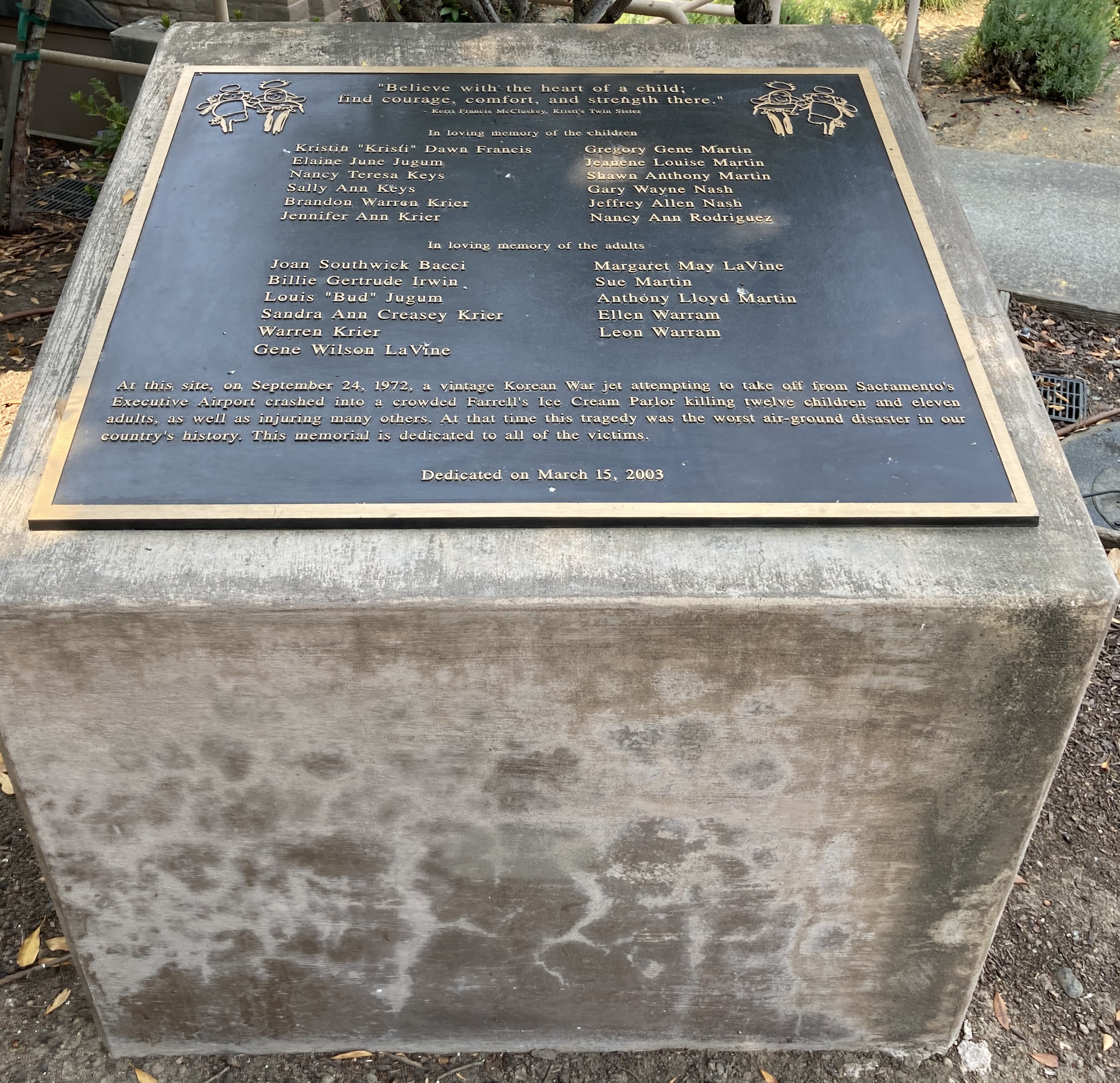
Twenty-two people on the ground died, twelve of them children. Among the dead were members of the Sacramento 49ers junior football team, who had gathered at the parlor after a day at the air show. A family of four perished together. Two people in the car struck on Freeport Boulevard were killed. In the chaos immediately following the crash, an elderly couple trying to cross the street to help were hit by a vehicle, killing the wife. One eight-year-old boy survived but lost nine family members: both parents, two brothers, a sister, two grandparents, and two cousins. Bingham, the pilot, suffered a broken leg and a broken arm. He survived. The National Transportation Safety Board later determined that the premature rotation of the aircraft's nose was the cause of the accident.
Fire and Its Aftermath
The ruptured fuel tanks turned the crash into an inferno. Among the dead was Sacramento firefighter Gene LaVine, who was off duty that day -- he and eight members of his family were inside the parlor. The scale of burn injuries overwhelmed Sacramento's medical infrastructure. Captain Cliff Haskell of the Sacramento Fire Department, haunted by what he had witnessed, convinced Local 522 of the Sacramento Area Fire Fighters to let him begin fundraising for a dedicated burn treatment facility. In December 1973, his efforts produced the Firefighters Burn Institute. Within weeks, the FFBI partnered with UC Davis Medical Center to open the UCDMC Regional Burn Center in January 1974 -- one of California's first specialized burn units. The tragedy on Freeport Boulevard had created something that would save thousands of lives in the decades that followed.
What Remains
The Farrell's Ice Cream Parlor is gone. The site is now part of the Freeport Square Shopping Center. In 2002, thirty years after the crash, a memorial was built on the spot and dedicated in March 2003. It consists of a rose garden with two benches, a fountain, a concrete marker, and two metal plaques bearing the names of the twenty-two people who died. Survivors and families still gather at the memorial on the anniversary. The eight-year-old who lost nine family members grew up in Sacramento. The fire department's payroll deductions that funded the Burn Institute continued for decades. Had the external fuel tanks not ruptured before the jet reached the building, or had the car on Freeport Boulevard not slowed the aircraft's momentum, the death toll would have been far higher. But the mathematics of what could have been worse offers no comfort to the families of twenty-two people who went out for ice cream on a Sunday afternoon.
From the Air
Located at 38.52N, 121.50W on Freeport Boulevard, just south of Sacramento Executive Airport (KSAC). The crash site is immediately adjacent to the airport's runway environment -- visible from any departure or approach to KSAC. Sacramento International Airport (KSMF) is 10 nautical miles to the northwest. From 2,000 feet AGL, the Freeport Square Shopping Center that replaced the parlor is visible along Freeport Boulevard, with the airport runway clearly nearby. The proximity of the commercial district to the runway end is immediately apparent from the air.