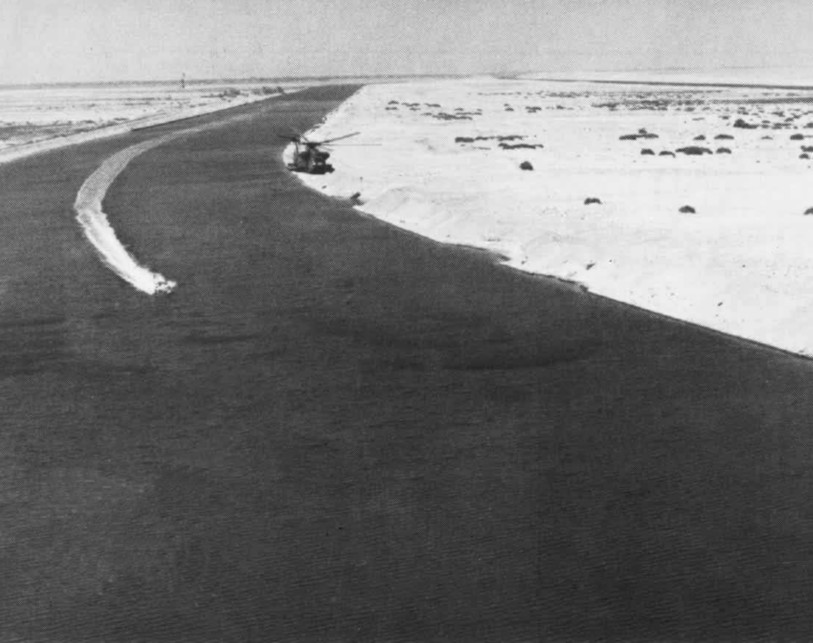
1974 Suez Canal Clearance Operation
On 22 April 1974, a U.S. Navy RH-53D Sea Stallion helicopter lifted off from the amphibious assault ship USS Iwo Jima, anchored at the northern end of the Suez Canal, picked up a Mark-105 magnetic minesweeping sled from a support team on shore, and began sweeping the approaches to Port Said harbor. It was the first step in one of the most complex military clearance operations since World War II. The Suez Canal had been closed since June 1967, shut down at the start of the Six-Day War and kept sealed through the War of Attrition and the 1973 Yom Kippur War. Eight years of conflict had left the canal and its banks saturated with naval mines, unexploded ordnance, and sunken wrecks. Reopening it would require the combined efforts of the United States, United Kingdom, and France -- and the discovery of 686,000 landmines buried along its shores.
Three Operations, One Canal
The clearance effort was divided into three overlapping operations, each targeting a different dimension of the problem. Operation Nimbus Star handled the naval mines. The USS Iwo Jima, deployed more than a month early on just five days' notice, became the flagship of Task Force 65. Helicopter Mine Countermeasures Squadron 12 (HM-12) flew RH-53D Sea Stallion helicopters towing Mk 105 hydrofoil minesweeping sleds through the canal's waters, while a detachment from Marine Medium Helicopter Squadron HMM-261 provided search-and-rescue standby in CH-46 Sea Knight helicopters. Operation Nimbus Moon tackled the land -- the canal's banks out to 250 meters on each side needed to be swept for every mine and unexploded shell left by three wars. Operation Nimrod Spar addressed the wrecks, salvaging the sunken vessels that littered the canal bed and obstructed navigation.
686,000 Mines in the Sand
The land clearance was staggering in scale. Nearly 1,700 Egyptian Army engineers received training from U.S. Army Explosive Ordnance Disposal specialists, including personnel from the 43rd Ordnance Detachment. Their task was to sweep the full length of the canal's banks, cataloging and neutralizing everything they found. By July 1974, the Egyptian teams announced their tally: 686,000 landmines -- both anti-tank and anti-personnel -- plus 13,500 additional pieces of unexploded ordnance. These were the remnants of fortifications, ambushes, and bombardments stretching back to 1967. Each mine had to be individually located, identified, and either disarmed or detonated in place. The sheer density of ordnance meant that the canal's banks were among the most heavily mined landscapes on Earth, a legacy of a war that had turned a commercial waterway into a fortified front line.
Diving Into the Canal Bed
The underwater phase, Operation Moon Water, ran through the end of 1974 and at a reduced pace into 1975. U.S. Navy EOD divers -- prohibited from handling ordnance directly due to diplomatic constraints -- trained Egyptian Navy personnel in diving and explosives techniques, then accompanied them in boats as on-scene advisors. A Suez Canal Authority pilot boat fitted with an American sonar device swept the canal from bank to bank, producing precise charts of the bottom. Diving teams investigated every suspicious sonar contact. Ordnance was typically destroyed in place with explosive charges. Non-ordnance debris -- oil drums, sunken tanks, assorted military refuse -- was marked for later removal by Egyptian police divers, since the canal was slated for dredging. British and French EOD teams ran parallel operations, double- and sometimes triple-sweeping areas their counterparts had already covered. Each team found items the others had missed. The Royal Navy brought three mine-hunting ships with high-resolution sonar, and the French Navy used both mine hunters and minesweepers in support.
A Canal Reborn
By late November 1974, the American-Egyptian team had completed one full sweep of the canal bottom. When the combined underwater operations finished in December, the clearance teams had recovered a massive quantity of ordnance from the canal bed, adding to the hundreds of thousands of mines already pulled from the banks. The canal and its lakes were ultimately declared 99 percent clear of mines. On 5 June 1975 -- exactly eight years to the day after the canal had been closed -- Egyptian President Anwar Sadat boarded a destroyer and led the first convoy northbound to Port Said. The reopening was more than a logistical achievement. It signaled the end of the canal's role as a military front line and its return to its original purpose: a passage between seas. The fifteen cargo ships of the so-called Yellow Fleet, which had been trapped in the canal since 1967, were finally free to leave.
From the Air
Located at 30.41N, 32.36E along the Suez Canal, roughly midway between Ismailia and Suez. The canal is clearly visible from altitude as a straight waterway cutting through the desert between the Mediterranean and the Red Sea. The Great Bitter Lake is the prominent body of water just to the south. Port Said (HEPS) lies at the canal's northern terminus, and Suez at the southern end. The Sinai Peninsula extends to the east. At cruising altitude, the canal's full 193 km length is visible on a clear day.