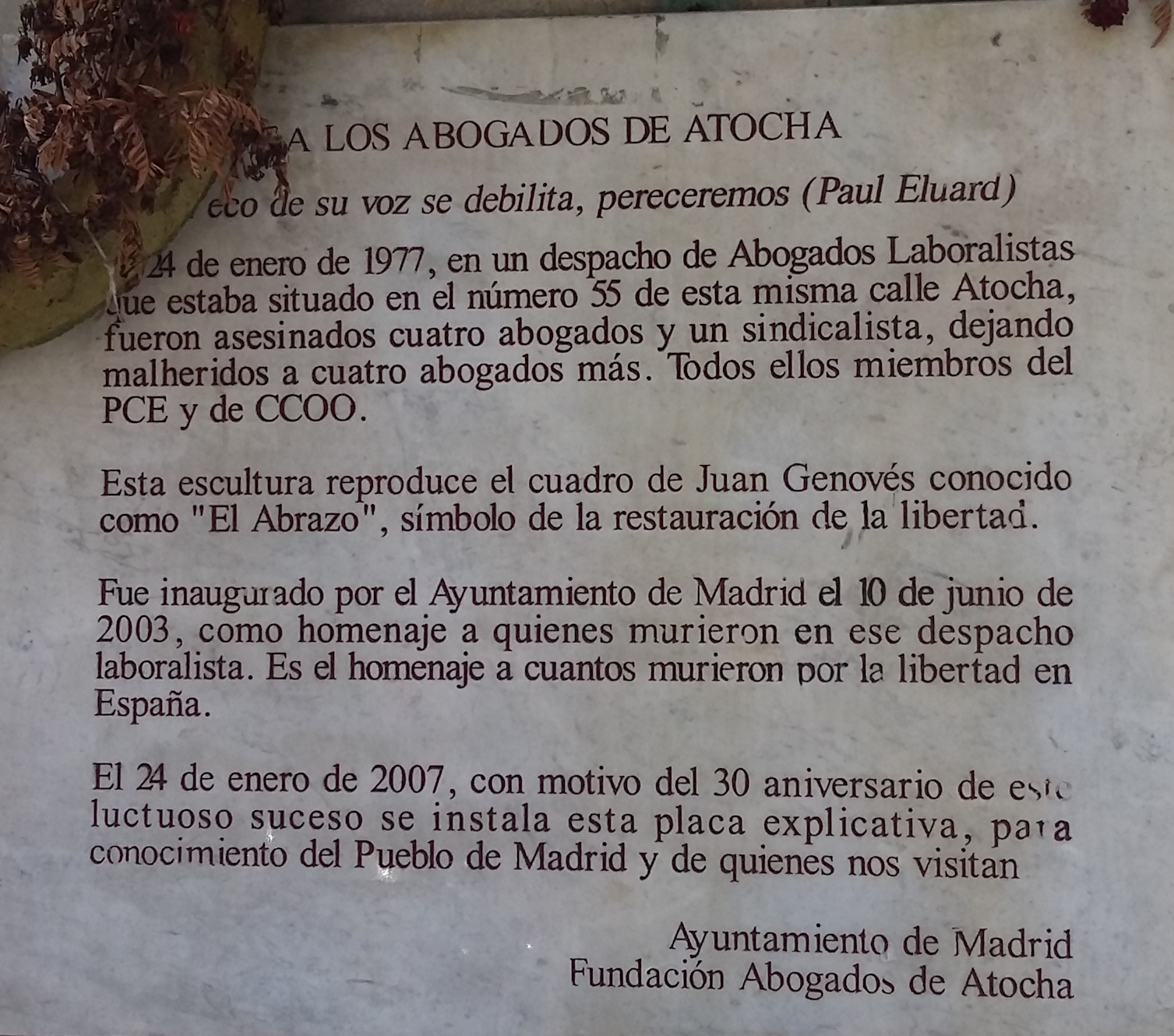
1977 Atocha Massacre
The killers entered the labor law office at 55 Calle de Atocha on the evening of January 24, 1977, expecting their violence would provoke a reaction violent enough to justify a right-wing coup. Instead, the murder of five people in that small Madrid office produced one of the largest peaceful demonstrations in Spanish history, accelerated the legalization of the Communist Party, and helped ensure that Spain's first free elections in four decades would take place on schedule. The 1977 Atocha massacre was, as journalist Juancho Dumall later wrote, "a terrorist act that marked the future of the country in a way that the murderers would never have suspected."
Spain on the Edge
Francisco Franco had been dead for just over a year. Spain was stumbling toward democracy under Prime Minister Adolfo Suarez, but the transition was fragile and contested. The Communist Party remained illegal, labor unions operated in a legal gray zone, and the far right -- still embedded in the military, the police, and the Francoist old guard -- viewed every step toward liberalization as an existential threat. In this atmosphere, a network of far-right extremists targeted the labor lawyers who provided legal support to workers affiliated with the Communist Party and the trade union Comisiones Obreras. The office at 55 Atocha, in the heart of Madrid near the famous train station, was one such hub of quiet, essential work: defending workers' rights in a country where those rights were still being defined.
Fifty-Five Seconds
Three gunmen entered the office and opened fire on everyone present. The lawyers Enrique Valdelvira Ibanez, Luis Javier Benavides Orgaz, and Francisco Javier Sauquillo were killed, along with law student Serafin Holgado and administrator Angel Rodriguez Leal. Four others were seriously wounded, including Alejandro Ruiz-Huerta Carbonell, who would become the last surviving witness, and Dolores Gonzalez Ruiz, who would carry the memory for decades before her death in 2015. She later said: "In the course of my life, my dreams broke me." The attackers intended the killings to ignite a violent left-wing response -- street battles, barricades, chaos -- that would give the military a pretext to intervene and shut down the democratic transition before it could take hold.
The Silence That Roared
The left did not take the bait. The Communist Party, still operating underground, organized a massive but disciplined response. Over 100,000 people marched through Madrid in silence to accompany the victims' funeral cortege. The images of that enormous, wordless crowd stunned Spain and the world. The far right's gamble had not merely failed -- it had produced the opposite of what was intended. The peaceful demonstration proved that the left could be trusted with democratic participation, undermining the primary argument against legalizing the Communist Party. Less than three months later, on April 9, 1977, Suarez ordered the Communist Party legalized. Spain's first free elections followed in June, and they were peaceful. The massacre at Atocha, intended to derail democracy, had instead become one of its founding moments.
Justice and Memory
The perpetrators were eventually identified, tried, and convicted, though the path to justice was long and uneven. One of the gunmen, Carlos Garcia Julia, fled Spain and remained a fugitive for 25 years before being extradited. Italian neo-fascist connections to the attack were investigated but never fully resolved. In 2002, the Council of Ministers posthumously awarded the Grand Cross of the Order of Saint Raymond of Penafort to the three murdered lawyers and law student Serafin Holgado, with the Cross of the Order given to Angel Rodriguez Leal. Across Madrid, 25 streets and squares bear the names of the victims, and many more exist throughout Spain. A sculptor named Juan Genoves created a monument near the site, and the 1979 film Seven Days in January dramatized the events. In 2024, the Spanish television network RTVE broadcast a six-part drama series, Las Abogadas, bringing the story to a new generation.
From the Air
Located at 40.413N, 3.700W near Madrid's Atocha train station in the city center. The site itself is not visible from altitude, but Atocha station -- one of Madrid's largest transit hubs -- is identifiable from the air. Recommended viewing altitude 3,000-5,000 ft AGL. Nearest airport: Madrid-Barajas (LEMD) approximately 14 km northeast. The dense urban core of central Madrid, with the Retiro Park and Atocha station as landmarks, provides context from above.