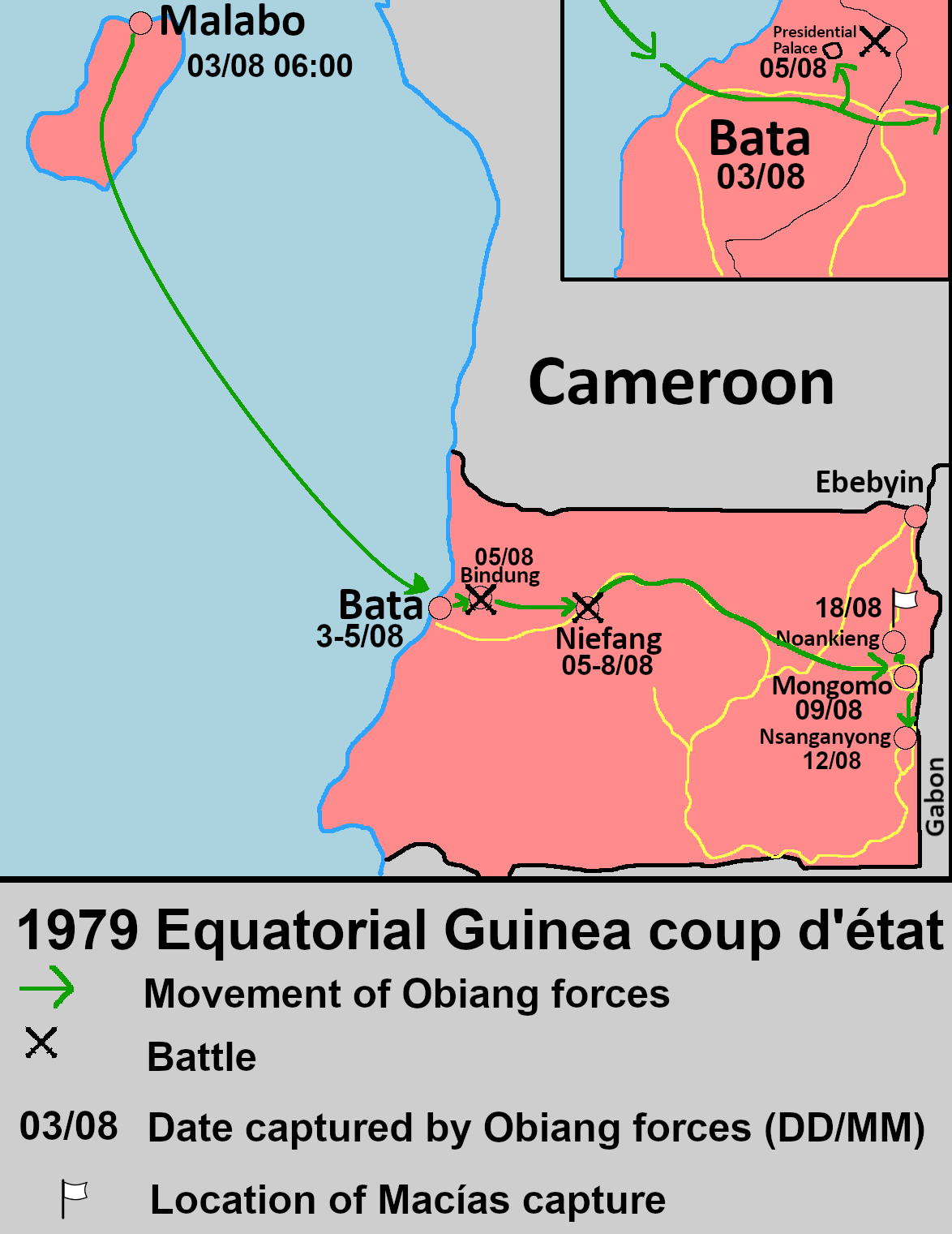
1979 Equatorial Guinea coup d'état
In the summer of 1979, Francisco Macias Nguema ordered several members of his own family killed. His nephew, Teodoro Obiang Nguema Mbasogo, was the brother of one of the victims. Obiang was also deputy defense minister, a member of the inner circle, and a man who understood that the killing had stopped following any discernible logic. On August 3, he moved. The coup that followed toppled one of the most murderous dictatorships in postcolonial Africa, but it did not bring democracy. Obiang took the presidency that day and, as of this writing, has never given it back.
Independence and the Descent
Equatorial Guinea gained independence from Francoist Spain in 1968, and the transition was almost immediately catastrophic. A power struggle between Francisco Macias Nguema and Atanasio Ndongo Miyone ended with Macias assuming the presidency. Ndongo attempted a coup the following year; he was captured and executed. Spain was blamed for backing the attempt, and the backlash triggered a mass exodus of Spanish residents from the country. With potential rivals eliminated and foreign oversight gone, Macias consolidated total authority. He became a totalitarian dictator in the fullest sense, wielding state violence against political opponents, Nigerian migrant workers, and minority ethnic groups. The Bubi people of Bioko Island suffered disproportionately. An estimated 35,000 to 50,000 people died during his rule through mass killings and imprisonment in notorious prison camps. By 1979, a quarter of the country's population had fled into exile.
A Nephew's Calculation
Macias's paranoia had been escalating for years, but the family killings of summer 1979 crossed a line that even his inner circle could not rationalize. Obiang and several other senior figures concluded that no one was safe. The calculation was not ideological but existential: stay loyal and risk becoming the next target, or act. Obiang chose to act. He assembled support from the nation's military and, crucially, from Macias's own Cuban palace guard, who had evidently reached their own conclusions about the dictator's trajectory. Several foreign embassies, including those of Spain and the United States, were aware of the plot before it happened. They did not intervene to prevent it.
Eighteen Days in August
The coup began on August 3, 1979. Obiang's forces moved quickly, but Macias escaped with his personal bodyguard to his home village of Nzeng-Ayong, where he barricaded himself in a fortified bunker protected by military loyalists. The fighting that followed killed an estimated 400 people. Macias held out for two weeks before burning his personal treasury and fleeing toward the Cameroon border, carrying what remained of the national reserves. A force led by naval commander Florencio Maye captured him on August 18. The trial that followed charged Macias with genocide against the Bubi people, along with other crimes committed during his eleven years in power. He and six of his allies were sentenced to death. On September 29, 1979, Macias was executed by firing squad. Foreign embassies that had known about the coup in advance provided financial and humanitarian aid in its aftermath.
The Dictator Who Replaced a Dictator
Obiang initially governed as chairman of the Revolutionary Military Council and Supreme Military Council, presenting himself as a reformer who would undo his uncle's damage. He became president and has remained in office ever since, making him one of the longest-serving heads of state in the world. The discovery of vast offshore oil reserves in the 1990s transformed Equatorial Guinea's economy but did not transform its politics. International observers have consistently criticized the country's human rights record and democratic governance under Obiang's rule. A second coup attempt in 2004, involving foreign mercenaries, failed to dislodge him. The 1979 coup replaced Africa's self-proclaimed most brutal dictator with a ruler who has outlasted almost every other leader on the continent. Equatorial Guinea's people, who endured Macias's terror and celebrated his fall, found that the machinery of authoritarian power proved more durable than the man who built it.
From the Air
The 1979 coup centered on Malabo, the capital of Equatorial Guinea, located on the northern coast of Bioko Island at approximately 3.75°N, 8.77°E. Malabo International Airport (FGSL) serves the city. The island sits in the Gulf of Guinea roughly 40 km off the coast of Cameroon. Macias fled to Nzeng-Ayong on the mainland portion of Equatorial Guinea before his capture near the Cameroon border. Bata, the largest mainland city, is served by Bata Airport (FGBT). Expect tropical humidity with frequent cloud cover over the island year-round.