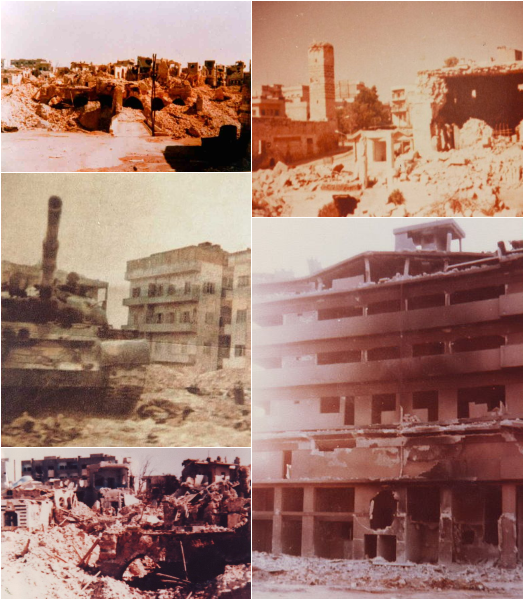
1982 Hama Massacre
For decades, Syrians could not speak its name. They called it "the events" or "the incident" -- euphemisms for the three weeks in February 1982 when the Syrian military besieged the city of Hama, leveled entire neighborhoods, and killed thousands of its own citizens. Estimates of the dead range from 10,000 to 40,000 people. The massacre was ordered by President Hafez al-Assad to crush a Muslim Brotherhood uprising, and it achieved its immediate objective with a thoroughness that silenced armed opposition in Syria for a generation. When rebel forces finally drove the Ba'athist government from Hama in December 2024 -- forty-two years later -- their leaders said they had come "to cleanse the wound that has persisted in Syria for 40 years."
The Stronghold and the State
The conflict between Syria's Ba'ath Party and the Muslim Brotherhood had been smoldering since the 1940s. The Ba'ath Party was secular and nationalist, drawing its members from modest backgrounds and favoring state control of the economy. The Brotherhood advocated Sunni Islamist governance and drew support from the merchant class and landowners of Syria's cities. Hama was a particular flashpoint -- a conservative city described as a "stronghold of Islamic conservatism" that had long resisted Ba'athist rule. From 1976 onward, Islamist militants waged a campaign of bombings and assassinations against government targets. In June 1980, they nearly killed Hafez al-Assad himself during a state reception. His response was immediate: within hours, between 600 and 1,000 imprisoned Islamists were executed in their cells at Tadmor Prison near Palmyra by units commanded by the president's brother, Rifaat al-Assad.
Two O'Clock in the Morning
The massacre began in the early hours of 2 February 1982. A Syrian army unit, searching Hama's old city, stumbled onto the hideout of local guerrilla commander Omar Jawwad. An ambush followed. Rooftop snipers killed roughly twenty soldiers, and Jawwad ordered a general uprising. Mosque loudspeakers that normally carried the call to prayer broadcast calls for jihad against the Ba'ath. By dawn, hundreds of insurgents had attacked government officials' homes, overrun police posts, and seized armories. Some seventy leading Ba'athists were killed. The rebels proclaimed Hama a "liberated city" and called on all of Syria to rise. No other city answered.
The Siege
President al-Assad mobilized 12,000 troops, including Rifaat's Defense Companies -- elite units staffed largely by Alawite soldiers loyal to the Assad family. The government warned that anyone remaining in the city would be considered a rebel. According to Amnesty International, the military bombed the old city center from the air, then sent tanks through the narrow streets, demolishing buildings during the first four days of fighting. Artillery ringed the city. When government forces suspected rebels were hiding in tunnels beneath the old quarters, they pumped diesel fuel into the passages and stationed tanks at the exits. The bombardment razed mosques, churches, and heritage sites. The Azm Palace was severely damaged. For three weeks the siege continued -- the first week to seize control, the last two to hunt survivors.
The Reckoning Nobody Could Speak
The killing did not end with military operations. Baathist paramilitaries looted for weeks afterward, and families were rounded up and shot. Baathist dissident Akram al-Hawrani testified that women, children, and Hama residents of every political persuasion were targeted indiscriminately -- including Ba'ath Party members themselves. Rifaat al-Assad reportedly boasted of killing 38,000 people. Amnesty International estimated the death toll at 10,000 to 25,000; the Syrian Human Rights Committee placed it between 30,000 and 40,000. Afterward, the Assad regime suppressed all public discussion of what had happened. The silence was enforced for decades. But the memory was not erased. In 2012, Professor Gregory Stanton of Genocide Watch characterized the Hama massacre as a "genocidal massacre" and warned that the regime's methods could foreshadow future atrocities in the Syrian civil war.
The Wound That Persisted
A satirical Arabic saying captured what many Syrians felt but could not say openly: "Asad 'alayya wa fil-hurubi na'amah" -- "Against me a lion, and in wars an ostrich" -- a bitter play on the president's surname (Assad means "lion") and his muted response to Israel's invasion of Lebanon the same year he destroyed Hama. The massacre broke the Muslim Brotherhood as a military force. Its members scattered into exile in Iran, the United Kingdom, the United States, and Germany. The organization split into factions and abandoned armed struggle. But the memory endured, shaping Syrian political consciousness for four decades. When Hama was liberated in December 2024, the city that had been silenced for a generation finally had the ability to name what had been done to it. The wound had persisted. Whether it could now begin to heal remained uncertain.
From the Air
Located at 35.13N, 36.75E in central-western Syria. Hama sits along the Orontes River, identifiable from altitude by its distinctive norias (ancient waterwheels) along the riverbank. The city lies approximately 210 km north of Damascus. Nearest airports include Hama Military Airport and Bassel Al-Assad International Airport (OSLK) approximately 170 km to the northwest. The old city, much of which was destroyed during the 1982 siege, has been partially rebuilt.