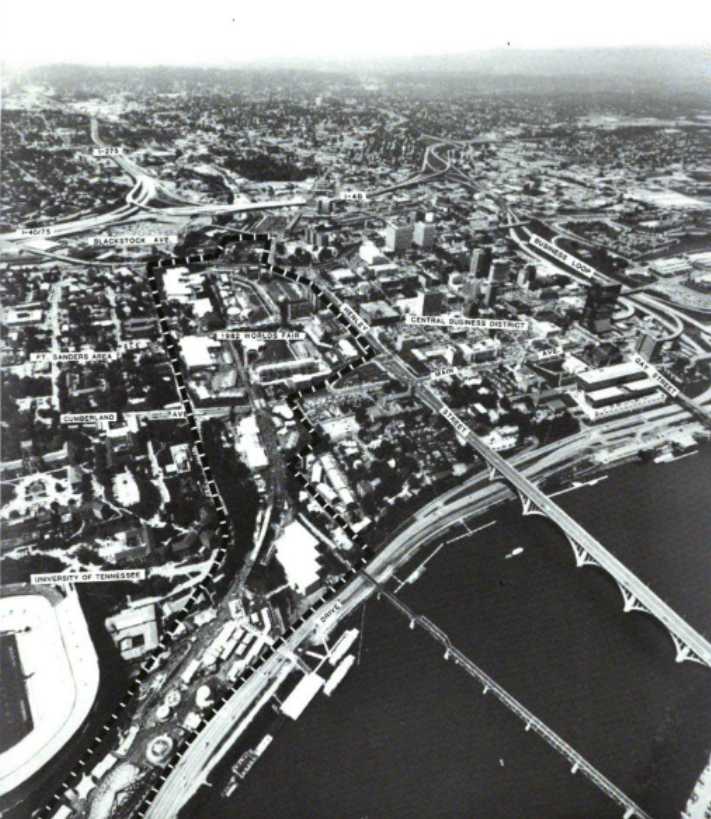
1982 World's Fair
The Wall Street Journal called it a "scruffy little city." Knoxville, Tennessee -- wedged between the Great Smoky Mountains and the Tennessee Valley -- had no business hosting a World's Fair, or so the skeptics said. But in 1982, that scruffy little city opened the Knoxville International Energy Exposition to the world, drew visitors from 25 nations, and accidentally gave America Cherry Coke. The insult stuck, though. Knoxvillians adopted "Scruffy City" as a badge of honor, and the nickname has outlasted every pavilion that once stood on the old Louisville and Nashville Railroad yard.
Jake's Fair
The fair was the brainchild of local banker Jake Butcher, appointed by Mayor Kyle Testerman to lead an exploratory committee. Knoxvillians simply called it "Jake's Fair." Butcher became the driving force behind the project, personally investing approximately $25 million through his companies. The federal government contributed an estimated $44 million, Tennessee added $3 million, and the city approved a nearly $12 million bond. The site chosen was a roughly 70-acre disused railyard along the Second Creek watershed, sitting between downtown and the University of Tennessee campus. The old Louisville and Nashville Railroad yard was demolished to make way for nation-representing pavilions, the Tennessee Amphitheater, and the fair's crown jewel -- the Sunsphere, a gold-skinned globe perched atop a steel tower that still defines the Knoxville skyline. President Ronald Reagan arrived to open the fair on May 1, 1982.
Twenty-Five Flags and a Mummy
The theme was "Energy Turns the World," and 25 nations answered the call. China's participation proved historic -- the People's Republic had not appeared at an international exposition since 1904, and its presence signaled the country's shift toward engagement with the capitalist world. Hungary, homeland of the Rubik's Cube, sent the world's largest version with rotating squares; it remains on display at the Knoxville Convention Center. Peru brought an actual mummy, unwrapped and studied at the fair. Egypt contributed ancient artifacts valued at over $30 million. Panama never showed up, citing "economic problems," and its empty pavilion was eventually occupied by a group of Caribbean island nations. Every night at 10 pm, a fireworks display lit up the Knoxville sky for six straight months.
The Inventions You Did Not Know Started Here
The 1982 World's Fair was a quiet launchpad for products that reshaped daily life. Coca-Cola set up a tasting station where visitors sampled lime, lemon, vanilla, and cherry versions of Coke. Cherry won decisively, and Coca-Cola Cherry hit store shelves in 1985 -- born from a flavor test in Knoxville. Texaco demonstrated pay-at-the-pump technology as part of the energy theme. Kodak introduced one-hour photographic processing. An early cordless telephone made its public debut. Ford Motor Company showcased a Lincoln Town Car with a built-in car phone and a concept car called the AFV that ran on alternative fuel. Tetra Pak demonstrated boxed shelf-stable milk. Even the arcade area made its mark -- seven custom video game tokens were minted, featuring Pac-Man, Ms. Pac-Man, Space Invaders, Donkey Kong, and other icons of the era.
The Hangover
The fair's financial aftermath was less celebratory. When the books closed, the exposition had earned a profit of exactly $57 -- far short of the $5 million surplus organizers had projected. Jake Butcher's United American Bank was raided by federal regulators the day after the fair closed. On February 14, 1983, the FDIC seized control of the bank due to irregularities in its financial records, sparking speculation that Butcher's World's Fair financing had contributed to the collapse. The centralized hotel reservation system, Knoxvisit, was a disaster from the start -- its administrative troubles led to a takeover by a management company that itself filed for bankruptcy. A six-month pass had sold for $100, and many visitors felt they had not gotten their money's worth.
What the Scruffy City Kept
The U.S. Pavilion operated as a soccer arena before structural problems led to its demolition by controlled implosion in 1991. But the fair's deeper legacy endures. The Japanese Pavilion site became home to the Knoxville Museum of Art in 1990. The Tennessee Amphitheater, renovated between 2005 and 2007, was voted one of the top fifteen architectural works of East Tennessee. World's Fair Park hosts annual Independence Day concerts by the Knoxville Symphony Orchestra. The Sunsphere's observation deck reopened to the public in 2007 after renovations. And the fair's theme -- "Energy Turns the World" -- proved prophetic for Knoxville's economy. With the Tennessee Valley Authority and Oak Ridge National Laboratory nearby, the energy sector continues to drive the region, from electric vehicles to advanced battery manufacturing. The scruffy little city kept exactly what mattered.
From the Air
Located at 35.96N, 83.92W in Knoxville, Tennessee. World's Fair Park sits between downtown Knoxville and the University of Tennessee campus, along the Second Creek watershed. The Sunsphere -- a gold-skinned sphere atop a steel tower -- is the most recognizable landmark from the air. Neyland Stadium (University of Tennessee football) is visible immediately to the south along the Tennessee River. Nearby airports: KTYS (McGhee Tyson, 12nm south), KDKX (Knoxville Downtown Island, 3nm east on an island in the Tennessee River). Best viewed at 2,000-3,000 ft AGL. The Great Smoky Mountains are visible to the southeast, and the Tennessee River curves through the city.