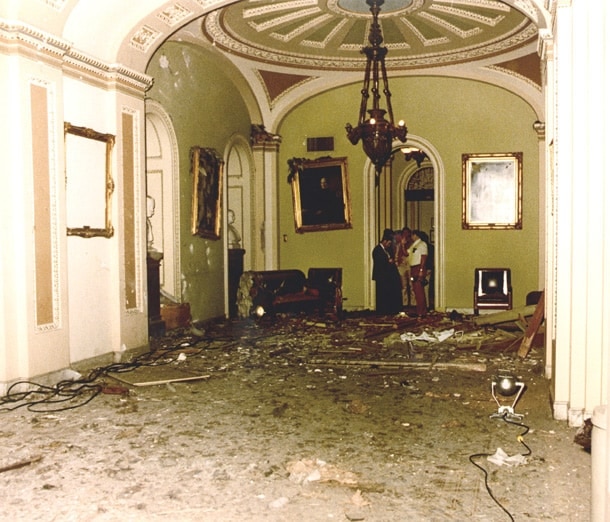
1983 United States Senate Bombing
The Senate had adjourned at 7:02 p.m. on November 7, 1983. A well-attended reception carried on near the Chamber for two more hours, staffers and lawmakers mingling in hallways that the public could still freely walk. At 10:58 p.m., after the building had largely emptied, an explosion tore through the second floor of the Capitol's north wing. A bomb planted beneath a bench at the eastern end of the corridor outside the Senate Chamber blew the door off Democratic Leader Robert C. Byrd's office and shredded a portrait of Daniel Webster that had hung on the wall for generations. No one was killed -- but the building, and the openness it represented, would never be the same.
Cold War Fury on the Home Front
The bombing did not emerge from a vacuum. In October 1983, the United States had invaded the Caribbean island nation of Grenada, overthrowing its Marxist-Leninist government. Simultaneously, American troops were deployed as part of a multinational peacekeeping force in Lebanon, a mission that had turned deadly when a truck bomb killed 241 U.S. service members in Beirut just eleven days before the Senate blast. For a left-wing militant cell calling itself the Armed Resistance Unit -- also known as Resistance Conspiracy, a branch of the May 19th Communist Organization -- these Cold War interventions demanded a response on American soil. They chose the most symbolic target they could find: the seat of the legislative branch itself.
A Warning Call, Then Silence
Minutes before the blast, a tape-recorded message was phoned in simultaneously to the Washington Post news desk and the Capitol switchboard. The caller claimed to represent the Armed Resistance Unit and warned that a bomb was about to detonate near the Senate Chamber in retaliation for U.S. military actions in Grenada and Lebanon. It was too late for anyone to respond. The explosive device, concealed beneath a wooden bench in the ornate corridor, detonated with enough force to blow open Senator Byrd's office door and send debris scattering across the hallway. The portrait of Daniel Webster -- one of the Senate's most treasured historical artifacts -- was badly damaged, its fragments later gathered by Senate members themselves. A conservator spent months painstakingly restoring the painting. The group had also plotted to murder former Secretary of State Henry Kissinger, though that plan never materialized.
A Five-Year Hunt
Within minutes of the explosion, a dozen fire trucks and four ambulances converged on the west front of the Capitol while officers with police dogs combed the rubble for evidence. The investigation would stretch across five years. Finally, on May 12, 1988, federal agents arrested six members of the conspiracy: Marilyn Buck, Linda Evans, Laura Whitehorn, Susan Rosenberg, Timothy Blunk, and Alan Berkman. A seventh suspect, Elizabeth Duke, evaded capture and remained a fugitive. All were charged with the Capitol bombing as well as related attacks on Fort McNair and the Washington Navy Yard. In December 1990, Judge Harold H. Greene sentenced Whitehorn to 20 years and Evans to 5 years concurrent with a 35-year sentence for illegally purchasing firearms. On his final day in office, January 20, 2001, President Bill Clinton commuted the sentences of Evans and Rosenberg.
The Corridors That Closed
The 1983 bombing left a physical mark on the Capitol that visitors can still sense today. The corridor outside the Senate Chamber, once open to anyone who walked in off the street, was permanently sealed to the public. Congressional officials installed a staff ID card system for building entry and added metal detectors at every entrance -- supplementing those already guarding the Chamber Gallery doors since a prior Capitol bombing in 1971. The Washington Navy Yard Officer's Club, bombed by a related group in April 1984, suffered blown-out windows and ceiling damage but no casualties. Taken together, these attacks by the Resistance Conspiracy -- twenty incidents of politically motivated domestic terrorism over nearly a decade -- transformed the Capitol from an accessible people's house into the secured fortress it remains. The shrapnel scars may have been repaired and the Daniel Webster portrait restored, but the open hallways never returned.
From the Air
Located at 38.890N, 77.009W atop Capitol Hill in Washington, D.C. The distinctive white dome of the U.S. Capitol Building is one of the most recognizable landmarks from the air, prominently visible along the National Mall axis. Nearest airport: KDCA (Ronald Reagan Washington National), approximately 3 nm south. Also nearby: KIAD (Dulles International) to the west and KADW (Joint Base Andrews) to the southeast. The Capitol sits within the P-56A prohibited airspace -- flight restrictions apply. Best observed during approach or departure from KDCA.