1987 America's Cup
For 132 years, the America's Cup never left the New York Yacht Club. Then in 1983 an Australian businessman named Alan Bond did what twenty-five previous challengers could not: he won it. The trophy crossed the Pacific to Perth, and suddenly the world's oldest international sporting prize belonged to the Royal Perth Yacht Club. What followed was a frenzy of ambition, infrastructure, and wind-blasted competition that turned the port city of Fremantle into the center of the sailing universe.
A Streak Broken, a Nation Electrified
The backstory begins off Newport, Rhode Island, in 1983. Dennis Conner, the American skipper considered the finest match racer of his generation, lost the Cup to Bond's Australia II in a series that went the full seven races. It was the most dramatic upset in sailing history. The New York Yacht Club had held the trophy since 1851, longer than any team had held any prize in any sport. When Bond's crew carried the Cup through the streets of Perth, Australia declared a national holiday. Conner, humiliated, immediately began planning his return. He would spend the next three years raising funds, testing designs, and training obsessively in the very waters where he would have to win it back.
Gage Roads and the Fremantle Doctor
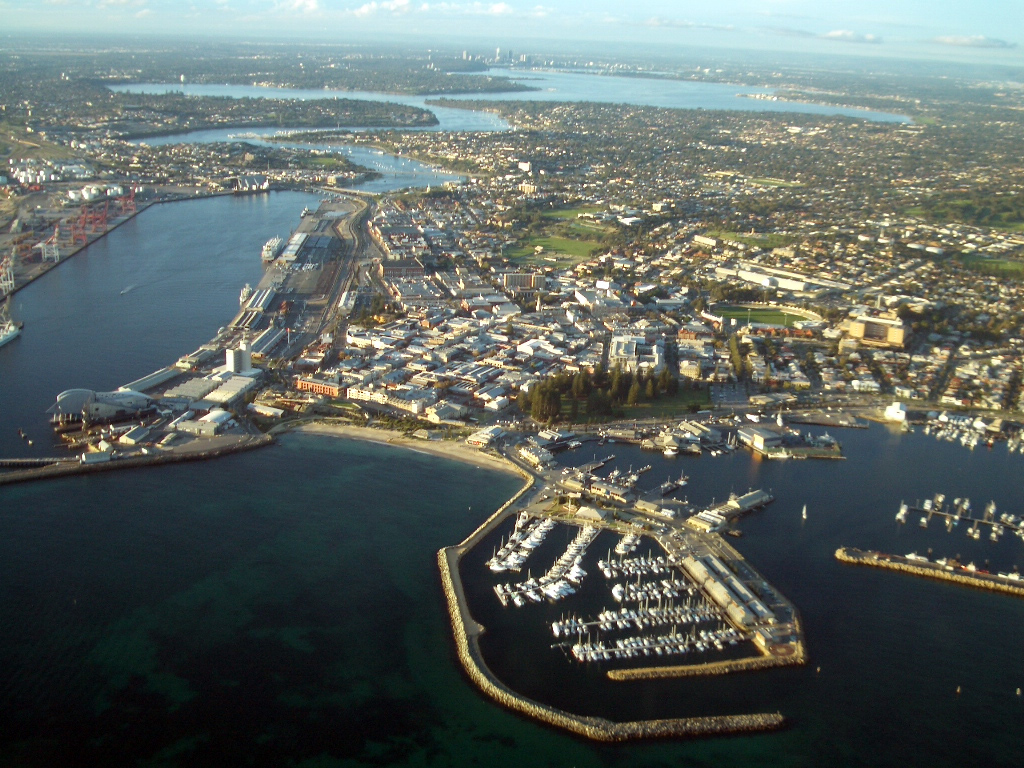
The racecourse sat in Gage Roads, the open water northwest of Fremantle Harbour, where the Indian Ocean meets the mouth of the Swan River. These are not gentle waters. A precursor regatta in early 1986 shattered four 90-foot masts, destroyed a dozen booms, and washed five crewmen overboard. Gary Jobson of the American Heart of America syndicate declared the waters "unsuitable for racing." The conditions owed much to the Fremantle Doctor, the powerful afternoon sea breeze that sweeps off the ocean most summer days. Races ran 24.3 nautical miles over eight legs, with starting lines set square to the prevailing wind twenty minutes before each gun. The America's Cup buoy, a permanent shipping marker eight nautical miles west-northwest of the harbour, anchored one end of every start and finish line.
A City Remade for Yachts
Western Australia threw itself into the event with transformative energy. Challenger Harbour was built from scratch alongside the existing Fishing Boat Harbour to berth the competing syndicates. The state government set up an Office of America's Cup Defence to coordinate logistics, collecting $2.3 million from defence syndicates against $8 million in harbour construction costs. Vehicle registration plates across the state swapped their old slogans for "W.A. Home of the America's Cup." A Festival of Sport accompanied the racing season, with cricket Tests, sprint car championships, and a heavyweight boxing title fight. The cruise ship Achille Lauro was chartered as a floating grandstand and hotel for 1,400 spectators, doubling as headquarters for the international jury. Thirteen challenger syndicates from six countries and four Australian defence syndicates arrived with twenty-nine 12-metre yachts, the largest fleet the Cup had ever drawn.
Conner's Comeback
The final act was swift and decisive. Dennis Conner's Stars & Stripes 87 won the Louis Vuitton Cup to earn the right to challenge, while Iain Murray's Kookaburra III emerged as Australia's defender after sweeping Alan Bond's Australia IV five races to nil. For the first time in thirteen years, Bond's syndicate stood on the outside looking in. When the best-of-seven final began on 31 January 1987, Conner made it look almost easy. He swept Kookaburra III in four straight races, wrapping up the Cup on 4 February. Conner became the first sailor in history both to lose the America's Cup and then to win it back, a redemption story that cemented his reputation as the most tenacious competitor the sport had seen.
The Last of the Twelves
The 1987 regatta was the final America's Cup sailed in 12-metre class yachts, the elegant sloops that had defined the competition since 1958. Future Cups would move to larger, faster, and increasingly exotic designs. Fremantle's transformation, meanwhile, proved permanent. The harbour infrastructure, the restored heritage buildings, the restaurants and bars that sprang up to serve the international crowd stayed long after the syndicates packed their sails. What was once a working port town emerged as one of Perth's most vibrant neighborhoods, its waterfront identity inseparable from the summer the Cup came to Western Australia.
From the Air
Located at 31.95S, 115.65E off Fremantle, Western Australia. The racecourse at Gage Roads is visible as open water northwest of Fremantle Harbour. Challenger Harbour and Fishing Boat Harbour are prominent along the Fremantle waterfront. Nearest major airport is Perth Airport (YPPH), approximately 30 km east. Jandakot Airport (YPJT) is closer at about 15 km southeast. Best viewed at 3,000-5,000 ft AGL on a clear day with the Indian Ocean coastline stretching south.