1992 Gothenburg Tram Derailment
The snow was falling at Vasaplatsen that March morning in 1992, and most of the fifty-odd commuters waiting at the tram stop kept their eyes on the ground. They never saw the 54-tonne tram hurtling toward them sideways, out of control. In the minutes that followed, thirteen people would die and forty-two would be injured in what remains the deadliest accident in the history of the Gothenburg Tramway. The disaster began not with malice or dramatic mechanical failure, but with a burnt overhead wire and a traffic controller's reasonable-sounding decision.
A Chain of Reasonable Choices
The morning of March 12, 1992 started with a mundane problem. Near the Medicinaregatan stop, a faulty pantograph had damaged an overhead wire, cutting power to a section of tram Line 7. Tram train number 19, consisting of two M21 carriages numbered 235 and 245, halted automatically near Wavrinskys plats, its brakes engaging when power was lost. The driver evacuated passengers to find other transport. Behind the stalled tram, other trams began queuing on powered track. A traffic controller began routing them around the obstruction by reversing them down Aschebergsgatan. But the powerless tram at Wavrinskys plats could not be reversed. It sat blocking traffic, brakes locked. The controller made a fateful decision: manually disengage the brakes from outside, let the tram roll downhill to the powered section at Chalmers stop, where the driver could pull the emergency brake and restart. A police patrol was asked to escort the rolling tram. It seemed workable. It was not.
Gathering Speed
The regulations were clear: a powerless tram's brakes should only be disengaged when connected to another tram or recovery vehicle. The traffic controller did not know, and neither did the driver nor thirteen of eighteen other controllers, that manually releasing the mechanical brakes also disconnected the emergency brakes. When the tram rolled into the powered section, a fuse blew in the control panel, preventing the motor from starting. The brakes could not re-engage. The tram began rolling backward down Guldhedsgatan, picking up speed. The driver sprinted through the carriage, yanking all four emergency handles. None worked. The police patrol, recognizing disaster, raced ahead to warn traffic. At the intersection with Engelbrektsgatan, a Ford Escort pulled aside to let the police car pass and was struck by the tram instead. The driver survived with a sprained foot. The tram was now traveling at an estimated 90 kilometers per hour.
Nine Seventeen A.M.
At the Vasagatan intersection, the runaway tram struck a stationary taxi, sending it onto its roof, then hit a junction and derailed, continuing sideways through the street. At Vasaplatsen, people waited for a tram to Tynnered. The falling snow kept their heads down. A few looked up in time. Most did not. The 54-tonne tram plowed sideways across platform D, crushing more than fifty people, then crossed a parallel roadway, destroying two cars and their passengers, before slamming into a building. Petrol from a crushed car ignited, flames spreading along the rails toward Parkgatan. The first emergency call reached SOS Alarm at 9:17 a.m. Twenty more calls followed within seconds. Some first responders thought it was a training exercise, the scale of destruction so surreal. Within forty minutes, all injured had been evacuated to Sahlgrenska, Ostra, and Molndal hospitals using a 'load and go' strategy. Forensic examination later confirmed that none of the thirteen dead could have been saved by on-site care.
Who Bears the Blame
That same evening, the mechanism allowing external brake release was removed from every tram in the system. The Swedish Accident Investigation Authority concluded the company had not adequately trained staff on the M21 model. Two years later, prosecutors charged both the managing director and the traffic controller with gross negligence manslaughter. The court found the regulations approved by Jarnvagsinspektionen were clear and that the traffic controller 'should have known better.' The managing director was acquitted. The traffic controller received a suspended sentence and a fine, was placed on sick leave, and eventually transferred to a subsidiary company. The driver returned to work after three weeks, initially with an instructor beside him. The debate over individual versus systemic blame continued for years. A 2010 episode of P3 Dokumentar summarized it simply: who is responsible when a rule exists that almost no one understands?
Memory at Vasaplatsen
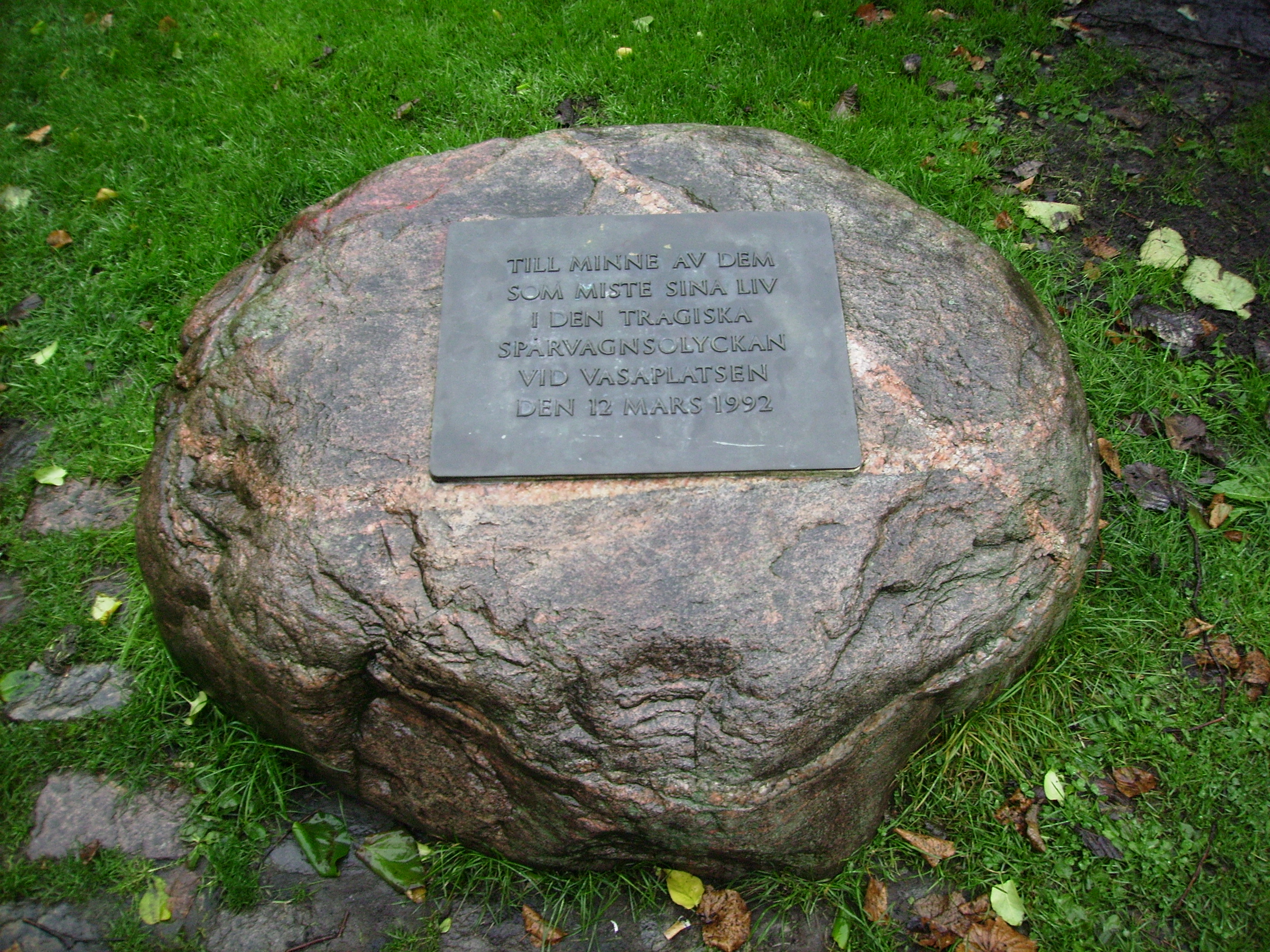
Today a memorial stone stands in the park beside the tram stop where thirteen people died. The platforms have been rebuilt, the trams modernized, the safety systems overhauled. Gothenburg's tram network, one of the oldest and largest in Scandinavia, has operated safely for decades since. But for those who were there, for the families who lost someone waiting for a routine morning commute, Vasaplatsen carries weight beyond its function as a transit hub. The accident remains a case study in how small, individually defensible decisions can combine into catastrophe, and how organizations must design systems that account for human fallibility rather than punishing it after the fact.
From the Air
Located at 57.699N, 11.969E in central Gothenburg, Sweden. The Vasaplatsen tram stop sits along Aschebergsgatan, visible from low altitude when following the tram lines through the city center. Nearby airports include Gothenburg Landvetter (ESGG, 20nm east) and Gothenburg City Airport Save (ESGP, 8nm northwest). Best viewed at 1,500-2,000 feet AGL when approaching from the south along the Gota River.