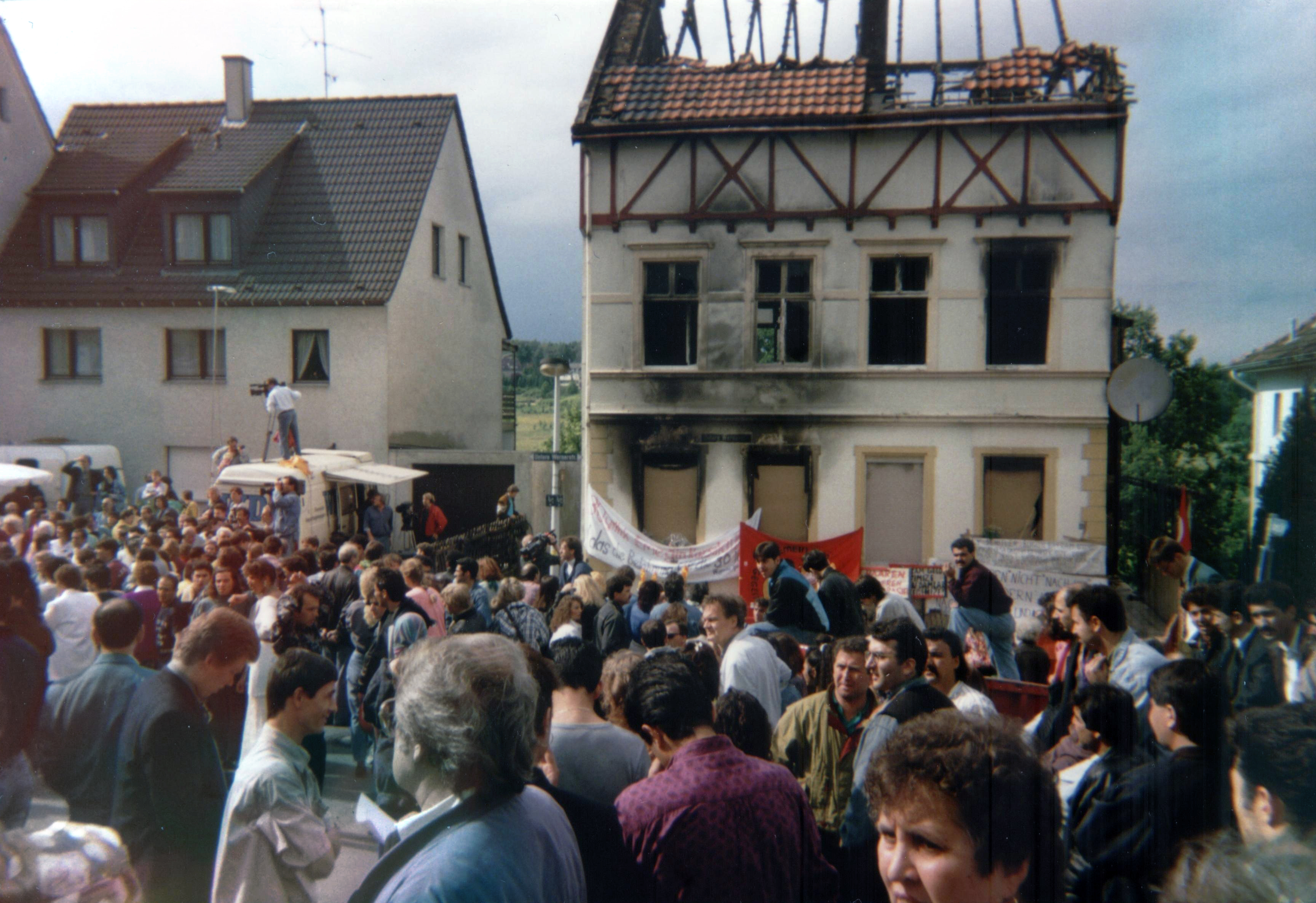
1993 Solingen Arson Attack
Mevlude Genc was fifty years old when she climbed out the window of her burning home on Untere Wernerstrasse and ran for the neighbors. The fire was at the front door. It was 1:38 in the morning on the 29th of May, 1993. By the time the smoke cleared from the narrow Solingen street, she had lost two daughters, two granddaughters, and a niece - five lives, the youngest just four years old. The men who set the gasoline alight were boys, really: sixteen, sixteen, nineteen, and twenty-three. They had decided that night, drunk and full of borrowed grievance, to frighten some Turks. Mevlude Genc, who had every conceivable reason to hate, chose something else instead. She spent the rest of her life asking Germans and Turks to live as neighbors.
The Names That Should Be Spoken
The dead deserve to be named, not numbered. Gursun Ince was twenty-seven. Hatice Genc was eighteen. Hulya Genc was nine. Saime Genc was four. Gulustan Ozturk, a niece visiting the family, was twelve. Three of them had been asleep when the fire reached the upper floors. Fourteen other family members survived, some with severe burns that would shape the rest of their lives. The house was a typical narrow German row building of brick and timber, the kind that burns fast. Mevlude Genc, the family matriarch, would later say she heard her granddaughter call out for her in the smoke and could not reach her. She carried that sound, by her own account, for the next twenty-nine years.
A Country in an Ugly Mood
The early 1990s in Germany were combustible in more than the literal sense. Reunification had collided with recession. Asylum seekers from the collapsing Yugoslav wars and elsewhere were arriving in record numbers, and a tabloid press kept the temperature high. In Hoyerswerda in 1991, a hostel was besieged. In Rostock-Lichtenhagen in 1992, a crowd of thousands cheered while Molotov cocktails flew at Vietnamese workers trapped on the roof of a high-rise. In Molln in November of 1992, three Turkish women and girls died in another arson. Three days before Solingen burned, the Bundestag rewrote Article 16 of the constitution to restrict the right to asylum. The four young men who would commit the attack had trained together at a Solingen martial arts school. After the fire, that school turned out to be run by an informant of the state's domestic intelligence service - a detail that has never sat easily with anyone in the city.
What Mevlude Genc Did Next
The trial took two years. In October 1995 the four were convicted of murder, attempted murder, and arson. The three who had been minors received the maximum ten years available under juvenile law; the eldest received fifteen. The Federal Court of Justice confirmed the verdicts on appeal. But Mevlude Genc was no longer principally concerned with the courts. From the very first week, she spoke publicly - in Turkish, in halting German - against vengeance. She accepted the Federal Cross of Merit. She accepted, in 2018, the new Mevlude-Genc-Medal that the state of North Rhine-Westphalia named after her while she was still alive to receive it. When she died in 2022, her funeral in Solingen was televised. The Turkish president and the German federal president both spoke. Both called her, in slightly different words, a teacher.
The Street, Today
Untere Wernerstrasse 81 is still there, or rather what was rebuilt in its place. The family lives in it still, behind windows specially rated against fire, behind cameras paid for by donations from across Germany and Turkey. A few hundred meters away, in front of the Mildred-Scheel-Schule, there is a memorial: five chestnut trees, one for each of the dead, and a stone with the five names. On the anniversary every May, the chestnuts are in bloom. Children from the school come out and read the names aloud. In Frankfurt-Bockenheim there is a small square called Hulyaplatz, for Hulya, who was nine. In Solingen they have renamed the school nearest the house after Mevlude Genc. Walking the street now, with its ordinary parked cars and ordinary brick fronts, you would not know what happened there - which is precisely why the small things, the plaques and the trees and the named square in Frankfurt, do the work they do.
What Solingen Carries
Cities carry their wounds for a long time, and Solingen carries this one. In 1993 the chancellor declined to come to the memorial; Helmut Kohl said it would be inappropriate to engage in what he called Beileidstourismus, condolence-tourism. The phrase has not aged well. Successive German presidents have come. So have ambassadors. So have ordinary Germans, every year, by the thousand. The 1993 attack did not stop the violence - one hundred and thirty-five people of foreign background have died in xenophobic attacks in Germany since reunification - but it shifted something in how the country talked about itself. The 700,000 Germans who marched against xenophobia in December 1992 became, after Solingen, a recurring phenomenon. The candle marches. The chains of light across bridges. The Genc family did not ask for any of this. They lived their lives in a small house on a small street and woke up in May to a fire.
From the Air
Solingen sits at 51.18 degrees north, 7.09 degrees east, in the Bergisches Land east of Dusseldorf. The nearest airports are Dusseldorf (EDDL) about 30 km west-northwest and Cologne-Bonn (EDDK) about 30 km southwest. From cruising altitude the city is a dense urban band on the slopes above the Wupper, distinguishable from neighboring Remscheid and Wuppertal mainly by the rail line snaking through to the south.