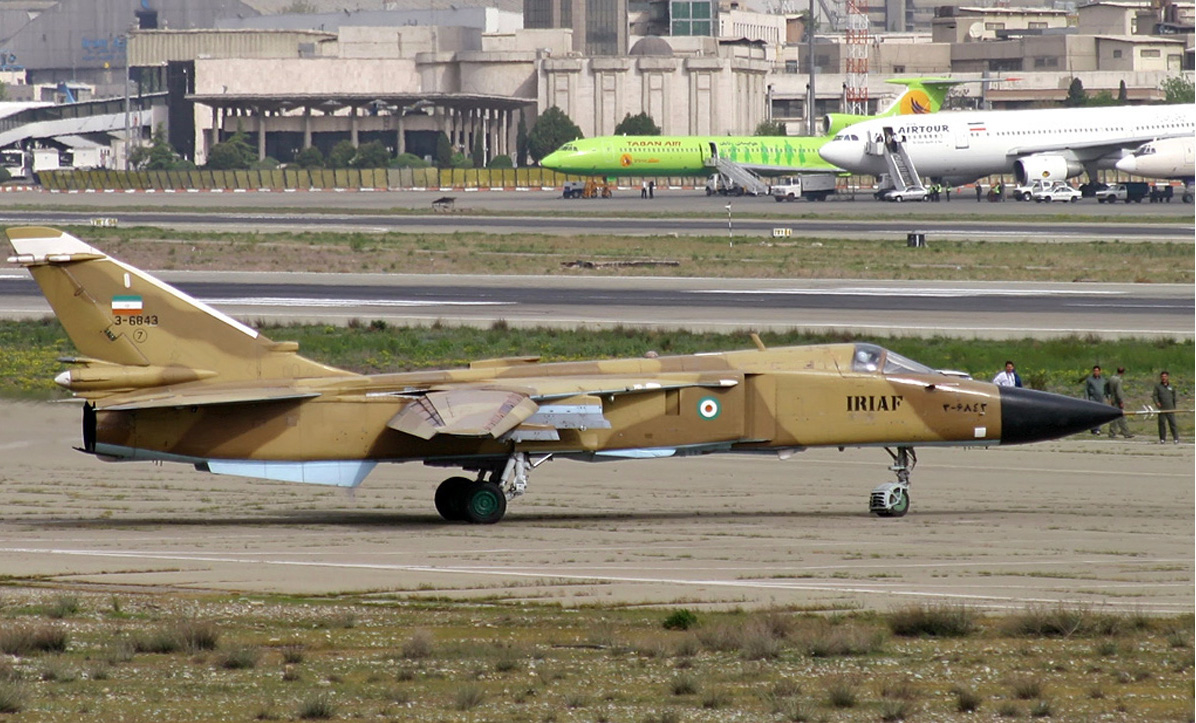
Collision Over Tehran: When a Ceremony Rehearsal Killed 133
Five Sukhoi Su-24 fighter jets were approaching Mehrabad Airport on the afternoon of February 8, 1993, returning from low-altitude flypast maneuvers for Iranian Air Force Day. At the same moment, Iran Airtour Flight 962 was climbing away from the same airport, carrying 119 passengers and 12 crew on a domestic flight to Mashhad. One controller managed both. Within minutes, the Tupolev Tu-154 airliner and one of the Su-24s occupied the same patch of sky west of Tehran. The collision killed everyone aboard both aircraft, 133 people in total, making it the deadliest aviation accident anywhere in the world that year.
Parallel Paths from the Same Runway
Mehrabad Airport sits in western Tehran, hemmed in by the city on all sides. Its parallel runways, 29R and 29L, pointed northwest toward the Alborz foothills. Flight 962 departed from 29R at an altitude cleared to 6,000 feet. The five Su-24s were simultaneously approaching 29L from the west at 5,000 feet, assigned that altitude by air traffic controller Faramarz Sarvi. The vertical separation between the climbing airliner and the descending fighters was just 1,000 feet, a margin that would have been adequate only if everyone maintained their assigned altitudes precisely. The Russian captain commanding the Tu-154 had 12,000 flight hours of experience. He followed every instruction from the tower.
A Thousand Feet Apart
The investigation determined that one of the Su-24 pilots failed to maintain the assigned altitude. As Flight 962 climbed and the fighters descended, the gap between them collapsed. The controller never informed the airliner crew about the military aircraft entering their airspace. He never warned the fighter pilots about the departing Tupolev. He raised no alarm about the shrinking distance. The collision happened over an army depot at Shahr-e Qods, near Tehransar, about 9.4 miles from Mehrabad. Both aircraft fell onto the depot. All 131 people aboard the Tu-154 and both pilots of the Su-24 died instantly.
A Chain of Failures
Iran's Civil Aviation Authority concluded that the crash resulted from multiple errors, none of which would have been fatal alone. The controller allowed Flight 962 to climb while the Su-24s were descending into the same vertical space. He failed to inform either party about the other. He expressed no concern about the 1,000-foot separation. The military pilots, for their part, did not hold their assigned altitude. The investigation spread blame across both the civilian controller and the military pilots, but the structural problem was more fundamental: military and civilian traffic were sharing the same airspace above a crowded airport with inadequate coordination between the two systems.
The Price of Celebration
The Su-24s were in the air because of Iranian Air Force Day, marked annually on February 8 to commemorate the founding of the Iranian Air Force. The collision exposed the danger of mixing combat aircraft with commercial flights in tight urban airspace, a risk amplified by the fact that military and civilian controllers did not share a unified communication system. The 133 people who died that afternoon included families heading to Mashhad, Iran's holiest city, and two military pilots preparing for a national holiday. Their deaths remain the worst mid-air collision in Iranian aviation history and one of the deadliest anywhere involving a military-civilian conflict of airspace.
From the Air
Located at 35.73N, 51.13E over the western suburbs of Tehran near Shahr-e Qods. The collision occurred approximately 9.4 miles west of Tehran Mehrabad International Airport (OIII), in the departure path of runway 29R. The crash site near Tehransar is now absorbed into Tehran's westward urban sprawl. Mehrabad Airport (OIII) is the closest major field; Imam Khomeini International Airport (OIIE) lies approximately 40 km to the south. The parallel runway configuration of Mehrabad (29R/29L) is clearly visible from altitude. Best viewed at 5,000-8,000 feet AGL where the relationship between the airport and the crash site in the western suburbs becomes apparent.