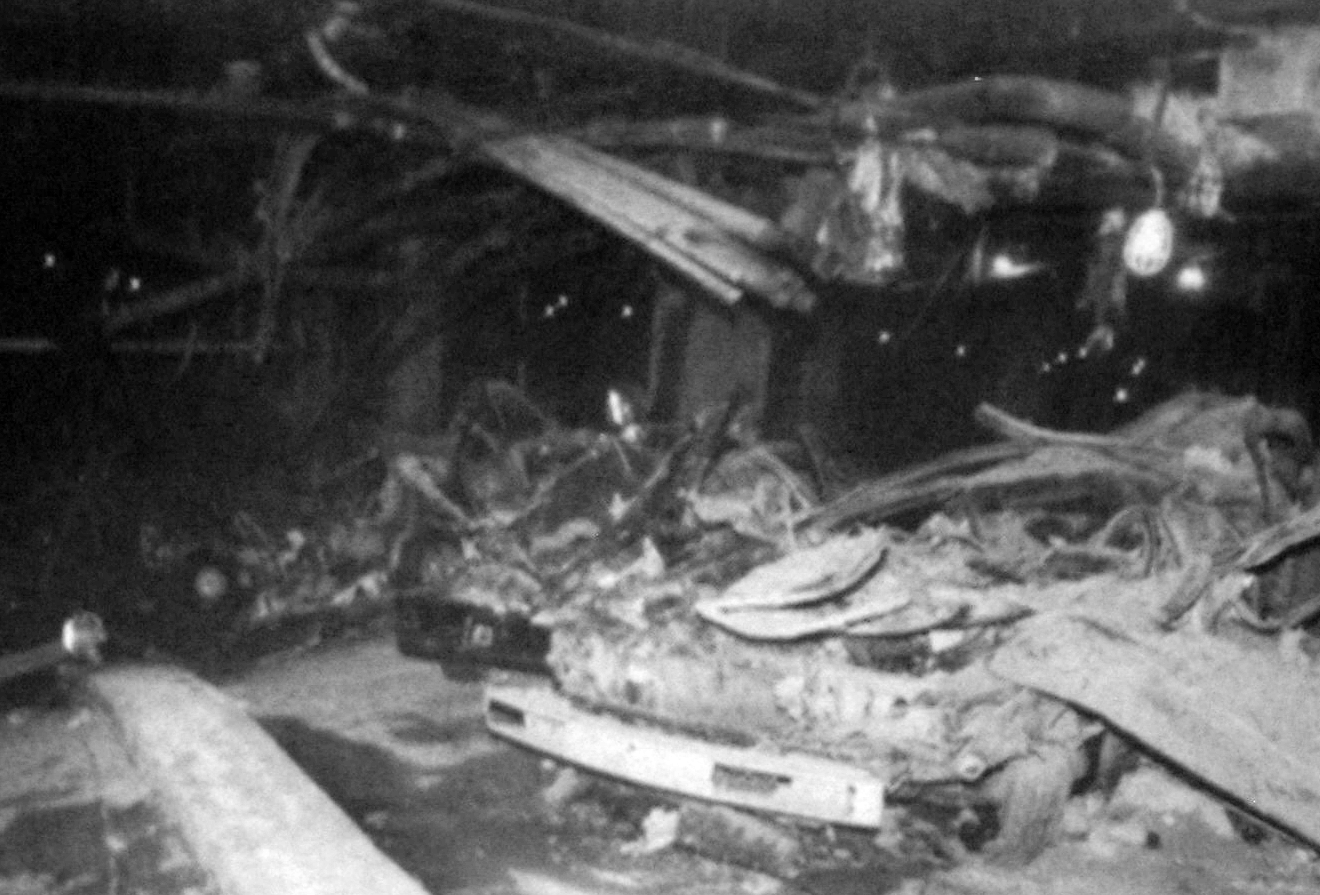
1993 World Trade Center Bombing
Mohammed Salameh went back for the deposit. That single act of frugality — returning to the Ryder rental office in Jersey City on March 4, 1993, to collect the $400 refund on a van he had reported stolen the day before the bombing — handed the FBI the thread that unraveled the entire conspiracy. Six days earlier, Ramzi Yousef and Eyad Ismoil had driven that same yellow Ford Econoline into the public parking garage beneath the World Trade Center, parked it on the B-2 level, lit a twenty-foot fuse wrapped in surgical tubing, and walked away. Twelve minutes later, at 12:18 p.m. on February 26, 1993, a 1,336-pound bomb blew a hundred-foot hole through four sublevels of concrete. Six people were killed. Over a thousand were injured. Yousef's plan — to topple the North Tower onto the South Tower and kill a quarter-million people — failed only because the van had not been parked close enough to the building's poured concrete foundations.
Six People at 12:18
The dead were not abstractions. John DiGiovanni, 45, was parking his car in the underground garage. Robert Kirkpatrick, Stephen Knapp, and Bill Macko were eating lunch together in an employees' break room on the B-2 level. Wilfredo Mercado, 37, was checking deliveries for the Windows on the World restaurant. Monica Rodriguez Smith, 35, a secretary seven months pregnant, was reviewing time sheets in her office next door. The blast generated pressure estimated at 150,000 psi and cut the World Trade Center's main electrical power line, killing the emergency lighting system. Smoke poured up through unpressurized stairwells to the 93rd floor of both towers. Hundreds were trapped in elevators, including seventeen kindergartners returning from the South Tower observation deck, stuck between the 35th and 36th floors for five hours. About 50,000 people were evacuated that day. Twenty-eight were airlifted from the rooftops by NYPD helicopters.
The Van, the Deposit, and the Apartment
Yousef had flown into JFK in September 1992 on a false Iraqi passport, claiming asylum. His traveling companion, Ahmed Ajaj, tried to enter on a forged Swedish passport and was caught with bomb-making manuals in his luggage. Yousef was given a hearing date and released. He set up in Jersey City, connected with the blind sheikh Omar Abdel Rahman's circle at the Al-Farooq Mosque in Brooklyn, and began assembling the device. He ordered chemicals from his hospital bed after one of three car crashes caused by the accident-prone Salameh. The bomb itself — urea nitrate enhanced with aluminum, magnesium, and ferric oxide particles, surrounded by three tanks of compressed hydrogen — was designed to generate a thermobaric fireball. When Salameh came back for his $400, investigators were waiting. His arrest led them to an apartment at 40 Pamrapo Avenue in Jersey City, where they found Yousef's bomb-making materials and a business card linking the plot to a wider network.
What the Tower Absorbed
Yousef had hoped the smoke alone would kill thousands, smothering people as it filled the sealed stairwells. He wanted the North Tower to topple sideways into the South Tower, bringing both down. The towers held. But the garage was devastated — the explosion destroyed two sets of track, a third rail, signal equipment, and an air compressor room beneath the complex. The blast knocked out broadcast transmitters for nearly every television and radio station in New York; only WCBS-TV channel 2 maintained its over-the-air signal, while other stations scrambled to broadcast via cable microwave hookups. Telephone service across Lower Manhattan was disrupted. A granite memorial fountain designed by Elyn Zimmerman was dedicated on the plaza above the blast site in 1995, inscribed with the six names in English and Spanish. That fountain was destroyed on September 11, 2001. A fragment marked 'John D' — from John DiGiovanni's name — was recovered from the rubble and incorporated into a temporary memorial. The rest was never found.
The Warning Nobody Heeded
Yousef fled to Pakistan hours after the bombing. He was eventually captured in Islamabad in 1995 and convicted in November 1997 along with Ismoil. Four other conspirators had already been convicted in 1994. Before the attack, Yousef mailed letters to New York newspapers demanding an end to U.S. aid to Israel and warning that the World Trade Center bombing would be 'merely the first' if his demands were not met. He made no religious justification. The 1993 bombing is now understood as a dress rehearsal — a proof of concept that the towers were vulnerable, that a small group could penetrate the security of the most prominent buildings in America, and that the will to try again existed. Eight years later, Yousef's uncle, Khalid Sheikh Mohammed, would succeed where Yousef had failed. The six names from 1993 are memorialized at the North Pool of the 9/11 Memorial, on Panel N-73, alongside those who died in 2001.
From the Air
Coordinates: 40.7115°N, 74.0134°W. The World Trade Center site is in Lower Manhattan, now occupied by the 9/11 Memorial and One World Trade Center. The bombing occurred in the underground parking garage beneath the original North Tower. Visible from altitude as the memorial pools and the Freedom Tower. Nearest airports: KEWR (Newark, 14 km W), KLGA (LaGuardia, 15 km NE), KJFK (JFK, 24 km SE). Best viewed at 3,000-5,000 ft AGL approaching from New York Harbor.