1995 Rugby World Cup
The jersey was green and gold, number 6, with the springbok emblem on the chest. Nelson Mandela pulled it on before walking onto the pitch at Ellis Park in Johannesburg on 24 June 1995, and in that single gesture he rewrote the meaning of a symbol. For decades the Springbok had represented white South Africa -- the team that played under apartheid while the rest of the sporting world refused to compete against them. Now the country's first Black president was wearing it, grinning, presenting the Webb Ellis Cup to captain Francois Pienaar after South Africa's 15-12 extra-time victory over New Zealand. Pienaar would later say that 60,000 fans were cheering in the stadium. Mandela corrected him: 43 million South Africans were cheering.
The Pariah Returns
South Africa had been banned from international rugby since the early 1980s, part of the worldwide sporting boycott against the apartheid regime. The International Rugby Football Board readmitted the country in 1992, as negotiations to dismantle apartheid accelerated. By 1993, South Africa had been awarded hosting rights for the 1995 World Cup following meetings between the IRB, F. W. de Klerk's government, and the African National Congress. It was the first time the tournament would be held entirely in one country. Nine stadiums across Cape Town, Port Elizabeth, Durban, East London, Johannesburg, Bloemfontein, Pretoria, Stellenbosch, and Rustenburg were selected, most upgraded specifically for the event. The tournament was also the last major event of rugby union's amateur era -- two months later, the sport officially went professional.
Thirty Days That Gripped a Nation
The competition ran for thirty days, from 25 May to 24 June, with sixteen nations contesting 32 matches across four pools. South Africa opened by defeating Australia 27-18 at Newlands in Cape Town, and the host nation's momentum built from there. The tournament format placed pool winners against opposite pool runners-up in the quarterfinals, feeding into semifinals and then the final. Along the way, the Springboks became something they had never been: a team that Black South Africans could root for. Mandela's deliberate, strategic embrace of the team -- attending matches, wearing the colors, speaking publicly about the power of sport to unite -- was not accidental. He understood that the Springbok jersey meant oppression to millions of his own supporters, and he chose to reclaim it rather than discard it.
Extra Time at Ellis Park
The final pitted South Africa against New Zealand's All Blacks, who had demolished nearly every opponent in the tournament and were widely considered the stronger side. The match was a grinding, tense affair -- low-scoring by rugby standards, with both teams' defenses refusing to break. New Zealand's Jonah Lomu, the tournament's breakout star, was contained by a swarming Springbok defense. At full time the score was locked at 9-9. In extra time, with the stadium shaking, fly-half Joel Stransky struck a drop goal that sailed through the posts to put South Africa ahead 15-12. New Zealand could not answer. When the final whistle blew, Ellis Park erupted. In townships and suburbs, in Afrikaans farming towns and Zulu villages, people who had never had a reason to celebrate the same thing at the same time found themselves doing exactly that.
More Than a Game
What Mandela did at Ellis Park was political theater of the highest order, and he knew it. The Springbok had been a symbol of exclusion -- the team had fielded only white players throughout the apartheid era, and the ANC had campaigned to change the emblem after the 1994 elections. Mandela personally intervened to keep it, recognizing that asking white South Africans to give up their most cherished sporting symbol would deepen division rather than heal it. By wearing the jersey himself, he drained it of its old meaning and filled it with something new. The moment has been retold in John Carlin's book Playing the Enemy and the film Invictus, but no retelling quite captures the raw improbability of it: a man who spent twenty-seven years in prison choosing to honor the symbols of his jailers because he understood that reconciliation requires generosity that feels unreasonable. The 1995 Rugby World Cup was a sporting event. What happened in its final seconds was something larger.
From the Air
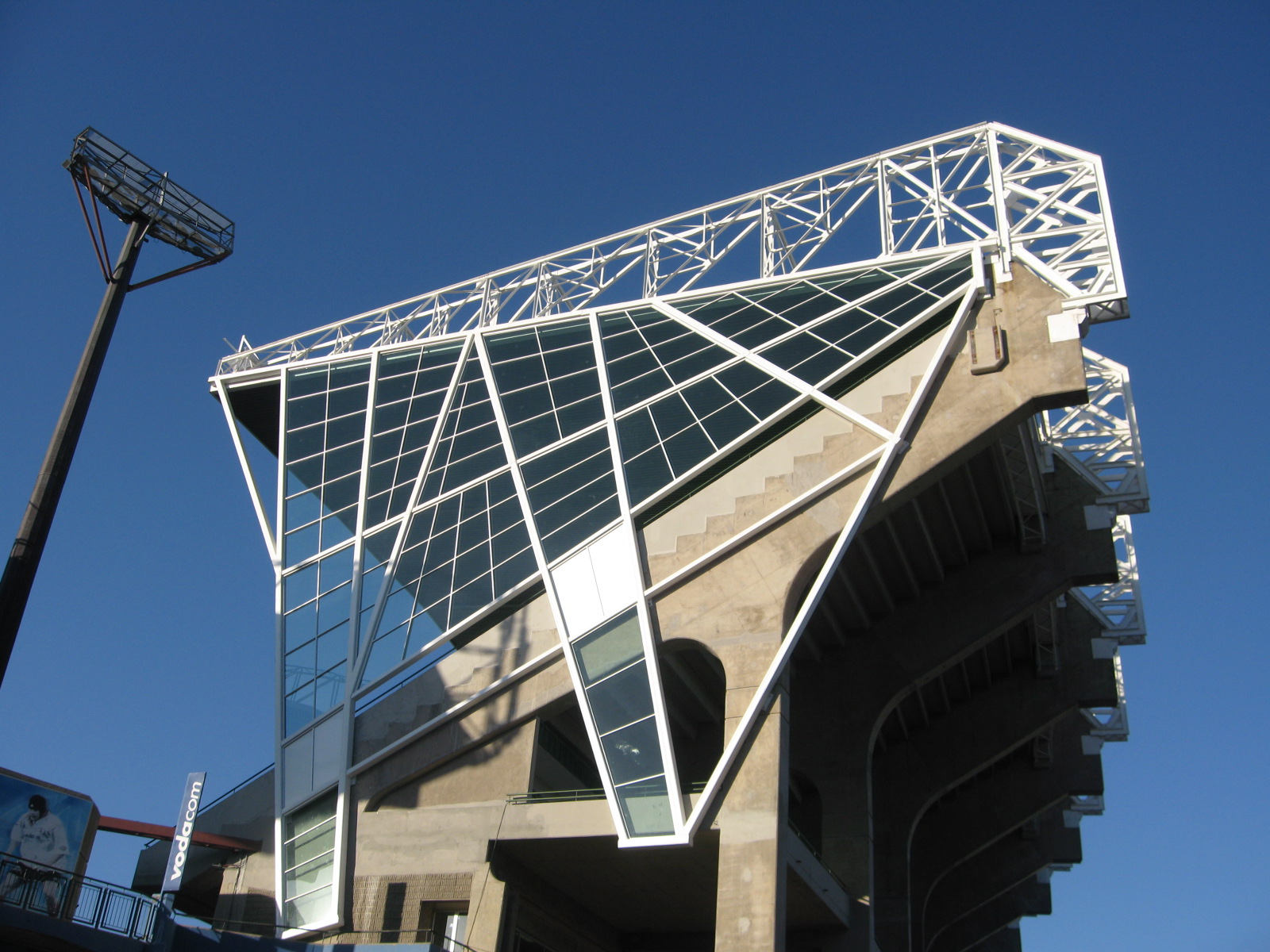
The 1995 Rugby World Cup final took place at Ellis Park Stadium in Johannesburg, located at approximately 26.20S, 28.06E. From the air, Ellis Park (now Emirates Airline Park) is visible in the Doornfontein neighborhood east of Johannesburg's CBD, identifiable by its rectangular pitch and surrounding stands. The broader tournament spanned nine venues across South Africa: Newlands in Cape Town, Boet Erasmus in Port Elizabeth, King's Park in Durban, Basil Kenyon in East London, Loftus Versfeld in Pretoria, Free State Stadium in Bloemfontein, Danie Craven in Stellenbosch, and Royal Bafokeng in Rustenburg. O.R. Tambo International Airport (FAOR) is the nearest major airport to Ellis Park, approximately 20 km to the east. Best viewed at 3,000-5,000 ft AGL to see the stadium in context with the Johannesburg skyline.