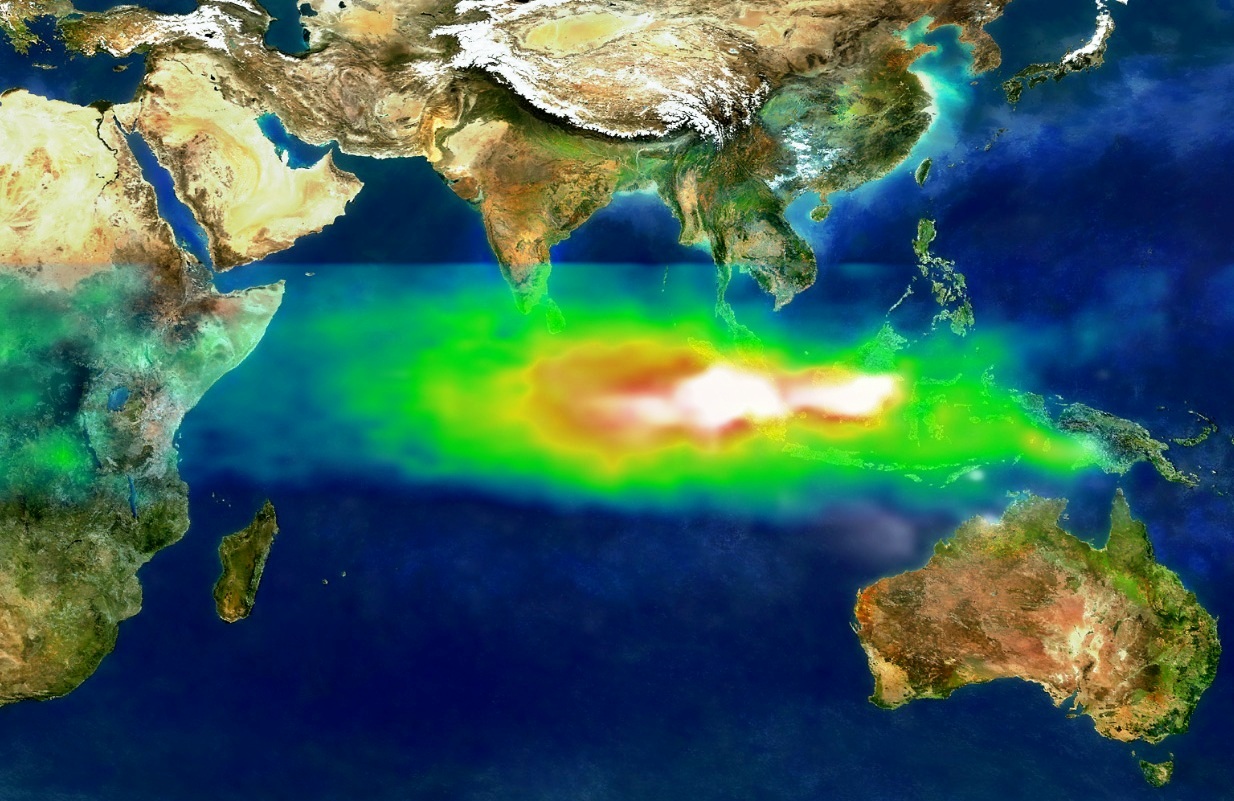
1997 Southeast Asian Haze
On September mornings in 1997, residents of Palembang, Jambi, and Pontianak woke to a sky the color of rust. Visibility dropped below 100 meters. Schools closed. Airports shut down. The air tasted of ash and carried a particulate load that hospitals across six countries would be measuring for months. What had started as seasonal agricultural burning in the forests and peatlands of Sumatra and Kalimantan had become the worst transboundary air pollution disaster Southeast Asia had ever seen -- a catastrophe whose economic toll would eventually reach an estimated US$9 billion.
Fire Season Without End
Slash-and-burn agriculture had long been the cheapest method for clearing land across Indonesia's outer islands. Smallholders used it to prepare fields for rice and rubber. Plantation companies used it on an industrial scale to convert forest to oil palm. In provinces where land titles were ambiguous or contested, fire served a cruder purpose: burn out the previous occupant, plant your crops, and claim the ground as yours. Every dry season brought smoke. But 1997 was not an ordinary dry season. The El Nino event of 1997-98, one of the strongest on record, suppressed the monsoon rains that normally arrived by September. Peat soils -- organic layers meters deep that normally stayed waterlogged -- dried out and became fuel. Once ignited, peat fires burned underground, smoldering for weeks and proving nearly impossible to extinguish. The fires spread across Kalimantan and Sumatra with a ferocity that overwhelmed firefighting capacity.
A Haze That Crossed Borders
By mid-September, NASA satellite imagery showed an unbroken haze layer stretching more than three million square kilometers. It blanketed Sumatra and Kalimantan, drifted north across Malaysia and Singapore, reached Brunei, Thailand, and the Philippines, and extended westward as far as Sri Lanka. In the worst-affected areas of Sumatra and Kalimantan, monthly mean visibility fell below one kilometer. Particulate matter concentrations soared past national air quality limits in every country the haze touched. Singapore reported a 30 percent increase in hospital visits for respiratory complaints -- asthma attacks, upper respiratory infections, eye and skin irritation. Children, the elderly, and anyone with pre-existing heart or lung conditions bore the heaviest burden. For millions of outdoor workers across the region, people who could not afford masks or air conditioning, there was no escape.
The Cost of Smoke
The economic damage rippled outward in concentric circles. Airports closed or diverted flights when visibility dropped too low for safe operations. Shipping slowed. Construction projects halted. Tourism collapsed across the region during what should have been peak season. A joint study by the Economy and Environment Program for Southeast Asia and the World Wide Fund for Nature estimated US$1 billion in haze-related damages for Indonesia alone, with Malaysia and Singapore absorbing another US$400 million. When fire damage to timber, agriculture, and infrastructure was added, the total reached US$4.5 billion -- and that figure could not account for the loss of biodiversity, the degradation of peat carbon stores, or the diminished quality of life across the region. The 1997 haze was not just an environmental crisis. It was an economic one, a public health emergency, and a diplomatic flashpoint that would shape regional environmental policy for decades.
Smoldering Legacy
The 1997 disaster did not end the burning. Southeast Asian haze events recurred in 2005, 2006, 2013, 2015, 2016, and 2019, each one driven by the same combination of agricultural clearing, weak enforcement, and dry weather. The 2015 event rivaled 1997 in severity. But the 1997 crisis was the inflection point -- the event that forced ASEAN member states to confront transboundary pollution as a shared problem rather than a domestic Indonesian matter. It led to the ASEAN Agreement on Transboundary Haze Pollution, signed in 2002, though Indonesia did not ratify it until 2014. The peatlands that burned in 1997 have not fully recovered. Drained peat continues to emit carbon dioxide, and fire remains the cheapest tool available to the farmers and companies clearing land across the archipelago. The rust-colored sky of September 1997 was not an anomaly. It was a warning.
From the Air
Centered near 3.00S, 105.00E over southern Sumatra. From cruising altitude, the haze-affected region spans most of Sumatra and Kalimantan (Indonesian Borneo). Nearest major airports include Sultan Mahmud Badaruddin II International Airport in Palembang (WIPP) and Sultan Thaha Airport in Jambi (WIPA). During haze events, visibility can drop below minimums across the entire region.