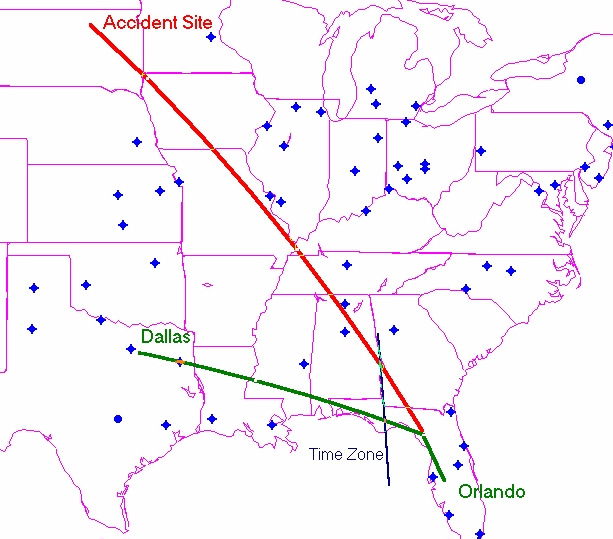
1999 South Dakota Learjet 35 Crash
Four months after sinking the putt that won him the 1999 U.S. Open at Pinehurst, Payne Stewart boarded a chartered Learjet 35 at Orlando International Airport on the morning of October 25, 1999. The plane was bound for Dallas, the first leg of a two-day, five-flight trip. It never arrived. Somewhere during the initial climb, the cabin lost pressure. Within minutes, everyone aboard - two pilots and four passengers - succumbed to hypoxia, their brains starved of oxygen. The autopilot, indifferent to the silence in the cockpit, kept the engines running and the wings level. The Learjet flew on, a ghost plane crossing the American heartland at 46,000 feet, while fighter jets scrambled from bases across the country to peer through its frosted windows at a cabin where no one would ever move again.
The Plane That Would Not Turn
The Learjet departed Orlando at 9:19 a.m. Eastern time, fueled for four hours and forty-five minutes of flight. Air traffic controllers expected the aircraft to climb to its assigned altitude and then turn west toward Dallas. It climbed - but the turn never came. Instead, the jet continued on its northwestern heading, passing over northern Florida, crossing into Alabama, Mississippi, and on into the heartland. Controllers tried repeatedly to raise the pilots on radio. Silence. The FAA scrambled military interceptors. First came F-16s from Tyndall Air Force Base in Florida, then fighters from Eglin. They pulled alongside the sleek white Learjet and reported what they saw: the cockpit windows were opaque with ice, and the control surfaces - ailerons and trim tabs - showed no sign of human input. The plane was flying itself.
A Nation Watches
For nearly four hours, cable news networks tracked the Learjet's path in real time, an eerie spectacle broadcast to millions. Fighter escorts rotated as the plane crossed state lines - Air National Guard F-16s from Oklahoma with the call sign TULSA 13, then jets from the 119th Wing of the North Dakota Air National Guard identified as NODAK 32. In Ottawa, Canadian Prime Minister Jean Chretien faced a grim decision: the plane's trajectory pointed toward Winnipeg. He authorized the Canadian military to shoot it down if it crossed the border without making contact. The order was never needed. Aboard the Learjet, the passengers included Stewart's agent Robert Fraley, a former Alabama Crimson Tide quarterback; Van Ardan, president of Leader Enterprises sports management agency; and Bruce Borland, a golf course architect with Jack Nicklaus's design company. All had been dead for hours.
The Silence on the Recorder
The cockpit voice recorder, an older model that captured only the final thirty minutes of audio, told the story of the end. At 12:10 p.m. Central time, the engines wound down - fuel exhausted after nearly four hours and forty-five minutes aloft. The autopilot tried to maintain altitude without thrust, bleeding airspeed until the stick shaker engaged, warning a pilot who could not respond. Then the autopilot disconnected. With no one at the controls and no fuel in the tanks, the Learjet entered an uncontrolled descent over the plains of South Dakota. It struck the earth in a field just outside the town of Mina in Edmunds County, roughly eight miles southwest of Aberdeen. The impact carved a crater in the flat prairie ground. The aircraft was destroyed.
What Went Wrong
The National Transportation Safety Board determined the probable cause was the incapacitation of the flight crew from hypoxia due to loss of cabin pressurization, for reasons that could not be determined. The crew of the Learjet 35, registration N47BA, operated by Sunjet Aviation of Sanford, Florida, never donned their supplemental oxygen. Whether the decompression was too rapid, too subtle, or whether the oxygen supply itself was compromised, investigators could not say with certainty. Hypoxia is insidious: at altitude, a person can lose consciousness in as little as fifteen seconds without supplemental oxygen, often feeling euphoric rather than alarmed. The Payne Stewart crash became a landmark case in aviation safety, reinforcing the critical importance of pressurization systems and rapid-donning oxygen masks for flight crews.
A Champion Remembered
Payne Stewart was 42 years old, known as much for his trademark plus-fours and tam-o'-shanter cap as for his three major championship victories. Just four months before the crash, he had captured the 1999 U.S. Open at Pinehurst No. 2, sinking a dramatic 15-foot par putt on the final hole to beat Phil Mickelson by a single stroke. In 2000, the PGA Tour established the Payne Stewart Award, given annually to a player who demonstrates respect for the traditions of the game. The crash site near Mina, South Dakota, sits on the open prairie - flat farmland stretching to every horizon, the kind of landscape a pilot might scan for an emergency landing if consciousness had held a few minutes longer. From the air, the field is indistinguishable from a thousand others. That anonymity is part of the story's power: a plane full of people, alive one moment and gone the next, carried by momentum across half a continent to a quiet patch of earth that had no reason to become famous.
From the Air
Crash site located at 45.42N, 98.75W, approximately 8 miles southwest of Aberdeen, South Dakota, near the town of Mina in Edmunds County. The terrain is flat agricultural prairie. Aberdeen Regional Airport (KABR) is the nearest facility. The crash site is on open farmland at approximately 1,300 feet MSL. From cruising altitude, the area is featureless plains - the same landscape the ghost plane crossed in its final minutes. Visibility typically excellent over the Great Plains except during winter blizzards.