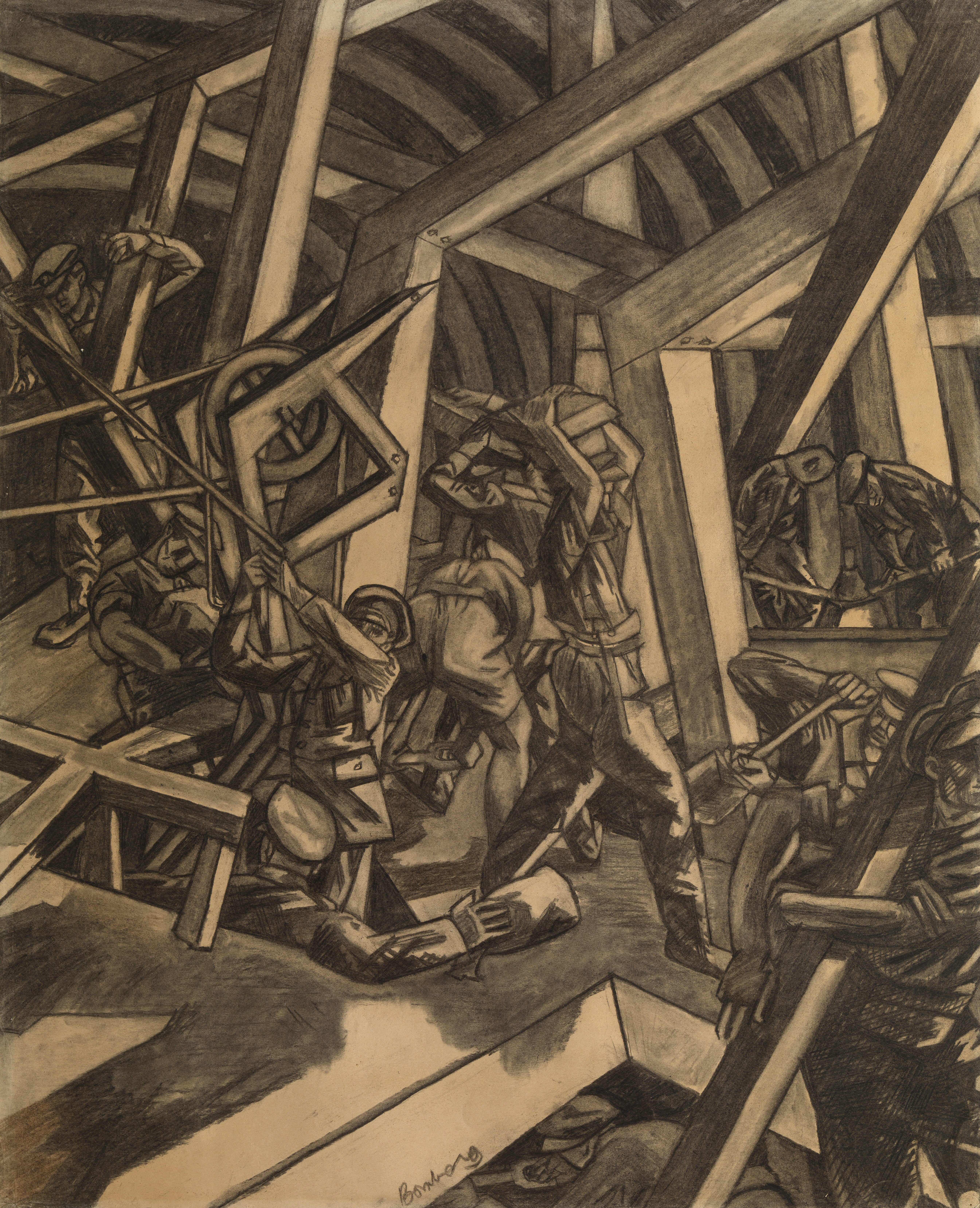
1st Canadian Tunnelling Company
David Bomberg's angular, fractured painting "Sappers at Work: A Canadian Tunnelling Company, Hill 60, St Eloi" captures something words struggle to convey: the claustrophobic geometry of warfare waged in the dark. The 1st Canadian Tunnelling Company spent years in that darkness, digging beneath the Western Front while German counter-miners listened for their picks. At St Eloi, they carved out the largest mine chamber of the Battle of Messines, a feat of engineering and endurance that would reshape the surface world above in a single catastrophic moment.
Into the Earth
By January 1915, the British Expeditionary Force recognized a grim truth: the Germans were mining systematically beneath their positions. Field Marshals French and Kitchener scrambled to respond, enlisting experienced coal miners who often fell outside normal recruitment standards. The 1st Canadian Tunnelling Company joined this subterranean army, one of three Canadian units contributed to the effort. These sappers dug offensive mines to destroy enemy positions, defensive counter-mines to intercept German tunnels, and the unglamorous but essential infrastructure of underground war: deep dugouts, signal chambers, cable trenches, and medical stations. The Ypres Salient became their proving ground, with constant underground fighting at places named Hill 60, Railway Wood, Sanctuary Wood, and St Eloi.
The Queen Victoria Shaft
The mine at St Eloi stands as the 1st Canadian Tunnelling Company's monument. Work began on August 16, 1915, with a shaft they named Queen Victoria, driving deep into the blue clay beneath Flanders. For ten months, Canadian miners extended a gallery reaching far beneath German lines. The chamber they carved sat at the end of a tunnel charged with ammonal explosive. It became the largest of all the mines prepared for the Battle of Messines. On June 7, 1917, after nearly two years of preparation, the mine detonated. The explosion ripped the ground from beneath the German positions, and the British 41st Division swept forward to capture the shattered defenses at St Eloi.
From Darkness to Daylight
The tunnelling companies did more than dig. In October 1918, with the war entering its final weeks, the 1st Canadian Tunnelling Company fought alongside the 4th Canadian Division in a mission far removed from their subterranean specialty. German forces were demolishing bridges across the Canal de L'Escaut northeast of Cambrai to slow the Allied advance. Captain Coulson Norman Mitchell led his men in operations to prevent these demolitions. On the nights of October 8-9, Mitchell's actions saved crucial bridges and earned him the Victoria Cross, adding to the Military Cross he had received the previous year. His medal now resides at the Canadian Military Engineers Museum at CFB Gagetown, New Brunswick.
A War Remembered Underground
The tunnelling war left few monuments above ground, its battlefields collapsed and flooded or simply forgotten beneath the reconstructed fields of Flanders. But the legacy endures. The British, Canadian, and Australian tunnelling companies transformed warfare, creating a new dimension of combat that demanded courage in conditions where panic meant death. The 1st Canadian Tunnelling Company embodied the grim determination required: years of work in darkness, the constant threat of counter-mining, the knowledge that a single mistake could bury an entire shift alive. When the mine at St Eloi erupted on that June morning in 1917, it announced that the war underground had been won by men who never saw the sun while fighting it.
From the Air
Located at 50.81N, 2.89E near the village of St Eloi (Sint-Elooi), south of Ypres in the Belgian province of West Flanders. The mine craters at St Eloi are visible from the air as water-filled depressions in the farmland. The Kemmelberg ridge rises to the southwest. Ypres (Ieper) with its rebuilt Cloth Hall lies approximately 3nm north. Kortrijk-Wevelgem Airport (EBKT) is approximately 15nm southeast. Best viewed at 2,000-3,000 feet AGL.