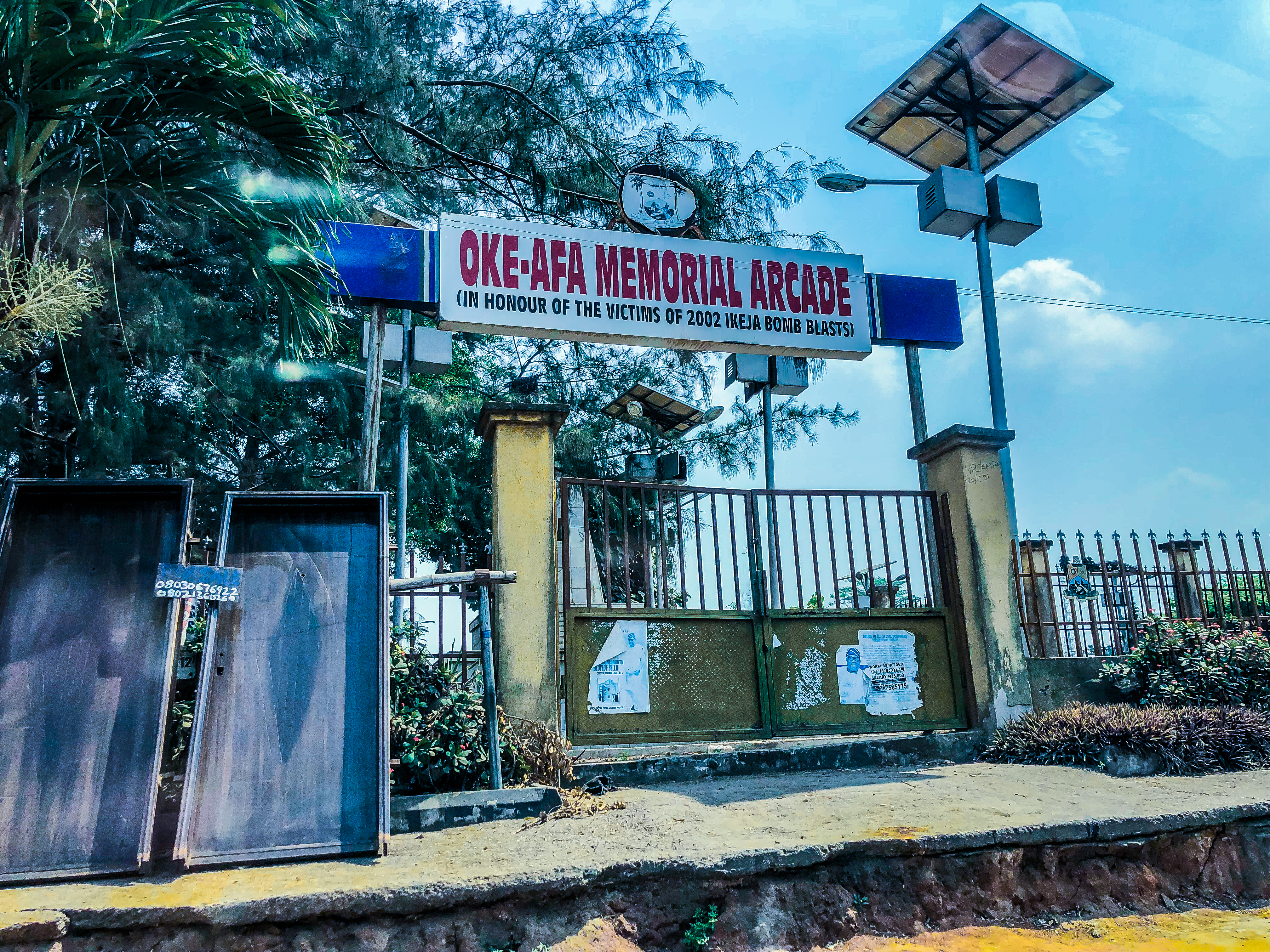
2002 Lagos Armoury Explosion
It started with a market fire. On the afternoon of January 27, 2002, flames broke out in a street market next to the Ikeja Cantonment, a sprawling Nigerian Army base in northern Lagos that doubled as a living area for soldiers' families. The fire was ordinary. What happened next was not. The flames reached a storage facility packed with high-caliber munitions that the army had been ordered to decommission the previous year but never did. The resulting detonation sent shells arcing across the city, igniting fires across entire neighborhoods and triggering a panicked flight that would prove more deadly than the explosion itself.
The Afternoon the Shells Fell
Ikeja Cantonment sat north of central Lagos, near the districts of Isolo and Onigbongo. When the munitions detonated, explosions tore through an area already crowded with people -- soldiers' families, market shoppers, residents of nearby neighborhoods. Shells tumbled from the sky, detonating on impact among fleeing crowds. A stampede developed as thousands of panicked people ran in every direction at once, trampling those who fell. Witnesses described people jumping from burning high-rise buildings and being killed trying to cross the busy Ikeja dual carriageway. The explosions did not stop. They continued to erupt from the wrecked armoury through the night and into the afternoon of January 28, a sustained barrage that made rescue operations nearly impossible and kept the fires burning across Lagos's northern suburbs.
The Canal
Running north to south through central Lagos, parallel to the Isolo-Oshodi expressway, there is a large open canal. It borders a banana plantation, and as fires and falling shells consumed the neighborhoods above, thousands of terrified residents fled toward the greenery, believing it might offer safety from the inferno. They did not see the canal until they were falling into it. In the darkness and chaos, people piled onto those who had fallen in before them. At least 600 people died in that canal, many of them children. Bodies drifted downstream for days afterward, some found as far as ten kilometers from the explosion site. The canal became the single deadliest feature of the disaster -- not because of the blast or the fire, but because of the geography of panic.
A City Overwhelmed
Lagos in 2002 was a megacity with emergency services scaled for a much smaller population. There were not enough fire crews or water points to fight blazes consuming entire districts. Hospitals were overwhelmed within hours; injured people waited without medical attention even if they managed to reach a facility that was still standing. Entire districts of northern Lagos were gutted. In addition to the estimated 1,100 dead, at least 5,000 people were injured and more than 12,000 were left homeless. Roughly 20,000 fled the city on the night of the explosion. Survivors drifted back over the following week to find their homes, businesses, and neighborhoods reduced to charred rubble. George Emdin, the base commander who had been absent during the explosion, issued a statement acknowledging the armoury was old, that improvements had been planned, and that the accident happened before those improvements could be made.
Accountability and Aftermath
The Nigerian government launched an inquiry that placed blame squarely on the Nigerian Army. The military had been instructed in 2001 to decommission the Ikeja Cantonment storage facility, but the order was never carried out. The munitions remained, aging and improperly stored, in the middle of a densely populated city. Relief agencies including the Red Cross and Red Crescent provided aid to thousands of displaced families in the weeks that followed, working to reunite at least 2,000 separated families. The recovery in Ikeja stretched on for years. Rebuilding was slow and expensive, and many survivors endured extended periods of homelessness and poverty, their livelihoods destroyed along with their homes. The disaster exposed how dangerously close military infrastructure sat to civilian populations in Lagos, and how poorly prepared one of Africa's largest cities was for a catastrophe of this magnitude.
From the Air
The Ikeja Cantonment site is located at approximately 6.45°N, 3.40°E, in northern Lagos, Nigeria, near the Ikeja district. From cruising altitude, the area is part of the dense urban sprawl of metropolitan Lagos. The Isolo-Oshodi expressway and the canal that figured in the disaster run roughly north-south through the area. Murtala Muhammed International Airport (DNMM) is located nearby in Ikeja, making this a heavily trafficked area for both road and air transport. Lagos weather is tropical and humid, with visibility often reduced by haze. The current landscape shows extensive rebuilding since the 2002 disaster.