2005 Glendale Train Crash
Juan Manuel Alvarez had slashed his wrists and stabbed himself in the chest. He parked his Jeep Cherokee on the railroad tracks near Chevy Chase Drive, somewhere in the industrial gray of Glendale, and waited for the 6:03 a.m. southbound Metrolink to finish what he couldn't. Then he changed his mind. He tried to drive off the tracks. The rain-soaked gravel and slick rails held his SUV in place like a trap. He ran. The train didn't stop.
A Chain Reaction at Dawn
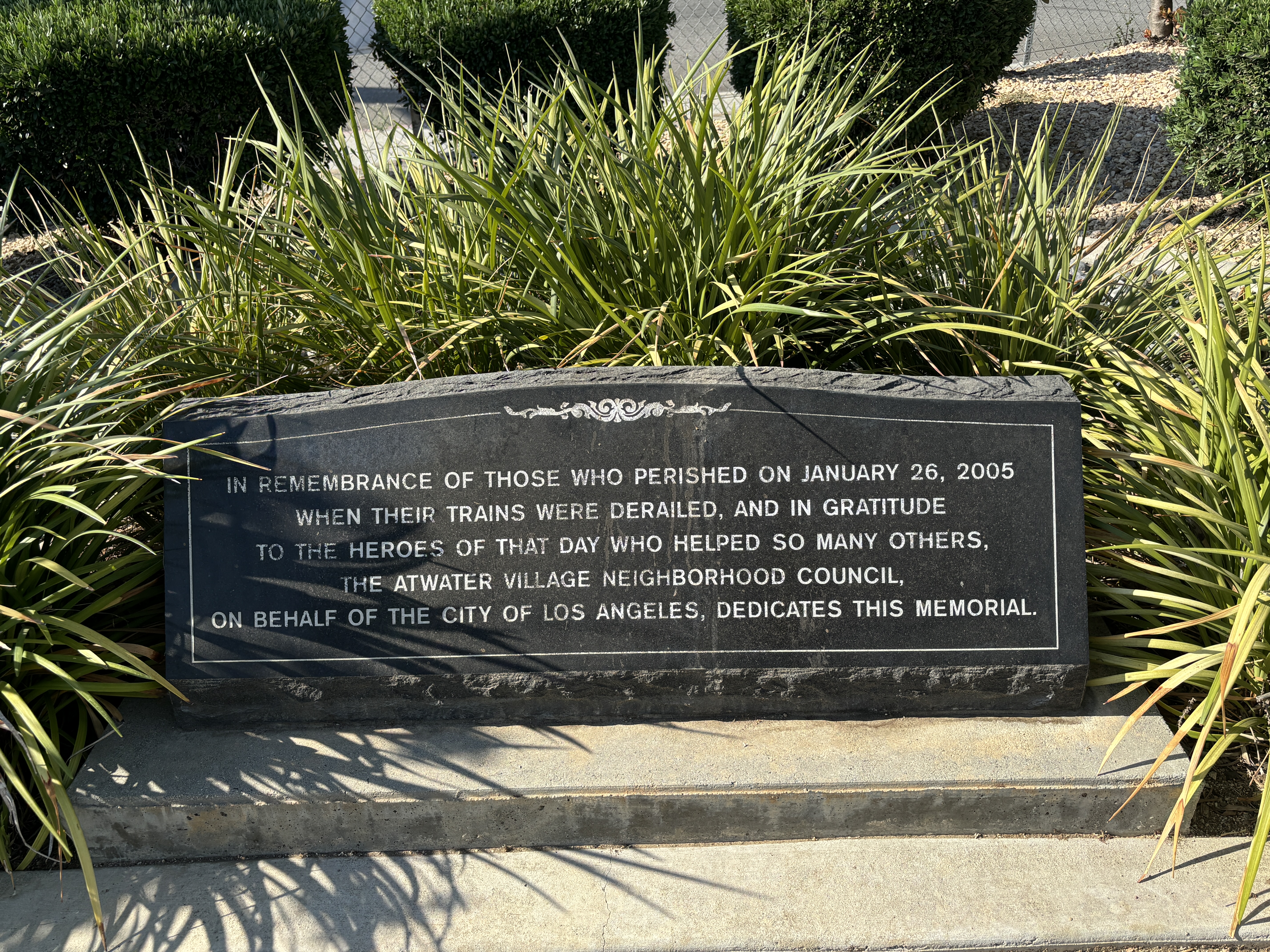
The southbound Ventura County Line train number 100 struck the Jeep at 6:03 a.m. on January 26, 2005, pushing it along the rails toward the Los Feliz Boulevard undercrossing. Automotive debris jammed into a track switch and lodged under the train's lead car, lifting it from the rails. The derailed cars jackknifed into a parked Union Pacific freight train on an adjacent track. They also sideswiped the rear of northbound Metrolink train 901, which was passing at that moment. At least one car rolled onto its side. Spilled diesel fuel ignited. The chain reaction killed eleven people and injured 177 more, making it one of the deadliest rail disasters in modern California history.
First Responders from Costco
The first people to reach the wreckage weren't professional rescuers. Employees at the adjacent Costco store heard the crash, called 911, and climbed the perimeter fence to help. They pulled survivors from twisted metal and used fire extinguishers on the flames until firefighters arrived. Eventually, 300 firefighters, helicopters, and cadaver dogs would converge on the site. But in those crucial first minutes, warehouse workers became heroes. Survivor John Phipps left his own mark on the disaster: a photograph in the Los Angeles Daily News captured his farewell to his family and high school sweetheart, written in his own blood on the interior of a passenger car.
An 1873 Law for Train Robbers
Prosecutors reached back into California's Old West history to charge Alvarez. A law from 1873, originally written to prosecute train robbers who blew up tracks, made train wrecking resulting in death a capital offense. The defense argued that Alvarez never intended to hurt anyone, that the crash was simply a suicide attempt gone wrong. But prosecutors pointed to evidence that he had doused his SUV with gasoline beforehand, suggesting he wanted to cause maximum destruction. The jury convicted him of eleven counts of murder but acquitted him of the train-wrecking charge. On August 20, 2008, he received eleven consecutive life sentences without parole.
The Push-Pull Question
The tragedy reignited debate about Metrolink's train configuration. Many commuter trains, including Metrolink's, operate in 'push-pull' mode: sometimes the locomotive leads, sometimes it pushes from behind while a lighter cab car leads. Critics argued that if the heavy locomotive had been at the front that morning, it might have plowed through the Jeep without derailing. Metrolink initially roped off the first cars of all trains, seating passengers only from the second car back. The controversy pushed the Southern California Regional Rail Authority to invest over 500 million dollars in safety improvements, including the nation's first positive train control system.
The Copycat
The day after the Glendale crash, police in Irvine, California, found another suicidal man who had parked his car on Metrolink tracks. When officers arrived, he drove away and was later arrested. The incident underscored a grim reality about rail suicides: they can inspire imitation. For the communities along the Ventura County Line, January 26, 2005, became a date marked by memorial services and safety reviews, by the memory of eleven lives lost because one man's desperation collided with a morning commute. Metrolink paid approximately 39 million dollars in settlements to victims and their families.
From the Air
Located at 34.13N, 118.263W in an industrial area of Glendale, just east of the Los Angeles city limits near the junction of the Ventura and Antelope Valley Metrolink lines. The crash site lies between Chevy Chase Drive and San Fernando Road, visible as rail infrastructure running parallel to the I-5 corridor. Bob Hope Airport (KBUR) is approximately 3nm northwest. From the air, the dense rail yard and adjacent Costco are identifiable landmarks.