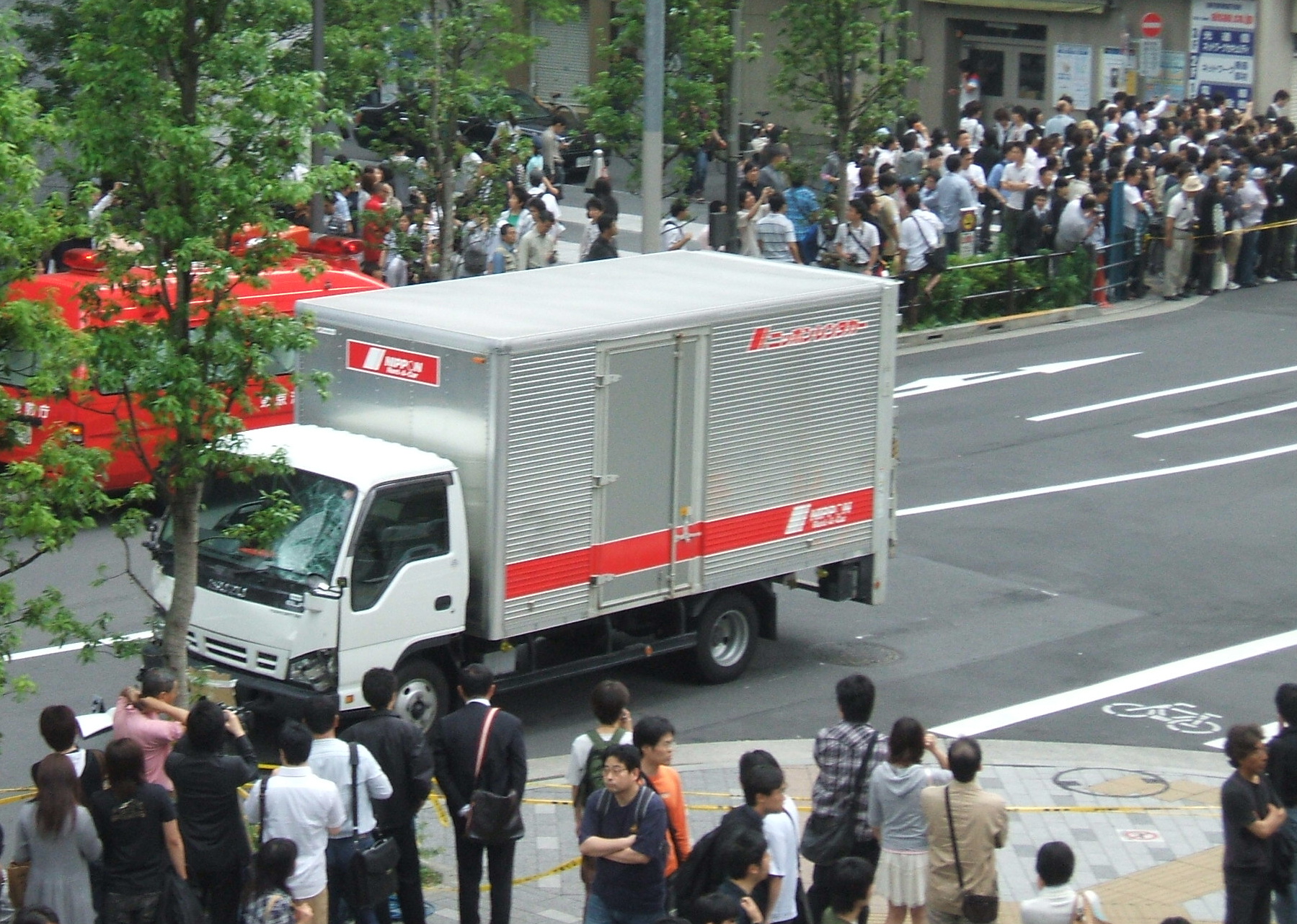
The 2008 Akihabara Massacre
Every Sunday and holiday afternoon for thirty-five years, Chūō-dōri -- the main avenue through Akihabara -- closed to cars and became a pedestrian paradise. Shoppers browsed electronics stalls, cosplayers posed for photos, and the otaku district hummed with its particular brand of cheerful commerce. On Sunday, June 8, 2008, at 12:33 in the afternoon, a rented five-ton truck ran a red light at the crossing of Kanda Myōjin-dōri and Chūō-dōri and plowed into the crowd. The driver climbed out and began stabbing people with a dagger. In two minutes, seven people were dead or dying, ten more were wounded, and the pedestrian tradition that had defined Akihabara for a generation was suspended indefinitely.
Two Minutes on Chūō-dōri
Tomohiro Katō, a twenty-five-year-old from Susono in Shizuoka Prefecture, drove the rented Isuzu Elf truck through a red light and struck five people on the pedestrian-filled avenue. When bystanders rushed to help the injured, Katō exited the truck and attacked with a dagger, stabbing at least twelve people as he moved through the crowd. Witnesses described him screaming as he struck. Police chased him into a narrow alley and cornered him within two minutes. An officer drew his weapon, and Katō dropped his knife and was taken down at 12:35, roughly fifty meters from the truck. Autopsies later determined that three victims died from being hit by the vehicle and four from stab wounds. The seven killed ranged in age from nineteen to seventy-four. Among them were two teenage friends, Kazunori Fujino and Takahiro Kamaguchi, both nineteen, and Mai Mutō, twenty-one, whose mobile phone records suggest she tried to call police even as she was attacked.
A Trail of Messages
In the hours before the attack, Katō posted a series of messages from his mobile phone to an online forum. A police official confirmed the first read simply: 'I will kill people in Akihabara.' Other messages revealed deep despair and isolation. He wrote of having no friends, of believing he would always be alone, of feeling 'lower than trash because at least the trash gets recycled.' Later messages laid out his plan: he would use the vehicle until it became inoperable, then continue on foot with a knife. He had waited specifically for Chūō-dōri to close to vehicular traffic at noon, ensuring the street would be packed with pedestrians. The day before, he had visited Akihabara to sell his personal computer and software to raise money to rent the truck. He purchased the weapons two days prior at a military supply shop in Fukui.
The Aftermath in a 'Safe' Society
The attack shook a nation that viewed public spaces as fundamentally safe. Prime Minister Yasuo Fukuda visited the site a week later to pray for the victims and expressed concern that 'similar cases occur about ten times a year in Japan.' The Tokyo Metropolitan Public Safety Commission immediately suspended Akihabara's thirty-five-year-old pedestrian zone tradition pending a safety review. The Japanese government announced it would revisit knife regulations. Katō's parents gave a televised apology. By 2010, his father had resigned from his job and was living in seclusion in Aomori, and his mother had been hospitalized for mental health reasons. In April 2014, Katō's twenty-eight-year-old brother took his own life, having told others he could not bear the shame. A makeshift memorial of flowers and offerings appeared at the attack site within hours and grew throughout the following days.
Trial, Sentence, and Execution
Katō was charged with murder and attempted murder. On March 24, 2011, the Tokyo District Court found him fully responsible for the attack and sentenced him to death. The Tokyo High Court upheld the sentence on appeal in September 2012. Katō expressed remorse, stating he 'would like to apologize to those who passed away, the injured, and their families,' though he also said he had 'no memory of some parts of the incident.' The Supreme Court of Japan finalized the death penalty on February 2, 2015. After seven years on death row, Katō was executed by hanging at the Tokyo Detention House on the morning of July 26, 2022. The case prompted broader conversations about social isolation, the pressures of Japan's employment system, and the phenomenon of hikikomori -- withdrawn individuals cut off from society. The pedestrian zone on Chūō-dōri was eventually restored, though the memory of that Sunday afternoon remains.
From the Air
Located at 35.700°N, 139.771°E in the Akihabara district of Chiyoda ward, central Tokyo. From the air, Akihabara is identifiable as a dense commercial district north of Tokyo Station, characterized by the wide north-south avenue of Chūō-dōri and its intersection with the east-west Kanda Myōjin-dōri. The elevated JR Yamanote Line and Sobu Line tracks run through the area. Best viewed at 2,000-3,000 feet AGL. Tokyo Haneda Airport (RJTT) lies approximately 10 nautical miles to the south. Narita International Airport (RJAA) is approximately 35 nautical miles to the east.