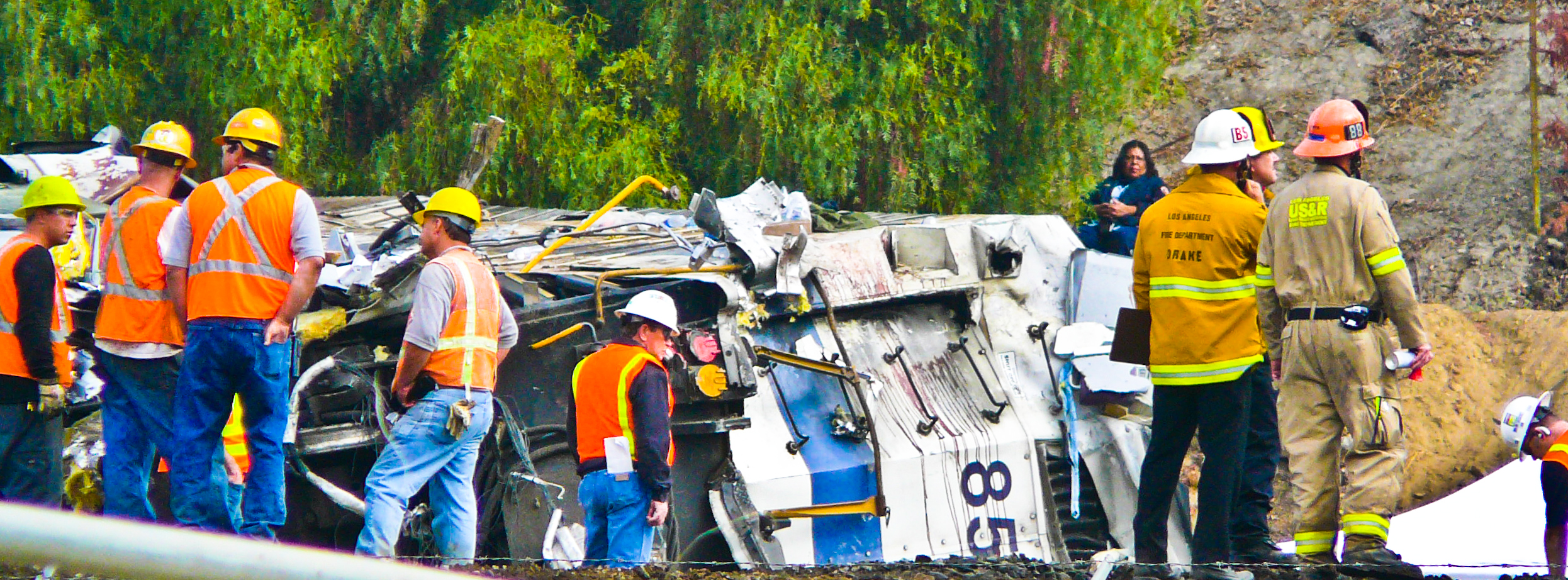
2008 Chatsworth Train Collision
At 4:22 in the afternoon on September 12, 2008, a Metrolink commuter train heading into Los Angeles met a Union Pacific freight train head-on in the hills near Chatsworth, in the northwestern corner of the San Fernando Valley. Twenty-five people died. More than a hundred were injured. The collision became the worst rail disaster in the United States since 1993, and the investigation that followed it changed American law.
The Last Text Message
The National Transportation Safety Board determined the cause with uncomfortable precision. Robert M. Sanchez, the 57-year-old Metrolink engineer operating Train 111, had been exchanging text messages with a 16-year-old railfan during his shift. The final message was sent 22 seconds before impact. Sanchez ran through a red signal without slowing, placing his train directly in the path of the oncoming freight locomotive.
Sanchez died in the collision, so he could not testify to what he had been thinking in those final seconds. The investigation found 57 text messages sent or received during his shift that day. The phone record documented a catastrophic failure of attention — not a mechanical failure, not a system failure, but a human being who was not watching the signals he was paid to watch. He had violated Metrolink rules prohibiting the use of personal devices while operating trains.
Twenty-Five People
The Metrolink train was carrying commuters home from downtown Los Angeles to Ventura County and the western San Fernando Valley. The collision happened at approximately 40 miles per hour, with both trains moving toward each other. The Metrolink cars were designed with crash energy management systems, but the forces involved exceeded what any passenger rail car is engineered to absorb cleanly. The forward cars of the commuter train were crushed.
Those who died were ordinary people making an ordinary trip home from work — teachers, retirees, office workers. The injured included many who were trapped in the wreckage for hours while rescue crews worked to extract them. The community that formed around the survivors and the families of those killed became one of the primary forces driving the legislative response to the disaster.
Law Made from Catastrophe
The NTSB report was direct about what needed to change. The investigators recommended mandatory implementation of Positive Train Control — an automated system that monitors train speed and location and can stop a train automatically if it runs a red signal or exceeds safe speed limits. PTC had been technically feasible for years but had not been required because implementation was expensive and the railroad industry had successfully argued against mandates.
Congress responded within weeks. The Rail Safety Improvement Act of 2008, signed into law in October, mandated PTC implementation across the nation's commuter and freight rail networks by 2015 — a deadline that proved optimistic but that established the legal requirement. California separately banned texting while driving within a week of the Chatsworth collision, making the state one of the first to enact explicit prohibitions. The legal landscape of rail safety and distracted driving was measurably different after September 12, 2008, than it had been before.
The Question of Compensation
Metrolink's liability was capped at $200 million under federal law — the Amtrak Reform and Accountability Act of 1997, which set the cap for rail accidents. For twenty-five families, and for survivors dealing with catastrophic injuries, that cap meant that the available compensation was divided among claims that would have justified far more. The gap between what victims deserved and what the law allowed them to receive became its own controversy, one that extended the collision's political and legal legacy well beyond the immediate investigation.
The Chatsworth collision is remembered now primarily through the legal changes it precipitated. The physical site in the hills above the San Fernando Valley has long since been cleared and repaired. Trains run through it again. But the requirement for Positive Train Control — the automated system that monitors engineer attention in real time — runs through every commuter rail network in the country, a direct consequence of twenty-two seconds of inattention on a September afternoon.
From the Air
The Chatsworth collision site lies in the hills northwest of the San Fernando Valley at approximately 34.2719 N, 118.601 W, near the Chatsworth community of Los Angeles. The Simi Hills rise to the north and west. Van Nuys Airport (KVNY) lies approximately 9 miles to the southeast. The Southern Pacific / Metrolink rail corridor that runs through this area is visible from the air as a single-track line threading through a narrow canyon before opening into the valley.