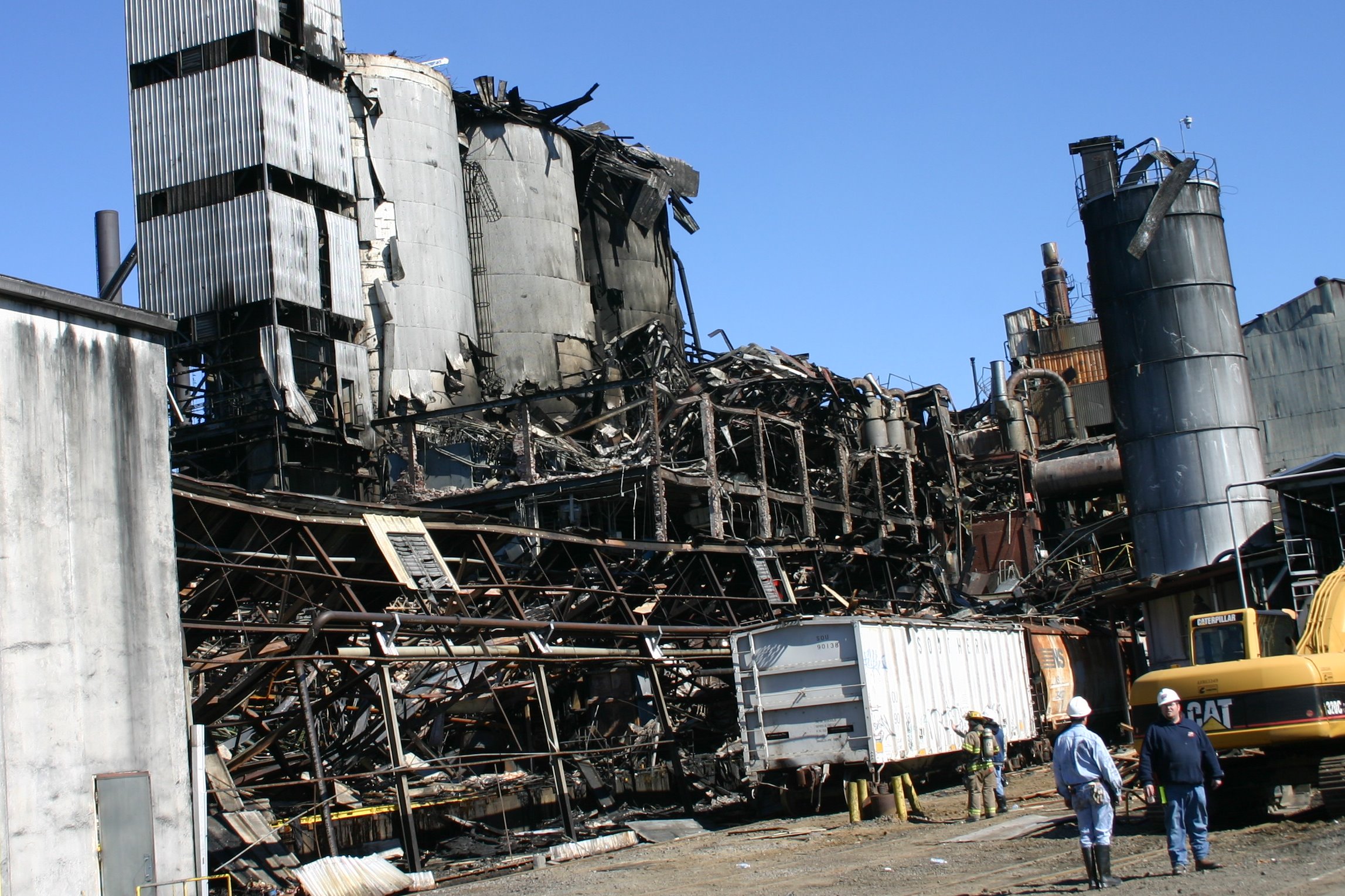
The Sugar Turned to Fire: The Imperial Sugar Refinery Explosion of 2008
Sugar is one of the most common substances on Earth. It sweetens coffee, fills birthday cakes, and lines grocery store shelves by the ton. It is also, in its powdered form, an explosive. On the evening of February 7, 2008, in a refinery that had been processing sugar since 1917, the ordinary became catastrophic. Accumulated sugar dust in a basement beneath the storage silos at Imperial Sugar's Port Wentworth plant ignited, and the initial blast sent shock waves rippling through the building that launched more dust into the air, triggering a chain of secondary explosions that ripped through the six-to-eight-story structures of the refinery complex. One hundred and twelve employees were on site. Fourteen would die. Thirty-six more suffered burns so severe that doctors placed many in medically induced comas.
A Factory from Another Era
The Port Wentworth refinery was built in 1916 by 400 workers relocated from Louisiana specifically for the job. It opened the following year and operated continuously for more than nine decades. Imperial Sugar had acquired the facility along with Savannah Foods, folding it into a national distribution network supplying Piggly Wiggly, General Mills, and Walmart. Workers described the factory as antiquated, with much of the machinery dating back more than twenty-eight years. The site persisted because of its excellent access to rail lines and the Savannah River shipping corridor. The refinery's buildings were tightly packed -- six to eight stories tall with narrow gaps between them -- and connected by a maze of elevators, conveyor belts, hallways, and tunnels. It was a layout designed for efficiency, not escape. Imperial Sugar had never practiced evacuation procedures at the facility, and there was no emergency lighting. When the lights went out on February 7, workers found themselves trapped in pitch-black corridors filling with smoke and flame.
The Evening of February 7
The explosion originated in the center of the refinery, in a basement beneath the sugar storage silos where bagging and packaging operations were fed by the network of elevators and conveyors. Poor housekeeping had allowed large accumulations of sugar dust to build up throughout the facility. The initial blast launched that dust into the air, and within seconds, a series of massive secondary explosions engulfed the complex. The Georgia Emergency Management Agency alerted local hospitals to prepare for up to 100 casualties. At Memorial Health Hospital, a doctor described patients arriving at the emergency triage with injuries ranging from minor hand burns to 80-90 percent burns over their bodies. One patient arrived with 95 percent burns. The victims ranged in age from 18 to 50. Off-duty employees were called in to assist with search and rescue because emergency services personnel were unfamiliar with the plant's labyrinthine layout. By the end of the night, six people were still missing. No deaths had been officially confirmed, but the worst was yet to come.
Entirely Preventable
The U.S. Chemical Safety Board released its investigation report in September 2009, delivering a verdict that carried the full weight of institutional failure: the explosion had been "entirely preventable." The CSB noted that the sugar industry had been aware of dust explosion risks since 1926 -- more than eighty years before Port Wentworth. Internal company memorandums from 1967 had explicitly flagged the danger of sugar dust accumulation. Yet Imperial Sugar had made construction changes that actually increased dust buildup. The company had no evacuation drills. The emergency lighting that might have saved lives in those dark tunnels did not exist. OSHA cited Imperial with 124 safety violations, finding that the company acted with "plain indifference to, or intentional disregard for, employee safety and health." The Department of Labor pushed for criminal prosecution, but U.S. Attorney Ed Tarver declined, citing insufficient evidence of intentional disregard and a lack of federal criminal laws specifically governing safety in the sugar industry. Malcolm Frazier, burned over 85 percent of his body, survived six months in the Joseph M. Still Burn Center before succumbing to his injuries in August 2008, becoming the fourteenth fatality.
Legacy in the Dust
Port Wentworth's economy suffered badly with the refinery's closure. Imperial had intended to rebuild and resume production by the end of 2008, with replacement buildings completed by summer 2009. The sugar silos were demolished on June 24, 2008, with a wrecking ball. During demolition, crews recovered tons of fire-hardened sugar from inside the silos, which the company hoped to recycle for ethanol production. Victims and their families filed up to 44 lawsuits against Imperial and its contractors. The Combustible Dust Explosion and Fire Prevention Act of 2008 passed the House of Representatives but died in the Senate. OSHA began developing a federal standard for combustible dust in 2009. On February 7, 2009 -- exactly one year after the explosion -- a monument was dedicated at Legacy Park on the grounds of the Port Wentworth plant, honoring the fourteen people who went to work at a sugar refinery and never came home. The CSB's investigation had found 281 combustible dust explosions in the United States between 1980 and 2005, killing 119 people and injuring 718. Port Wentworth was not the first. The question the monument silently asks is whether it will be the last.
From the Air
Located at 32.14N, 81.14W in Port Wentworth, Georgia, on the Savannah River northwest of downtown Savannah. The refinery site sits along the river's industrial corridor, adjacent to rail lines and shipping infrastructure. Savannah/Hilton Head International Airport (KSAV) is approximately 5 miles to the southwest. Hunter Army Airfield (KSVN) lies about 7 miles to the southeast. The industrial zone along the Savannah River is clearly visible from altitude, with the Port Wentworth area distinguishable by its cluster of industrial facilities, rail yards, and river access points. Best viewed at 2,000-3,000 feet AGL. The contrast between the industrial riverfront and the residential areas of Port Wentworth is stark from the air.