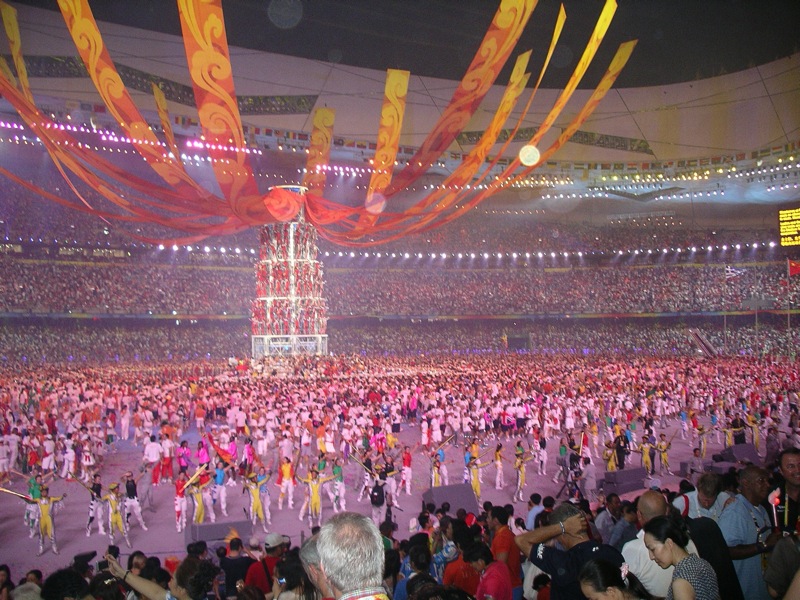
2008 Summer Olympics Closing Ceremony
If the opening ceremony had been a meditation on five thousand years of Chinese civilization, the closing was the party afterward. On the evening of August 24, 2008, the Beijing National Stadium -- the Bird's Nest -- filled with athletes, performers, and 91,000 spectators for a ceremony that Western media described as 'much more lighthearted,' 'silly,' and 'fun' than its predecessor. The number eight, associated with prosperity in Chinese culture, had governed the timing of the opening. The closing let the symbolism relax.
The Music of Farewell
The ceremony assembled an eclectic roster of performers. Placido Domingo and Song Zuying sang 'The Flame of Love,' a piece composed for the occasion. Wei Wei and Sun Nan performed 'Beijing Beijing.' From the Hong Kong and Taiwanese pop world came Andy Lau, Jackie Chan, Karen Mok, Kelly Chen, Joey Yung, and Nicolas Tse. Wang Lee Hom, Stefanie Sun, and the Korean-American pop star Rain represented a broader Asian presence. Han Hong performed, and German composer Klaus Badelt wrote the ceremony's score. The musical diversity was deliberate, reflecting the Olympics' role as a meeting point for cultures -- and China's desire to position Beijing as a world city, not merely a national capital.
London Calling
The ceremony's pivotal moment was the handover of the Olympic Games from Beijing to London. Guo Jinlong, the Mayor of Beijing, passed the Olympic flag to Boris Johnson, then Mayor of London, in the ritual transfer of the hosting privilege. The London Organising Committee staged a performance previewing the 2012 Games, featuring Leona Lewis and Led Zeppelin guitarist Jimmy Page, with David Beckham making a cameo appearance. Violinist Elspeth Hanson and cellist Kwesi Edman accompanied the performance. The contrast between Beijing's meticulously choreographed spectacle and London's looser, pop-culture-inflected preview became a talking point: two approaches to the Olympic stage, two conceptions of national identity.
Inside the Bird's Nest
Zhang Yimou, the filmmaker whose international reputation rests partly on work that was banned in his own country, directed both the opening and closing ceremonies. The Bird's Nest itself was an architectural statement -- designed by Swiss architects Herzog and de Meuron with Chinese artist Ai Weiwei as artistic consultant, its latticed steel structure had become the defining image of the Beijing Games. Inside it that evening, the ceremony moved through performances that celebrated both Chinese and international culture. The tone was celebratory and occasionally playful, a marked departure from the opening's emphasis on historical grandeur and national narrative.
Sixteen Days, One Billion Viewers
By the end of NBC's coverage, the Beijing Olympics had drawn the largest cumulative television audience in American broadcasting history up to that point. The closing ceremony capped 16 days that had placed China at the center of global attention in a way the country had never experienced before. The Games had been politically controversial -- concerns about human rights, Tibet, and pollution had shadowed the preparations -- but the ceremonies, particularly the opening, had demonstrated a capacity for spectacle that reshaped international perceptions. The Olympic flame was extinguished in the Bird's Nest that night, ending Beijing's moment on the world stage but not the questions about what the Games had meant, for China and for everyone watching.
From the Air
Located at 39.99N, 116.39E at the Beijing National Stadium (Bird's Nest) in the Olympic Green, northern Beijing. The stadium's distinctive latticed structure is visible from altitude. Nearest airports are Beijing Daxing International (ZBAD) and Beijing Capital International (ZBAA).