2009 Attack on the Dutch Royal Family
It was supposed to be the warmest day of the year - Koninginnedag, Queen's Day, when the Dutch wear orange and the royal family walks among them. On 30 April 2009, in Apeldoorn, the open-top bus carrying Queen Beatrix, Crown Prince Willem-Alexander, and Princess Maxima rolled past streets lined with families. Children waved small flags. Then a black Suzuki Swift came down the Jachtlaan at high speed. It went through the crowd. The car missed the royal bus, struck a stone monument, and stopped. Eight people were dead or dying. The cameras, broadcasting live, caught the royal family standing up to look. Hands flew to mouths. The country watched the worst day of its modern peacetime history in real time.
The People Who Died
They were spectators. They had come to see a parade. Seven people on the street died from their injuries in the hours and days that followed - among them a marechaussee officer, parents, grandparents, neighbors who had crossed the road to get a better view. An eighth victim, a 46-year-old woman, fought for over a week in critical condition before dying on 8 May. None of them had any connection to the royal family beyond their interest in seeing the parade go by. The driver who killed them, Karst Tates, also died - of brain injuries the day after the attack, on 1 May 2009. He was 38. He became the seventh to die; the 46-year-old woman who passed on 8 May was the eighth. The families of those he ran down have never accepted being counted in the same total as their attacker.
A Driver No One Saw Coming
Karst Tates had no criminal record. He had no history of mental health treatment. He had called his mother the day before the attack to wish her happy birthday, and told her he was looking forward to her party on 3 May. He had recently found work after a stretch of financial difficulty. His parents described him as kind and attentive. The official investigation concluded the attack was premeditated but poorly prepared: he had scouted the parade route earlier, but on the day, when crowds stood in an area he had expected to be cordoned off, he made no effort to swerve around them. Police interviewed him as he lay dying in his car. He told them, plainly, that he had meant to hit the royal family. The public prosecutor concluded his motive would never be fully understood. There was no manifesto. There was no group. There was, in the end, only a man and a car and eight families who would spend the rest of their lives without someone.
How the Country Responded
Queen Beatrix spoke to the nation in a video address that afternoon, visibly shaken. She had been queen for nearly thirty years; this was the first attack on the Dutch royal family in modern memory. Without any official instruction, Dutch people across the country began lowering their flags to half-mast - a quiet, simultaneous gesture from a nation that had been celebrating an hour earlier. Prime Minister Jan Peter Balkenende later made it official for government buildings. The royal family continued the Queen's Day tradition of mingling with citizens in subsequent years, refusing to let the attack take it from them. But something had shifted. Police protection at royal events changed. The casual openness of Dutch monarchy - one of its defining qualities - had to be reconsidered.
The Memorial in Apeldoorn
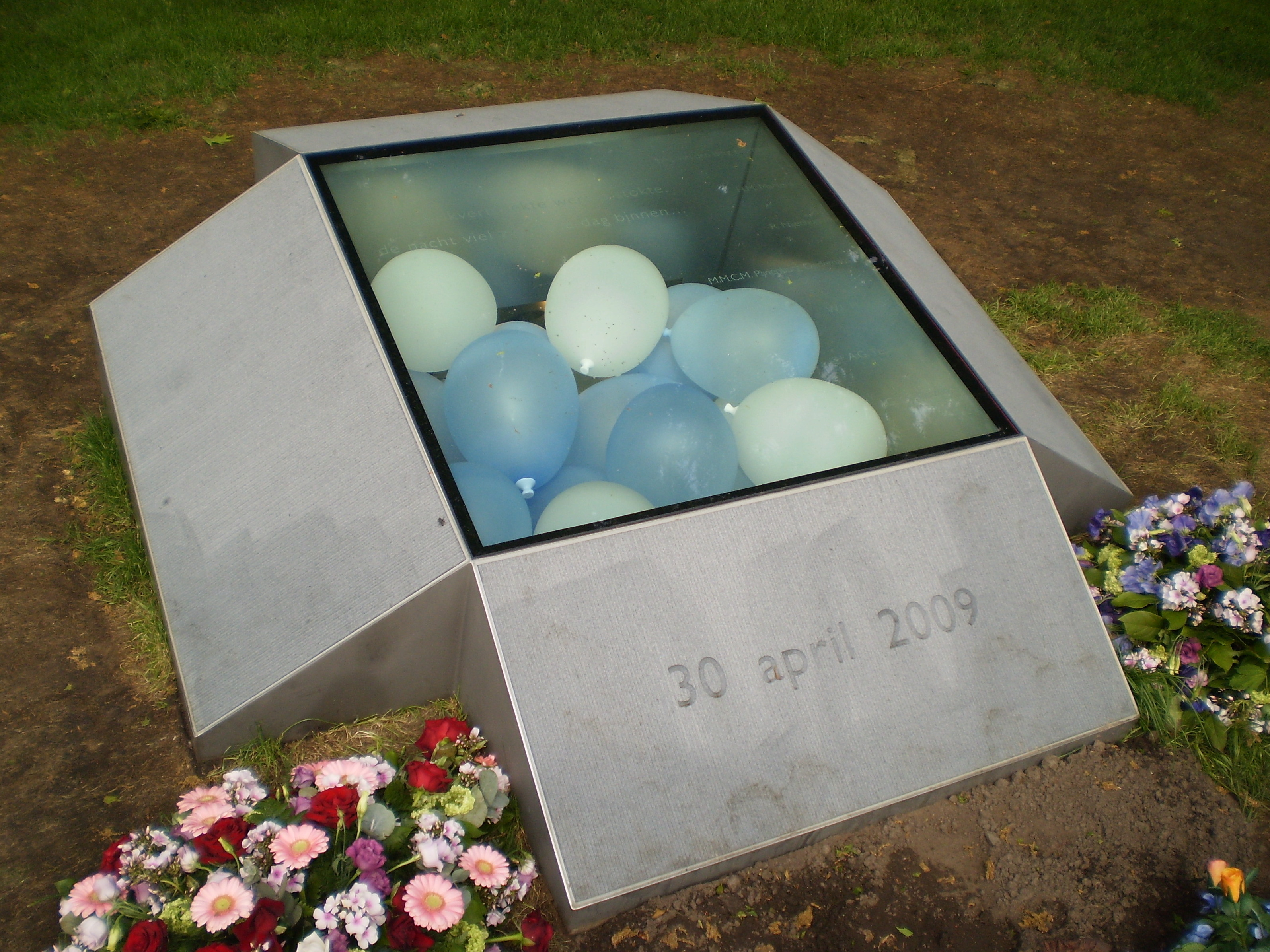
On 8 May, eight days after the attack, a memorial service was held at the Orpheus theater in Apeldoorn. Twelve hundred people sat inside. Five thousand watched on screens set up in the central market square. Millions more watched on live television. The Queen attended, along with Princess Maxima, Princess Margriet, and Pieter van Vollenhoven. Prime Minister Balkenende spoke. The mayor of Apeldoorn, Fred de Graaf, spoke. Hours after the service ended, the news came that an eighth person had died. The town that hosts the royal palace at Het Loo, that builds its identity around the House of Orange, had become the site of an attack on that very family. A memorial - a sculpture of white balloons among blue, representing vulnerability, festivity, and mourning - now stands where the car came to rest.
What Remains
The Jachtlaan in Apeldoorn is an ordinary suburban street, lined with trees that arch overhead in summer. There is a memorial. There are flowers, sometimes. The names of the dead are not famous; they were people you might have stood next to on a tram, neighbors of someone's grandmother, the woman who ran a small shop. The Dutch monarchy went on. Beatrix abdicated in 2013 and Willem-Alexander became king. Queen's Day became King's Day, moved to 27 April. But for eight families in and around Apeldoorn, the date 30 April 2009 still divides everything - before, and after.
From the Air
The site of the attack is on the Jachtlaan in Apeldoorn, at approximately 52.23 deg N, 5.95 deg E, on the western edge of the city near Park Berg en Bos. The Orpheus theater where the memorial was held sits in the city center. Apeldoorn is in Gelderland province, Netherlands. Teuge Airport (EHTE) is 3.5 nautical miles northeast. Schiphol (EHAM) is approximately 80 km west. From the air, look for Het Loo Palace's formal gardens on the city's northwestern edge - the royal residence the parade route was approaching.