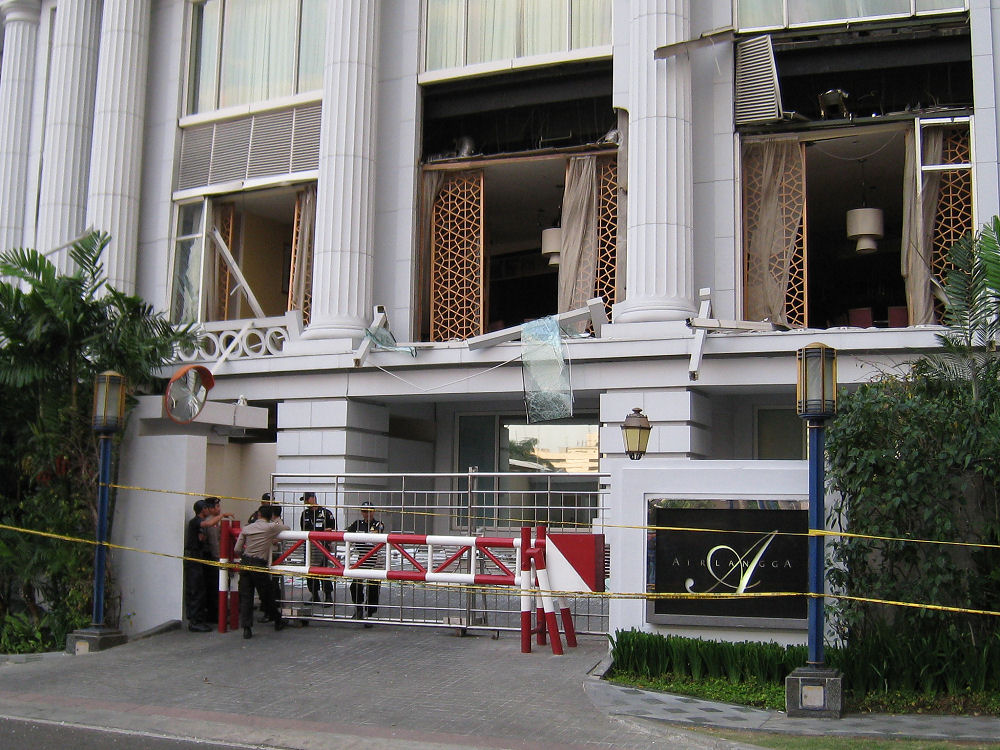
2009 Jakarta Bombings
The florist knew both hotels well. Ibrohim had worked for a company with shops inside the JW Marriott and the Ritz-Carlton, arranging flowers in lobbies where foreign executives took breakfast meetings and deals were sealed over coffee. By the time he drove a rented pickup truck to the Marriott's loading dock on July 16, 2009, he was no longer arranging bouquets. He was delivering bombs. The next morning, at 7:47 a.m. Jakarta time, the first device detonated in a small breakfast room inside the Marriott. Five minutes later, the second exploded in the Ritz-Carlton's Airlangga Restaurant on the second floor. Nine people died across both hotels, and the four-year lull in major terrorist violence that Indonesia had enjoyed since the 2005 Bali bombings was over.
The People in the Blast Radius
The dead were international in a way that reflected the hotels' clientele. Craig Senger, an Australian trade official with Austrade, was killed at the Marriott. So were Garth McEvoy, an Australian mining executive, and Nathan Verity, a Perth businessman. Tim Mackay, a New Zealander who served as president of PT Holcim Indonesia and held qualifications as a master mariner, died in the same attack. Two Dutch nationals were among the dead. The Indonesian victim was Evert Mokodompis, a waiter at the JW Marriott who was working his shift when the bomb went off. Sixteen foreigners were hospitalized, including a Canadian, an Indian, and three more Dutch men. These were not soldiers or officials in a war zone -- they were people eating breakfast, serving food, conducting business in what they believed to be one of the safest environments Jakarta could offer.
Recruited Through Family
The investigation revealed a conspiracy that had been germinating for nearly a decade. Ibrohim, the florist-turned-operative, had been recruited in 2000 by his brother-in-law, Saifudin Jaelani, while working at the Hotel Mulia in Jakarta. By 2005, both men had been inducted into the inner circle of Noordin Mohammad Top, a Malaysian bomb maker who had been involved in nearly every major terrorist attack in Indonesia since the 2002 Bali bombings. Planning for the hotel strikes began with a meeting on April 30, 2009. Ibrohim conducted surveillance of both locations, leveraging his knowledge of their layouts and routines. His brother-in-law recruited the two young men who would carry the bombs on their bodies. The suicide bomber at the Marriott was Dani Dwi Permana, an 18-year-old recent high school graduate from Bogor, West Java. The Ritz-Carlton bomber was Nana Ikhwan Maulana, 28, from Pandeglang, Banten. Dani had checked into room 1808 at the Marriott days before the attack, the room paid for by another conspirator, Amir Abdillah.
A Web That Kept Unraveling
Police found an unexploded bomb in room 1808 -- its design and materials identical to those used by Jemaah Islamiyah in previous attacks, confirming the network behind the operation. Abdillah was arrested on August 5. Two days later, officers raided a house in Temanggung, Central Java, arresting three suspects and killing Ibrohim in the operation. The following day brought an even more alarming discovery: a raid in Bekasi, West Java, killed two men believed to be assembling a truck bomb intended for Indonesian President Susilo Bambang Yudhoyono near his private residence in Bogor. The plot against the president had been running parallel to the hotel bombings, suggesting an ambition far larger than two breakfast-room explosions. Funding, investigators determined, had flowed from the Middle East, and among those arrested for handling the money was a Saudi Arabian national.
Aftermath and an Old Connection
The JW Marriott had been bombed before. In August 2003, a suicide attack at the same hotel had killed twelve people. That the Marriott was struck again, six years later, underscored a grim reality about soft targets: even with upgraded security, familiarity with a building's rhythms could defeat its defenses. President Barack Obama, who had spent part of his childhood in Jakarta, condemned the attacks and offered American assistance. Manchester United, which had booked rooms at the Ritz-Carlton for an exhibition match scheduled three days later, canceled the Jakarta leg of its tour. The hotels closed for two weeks. When the JW Marriott and Ritz-Carlton reopened on August 3, 2009, the 17th U.S. Ambassador to Indonesia, Cameron R. Hume, attended the ceremony -- a diplomatic gesture aimed at signaling that normalcy could be restored. For the families of Evert Mokodompis, Craig Senger, Tim Mackay, and the others, no reopening ceremony could accomplish that.
The Longer Shadow
The 2009 bombings were part of a pattern that had begun with the 2002 Bali attacks, which killed 202 people and forced Indonesia to confront the presence of Jemaah Islamiyah within its borders. An anti-terrorism law passed in 2003 gave authorities broader powers, and the crackdown that followed had produced years of relative quiet. The hotel bombings proved that quiet was not the same as safety. Noordin Mohammad Top, the mastermind, was killed by Indonesian police in a September 2009 raid -- two months after the attacks he had orchestrated. His death removed one of Southeast Asia's most dangerous operatives, but the network he had built continued to mutate. The men he had recruited through family ties and religious study circles would reappear in new cells, under new affiliations, in the years that followed. Jakarta's luxury hotels reinforced their security, adding vehicle barriers and screening checkpoints that remain visible today. The Mega Kuningan district, where the Marriott and Ritz-Carlton stand amid glass towers and embassy compounds, absorbed the violence the way Jakarta absorbs everything -- by building over it, while remembering underneath.
From the Air
Located at 6.23S, 106.83E in the Mega Kuningan business district of South Jakarta. The JW Marriott and Ritz-Carlton hotels sit among dense high-rise towers south of Jalan Sudirman, Jakarta's main commercial corridor. Nearest major airport is Soekarno-Hatta International (WIII), approximately 25 km northwest. Halim Perdanakusuma Airport (WIHH) lies roughly 12 km southeast. From altitude, the area is identifiable by the cluster of luxury hotels and office towers along the Mega Kuningan superblock.