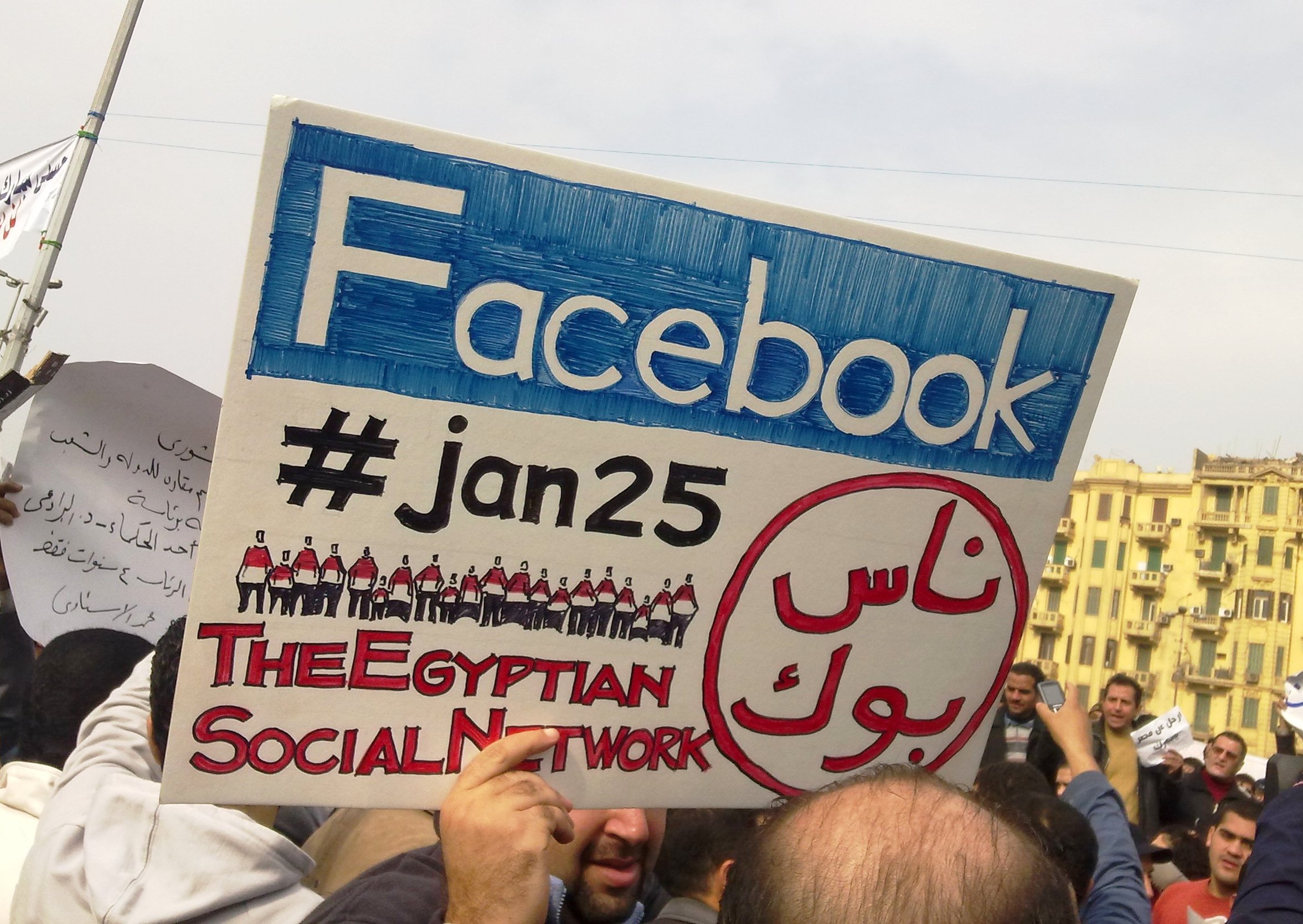
2011 Egyptian Revolution
On the morning of January 25, 2011 -- National Police Day, of all dates -- twenty-six-year-old Asmaa Mahfouz posted a video blog daring fellow Egyptians to meet her in Tahrir Square. The Facebook event she helped promote attracted 80,000 pledges. What arrived was something larger: a nation's accumulated fury at three decades of emergency law, rigged elections, and police brutality channeled into the streets of Cairo, Alexandria, Suez, and Mansoura. By nightfall, the chants had crystallized into four words that would define the uprising -- bread, freedom, social justice, and human dignity.
The Spark and the Kindling
Egypt had been under a continuous state of emergency since Anwar Sadat's assassination in 1981. Police powers expanded, habeas corpus vanished, and the security apparatus operated with near-total impunity. The Egyptian Organisation for Human Rights documented 567 cases of torture, including 167 deaths, between 1993 and 2007. When twenty-eight-year-old Khaled Mohamed Saeed was beaten to death by police in Alexandria in June 2010, a Facebook page titled "We are all Khaled Said" turned his disfigured morgue photo into a rallying point. Then Tunisia's revolution succeeded in January 2011, ousting President Ben Ali. Egyptian opposition groups -- the April 6 Youth Movement, the National Association for Change, the Muslim Brotherhood -- saw their opening and chose the symbolically loaded Police Day to act.
Eighteen Days That Shook Cairo
The first three days brought running battles with Central Security Forces. On January 28, the "Friday of Anger," hundreds of thousands marched after prayers while the government cut internet and mobile service across the country. Prisons were opened -- allegedly on orders from Interior Minister Habib El Adly -- and inmates escaped en masse in what many interpreted as an attempt to terrorize the population into submission. The tactic backfired. Neighborhood watch groups formed overnight, and the military, deployed to replace withdrawn police, refused orders to fire on civilians. Mubarak addressed the nation twice, offering concessions that fell short each time. On February 2, men on camels and horses charged into Tahrir Square wielding sticks, killing three and injuring six hundred in what became known as the Battle of the Camel. Still the square held. Nine days later, Vice President Omar Suleiman announced Mubarak's resignation.
A Revolution Unfinished
The jubilation was genuine but brief. Power passed to the Supreme Council of the Armed Forces, which suspended the constitution and dissolved parliament. Protesters cleaned and repainted Tahrir Square as a gesture of new beginnings, yet many pledged to stay until all demands were met. The trials began: Mubarak, his sons Gamal and Alaa, former ministers, and the steel magnate Ahmed Ezz faced charges of corruption and complicity in the killing of at least 846 people. Elections followed in late 2011, and the Muslim Brotherhood's Freedom and Justice Party won 48.5 percent of the vote. Mohamed Morsi became Egypt's first democratically elected president in June 2012 -- a milestone that lasted barely a year before his own presidential overreach provoked a second uprising.
The Second Wave
Morsi's November 2012 declaration immunizing his decrees from judicial review united an unlikely coalition against him. Mohamed ElBaradei called him "Egypt's new pharaoh." A youth campaign called Tamarod gathered millions of signatures demanding early elections. On June 30, 2013, the first anniversary of Morsi's inauguration, massive crowds again filled Tahrir Square. Three days later, Defense Minister Abdel Fattah el-Sisi removed Morsi from power. The dispersal of pro-Morsi sit-ins on August 14 killed at least 904 civilians and eight police officers. Sisi won the 2014 presidential election with a commanding majority, though opposition parties boycotted the vote. The revolution that had begun with calls for freedom had circled back to military rule -- different faces, familiar structure.
What Tahrir Means Now
At least 846 people died and over 6,000 were injured during the initial eighteen days. The dead included Emad Effat, a senior cleric at Al-Azhar, shot in front of the cabinet building on December 16, 2011, whose funeral drew hundreds chanting "Down with military rule." Reporters Natasha Smith, Lara Logan, and Mona Eltahawy were sexually assaulted while covering events in the square. The revolution demonstrated that Arab populations could topple entrenched autocracies through mass mobilization, but it also revealed how quickly revolutionary coalitions fracture once the shared enemy departs. Tahrir Square itself -- the traffic roundabout that became the protest movement's beating heart -- remains the most potent symbol of that double truth: the extraordinary courage of ordinary people, and the long distance between overthrowing a regime and building something better.
From the Air
Tahrir Square sits at 30.04N, 31.23E in central Cairo, easily identifiable from the air by its distinctive roundabout shape adjacent to the Nile and the Egyptian Museum. Cairo International Airport (HECA) is the primary field, approximately 22 km northeast. Best viewed at 3,000-5,000 feet for context of the surrounding downtown grid. The Nile provides the dominant visual landmark for orientation.