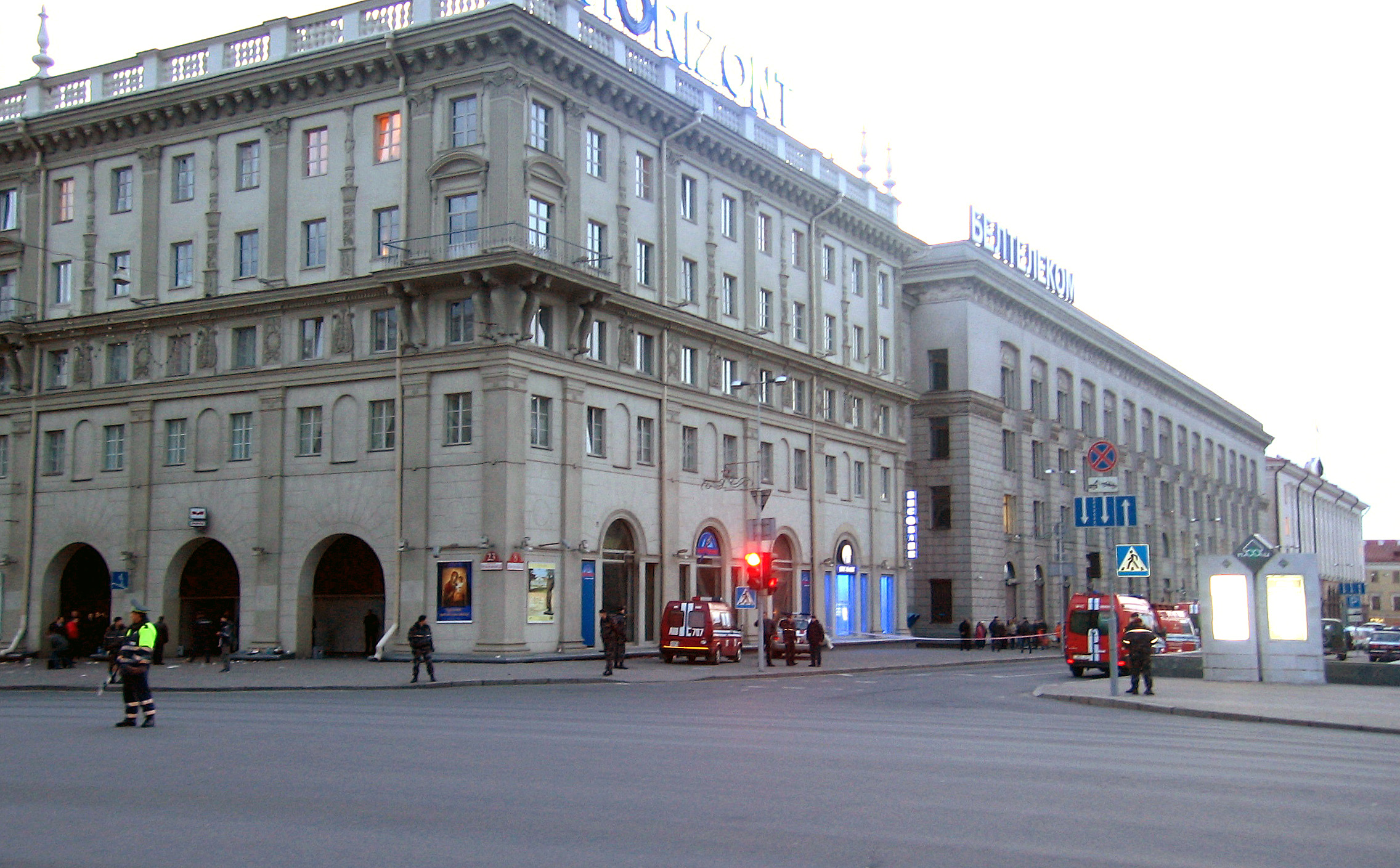
2011 Minsk Metro Bombing
It was 17:55 on a Monday in April. The trains at Kastryčnickaja station, central Minsk, were doing what trains in central Minsk do at that hour — disgorging commuters under the decorated ceiling of a typical Soviet-era metro, picking up others, leaving on time. A bench held the bomb. Five to seven kilograms of TNT equivalent, packed with metal fragments, radio-controlled. When it went off, fifteen people were killed and more than two hundred were injured. Within a year, two young men from Vitebsk were dead by firing squad, and most of Europe was no longer sure they had done it.
The Station
Kastryčnickaja sits near the geographic and political center of Minsk, a few hundred metres from the presidential offices. Like nearly every station in the Minsk Metro, it has an island platform between the two tracks, with the kind of stylised lighting and decorative ceiling tiles that Soviet metro architects considered standard. On the evening of April 11, 2011, trains were on both tracks when the bomb under a bench by the inbound platform exploded. The blast struck the second car of an arriving train, and most of the wounds were caused by shrapnel — the device had been packed with fragments specifically to kill as many people as possible, the interior minister later said. A national day of mourning was declared for April 13. Black ribbons went up on the flags. All entertainment was cancelled.
The Dead
Fifteen people. The number sits flat in news reports, but each was a person who had left home that morning expecting to come home that evening. Some were riding the metro after work, some heading to meet someone, some simply passing through. Their names appeared in Belarusian newspapers in the days after, in lists that grew as the wounded who did not survive joined them. More than two hundred were injured, thirty severely. Eight of the wounded were foreign nationals. The Minsk Metro had not seen anything like this; the country had not seen anything like this since 1999, when 53 people were crushed to death in a panicked stampede at the nearby Niamiha station during a sudden hailstorm. That had been an accident. This was deliberate.
Two Men From Vitebsk
Within forty-eight hours the Belarusian KGB announced arrests. Dzmitry Kanavalau and Uladzislau Kavalyou were both from Vitebsk, in the country's northeast. Kanavalau worked at a tractor factory there. Kavalyou had been raised by a single mother in Vitebsk and had moved to Minsk in 2010 for a job. The two were friends. Kanavalau had come to Minsk on April 10 — the day before the bombing, he later said, to meet a girl he had met online. Kavalyou let him share his rented apartment for those three days. The KGB said they had confessed; the state said they had also been responsible for two earlier unsolved bombings in Vitebsk in 2005 and at a Minsk concert in 2008 that had injured dozens but killed no one. President Lukashenko called it a brilliant operation. In November 2011 they were sentenced to death. On March 17, 2012, Uladzislau Kavalyou's mother received a one-line notification that her son had been executed by shooting. Kanavalau had been killed the same way. There was no body and no grave.
The Doubts
The trial drew international condemnation almost from the moment it began. The European Union called the investigation improperly conducted and the verdicts unsound. The German Bundestag formally questioned Interpol's role in accepting evidence supplied by Belarusian investigators. Even at the United Nations, the Security Council issued a deliberately hedged statement calling the bombing an "apparent" terrorist attack — the word "apparent" was inserted, an anonymous diplomat told reporters, because there was "a more than even chance that the government was behind this." The bombing had come during a serious economic crisis in Belarus and a period of intensifying protests against Lukashenko's rule. Lukashenko's opponents, by then, were either in prison or under KGB surveillance. None of this proves anything either way. What it proves is that two young men were killed by the state on evidence that the state alone controlled, and that in the absence of an independent inquiry there is no longer any way to know what really happened in Kastryčnickaja station that evening in April.
Black Ribbons
Minsk did what cities do when something like this happens. People brought flowers to the station and to the Belarusian embassy in Moscow, where they piled up against the gate. The metro reopened. Metal detectors were installed. Foreign leaders sent condolences — Russia, Ukraine, Lithuania, Poland, Estonia, Latvia, Israel, the United Kingdom — and offered help with the investigation that the Belarusian government, for its own reasons, did not particularly want. A memorial sits today near Kastryčnickaja for the fifteen who died on the platform. Lyubov Kovalyova, Uladzislau Kavalyou's mother, has spent the years since trying to clear her son's name. She still has the notification she received on March 17, 2012. She does not have her son.
From the Air
Kastryčnickaja station and the Minsk Metro line that runs through central Minsk lie at 53.902°N, 27.561°E in the Belarusian capital. The city centre is flat and dense, with the Svislach River winding through it. Minsk National Airport (UMMS) sits roughly 40 km east of the centre. Best viewed from medium altitude in clear weather; the surface plaza above Kastryčnickaja station, near the Palace of the Republic and Independence Square, is a useful visual landmark.