2012 East Azerbaijan Earthquakes
Eleven minutes separated the two earthquakes. The first struck at 4:53 in the afternoon on August 11, 2012, magnitude 6.4. Before people near Ahar and Varzaqan could process what had happened, a 6.2 aftershock hit ten kilometers to the east. In villages scattered across the mountainous countryside northeast of Tabriz, most of the men were away working. The mud brick houses that collapsed buried mainly women and children. By the time the shaking stopped, at least 306 people were dead and more than 3,000 injured across Iran's East Azerbaijan province.
A Landscape Built to Break
Northwestern Iran sits where the Arabian plate grinds northward into the Eurasian plate at roughly 20 millimeters per year. The collision zone stretches from the Zagros belt in the south to the Caucasus Mountains in the north, deforming some three million square kilometers of continental crust -- one of the largest convergent deformation regions on Earth. Near Tabriz, the dominant feature is the North Tabriz Fault, a strike-slip fault responsible for multiple destructive earthquakes of magnitude 6 or greater since 858 A.D. The region does not lack for seismic warnings. History has provided them repeatedly. But the villages that bore the worst of the 2012 quakes were built of mud brick, a traditional material that performs catastrophically under lateral shaking. The geology guaranteed the earthquakes would come. The construction ensured the cost would be high.
The Hours After
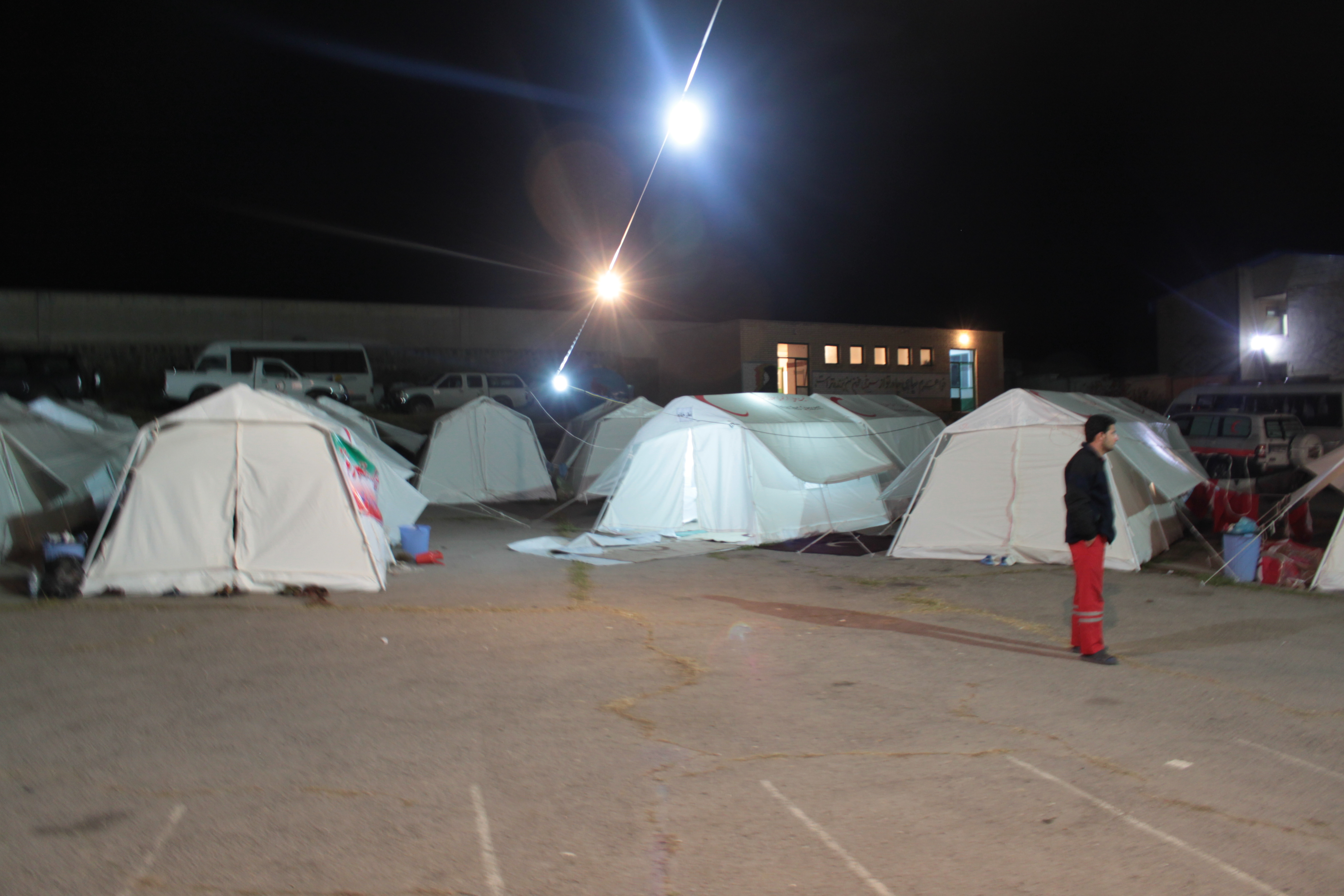
Sixty-six rescue teams converged on the stricken area, along with 200 ambulances and five helicopters. The scale of destruction defied quick response. One hundred and thirty villages sustained 70 to 90 percent damage. Twenty were completely leveled. In Ahar, at least 45 people died and 500 were injured. Electricity and phone lines went dead. In Varzaqan, more than 40 died. In Heris, 50. The nearest hospitals were far away, and many of the severely injured did not survive the journey. Over 200 people were pulled from collapsed buildings in Varzaqan and Ahar. Officials told residents to sleep outdoors because aftershocks -- at least 80 of them -- kept rattling the region. An estimated 16,000 people spent the first night in emergency shelters. Between ten and twenty villages near the epicenter remained cut off from any aid.
Help Offered, Help Refused, Help Accepted
The Iranian Red Crescent initially declined all international assistance. For two days, as the death toll climbed and the scale of devastation became clearer, the government maintained it could handle the crisis alone. On the third day, Iran reversed course and said it would accept foreign help. Neighboring Azerbaijan dispatched 25 trucks carrying tents, beds, blankets, rice, flour, and other food. Armenia sent tents, blankets, sleeping bags, and canned goods. Pakistan flew a C-130 loaded with relief supplies. The Turkish Red Crescent sent emergency provisions to the border. UN Secretary-General Ban Ki-moon expressed the organization's readiness to assist. Pope Benedict XVI, speaking from Castel Gandolfo, asked for prayers. The White House issued a statement of condolence. The earthquake briefly opened a diplomatic channel that geopolitics usually kept closed.
Accountability and Aftermath
Criticism came quickly. The government halted search-and-rescue operations after just 24 hours, declaring all survivors recovered -- a claim local doctors disputed, given the remoteness of some villages. Members of the Majlis pointed to a shortage of tents for the displaced. State television drew particular anger for its sparse coverage; an editorial in the Asr-e Iran newspaper called out the broadcaster's silence. In a Majlis session on August 13, parliamentarians from the affected region confronted President Mahmoud Ahmadinejad for neither visiting the disaster zone nor declaring national mourning. That same day, Iran announced two days of public mourning. The earthquakes exposed not just the physical vulnerability of rural construction in a seismic zone but the gap between a government's stated capacity and its response when disaster arrives in places far from the capital.
From the Air
The epicentral area is located at approximately 38.32N, 46.88E, roughly 60 km northeast of Tabriz in Iran's East Azerbaijan province, near the cities of Ahar and Varzaqan. The terrain is mountainous and rural, with villages scattered across valleys and hillsides. Tabriz International Airport (OITT) is the nearest major airport, approximately 60 km to the southwest. The North Tabriz Fault runs WNW-ESE through the region. Visibility is generally good in summer months. The landscape shows the rugged, semi-arid topography typical of northwestern Iran's collision zone between the Arabian and Eurasian tectonic plates.