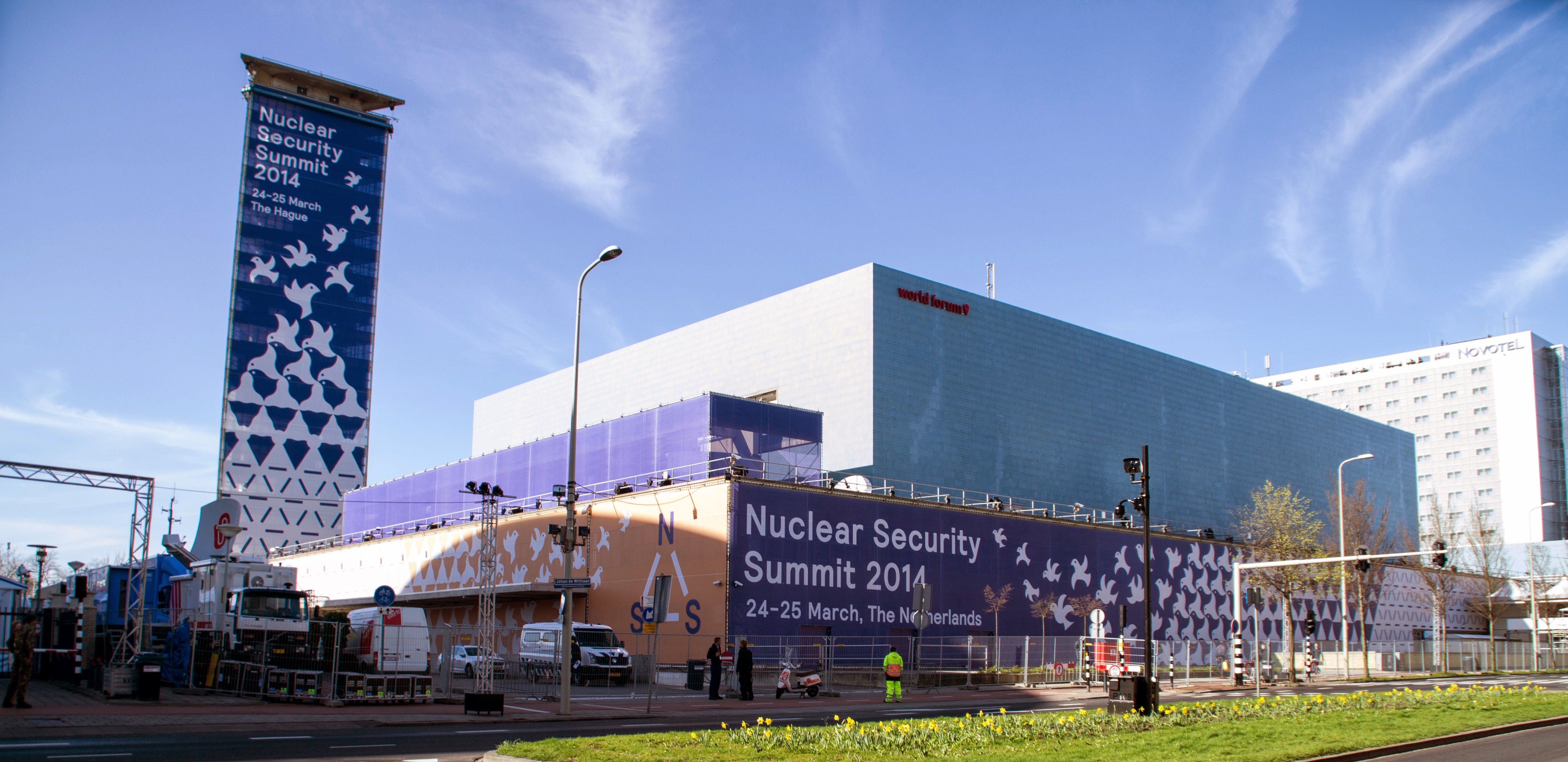
2014 Nuclear Security Summit
Two F-16s carved lazy circles over The Hague on the morning of March 24, 2014, and beneath them the largest security operation in Dutch history hummed into motion. Thirteen thousand police officers - four times the contingent that secured the royal succession the year before - had been drawn from every corner of the country. Apache helicopters waited on standby. Frigates patrolled the coast from Hook of Holland to IJmuiden. Inside the World Forum Convention Centre, surrounded by fences borrowed from the 2012 London Olympics, the leaders of fifty-three nations were arriving to talk about something most of them preferred not to mention out loud: the loose stockpiles of bomb-grade material scattered across the world, and what it would take to keep terrorists from finding them.
Why The Hague
The Nuclear Security Summit had been Barack Obama's idea, born from a 2009 speech in Prague where he laid out a vision of a world without nuclear weapons. The first summit had been in Washington, the second in Seoul, and now the third settled into the Dutch capital - a city already accustomed to the weight of international law and the architecture of cautious diplomacy. Prime Minister Mark Rutte received the heads of delegation himself, and that evening King Willem-Alexander hosted them for dinner at Huis ten Bosch, the royal palace tucked into the woods. The setting was deliberate. The Hague offered something Washington and Seoul could not: the symbolic gravity of a place that had spent more than a century building institutions to manage humanity's worst impulses.
Crimea in the room
Nobody planned for the summit to be about Ukraine. But three weeks before the leaders arrived, Russia had annexed Crimea, and now the talks had a second, urgent agenda running underneath. Vladimir Putin himself stayed away, sending Foreign Minister Sergey Lavrov in his place. On the evening of March 24, an emergency meeting of the G7 convened at the Catshuis, the prime minister's official residence, and David Cameron emerged to announce that the G8 summit planned for Sochi in June would not happen on Russian soil. The Group of Eight was, in that moment, becoming the Group of Seven again. Inside the World Forum, leaders kept the focus on nuclear materials. Outside, in the hallways and the bilateral meeting rooms, the post-Cold War order was visibly tilting.
The Japanese announcement
The summit's headline came from Tokyo. Japan announced it would hand over to the United States more than 700 pounds of weapons-grade plutonium and roughly 450 pounds of highly enriched uranium - a decades-old research stockpile, much of it originally American and British, that officials said was enough to build dozens of nuclear weapons. For years, the cache had been a quiet diplomatic problem. Iran had pointed to it as proof of a Western double standard. China had begun raising alarms a month earlier. Some right-wing politicians in Japan had referred openly to the stockpile as a useful deterrent, the kind of material you keep around so other countries know what you could do. The transfer was the single biggest result of Obama's five-year effort. Since 2009, twelve countries had cleared all their highly enriched uranium - Austria, Chile, Czechia, Hungary, Libya, Mexico, Romania, Serbia, Taiwan, Turkey, Ukraine, and Vietnam - and the equivalent of roughly 500 weapons' worth of material had been down-blended into reactor fuel.
What the agreements actually changed
Diplomatic communiques can read like wallpaper, but the Hague document raised the bar in a specific way. For the first time, the leaders committed to minimizing plutonium stockpiles, not just highly enriched uranium. Thirty-five countries signed on to a new set of Nuclear Security Guidelines: most of Europe, plus Japan, South Korea, Israel, Australia, and the United States. Eighteen others refused, including China, Russia, India, Pakistan, and Brazil - which left the harder cases for another summit. Thirteen countries pledged to eliminate their highly enriched uranium entirely by 2016. Seventeen had already converted research reactors and medical isotope facilities to safer low-enriched fuel. The numbers were technical, but the underlying argument was not: every kilogram secured was a kilogram a terrorist could not steal.
The students who walked in
For all the spectacle of fighter jets and water-cannon trucks, the most-talked-about security incident of the summit was almost comically small. Two Dutch students managed to obtain student press credentials and walked into the final press conference. They got within five meters of Obama and Rutte before anyone noticed. The Dutch Organisation of Journalists later admitted a mistake had been made. The Ministry of Foreign Affairs insisted the president's security had been optimal. The students, for their part, did nothing - they only wanted to prove they could. In a summit devoted to the principle that determined people will find their way past barriers, it was an oddly fitting coda.
From the Air
World Forum Convention Centre, The Hague, Netherlands. Coordinates: 52.09 degrees N, 4.28 degrees E. The site sits in the quiet diplomatic quarter near Scheveningen, a short distance from the Peace Palace. Recommended viewing altitude 2,500-3,500 feet for context with the North Sea coast and the Randstad metropolitan sprawl. Nearest airport is Rotterdam The Hague (EHRD), 15 nautical miles south; Amsterdam Schiphol (EHAM) lies about 25 nautical miles northeast. Dutch coastal weather can shift quickly - expect haze and broken low cloud in shoulder seasons.