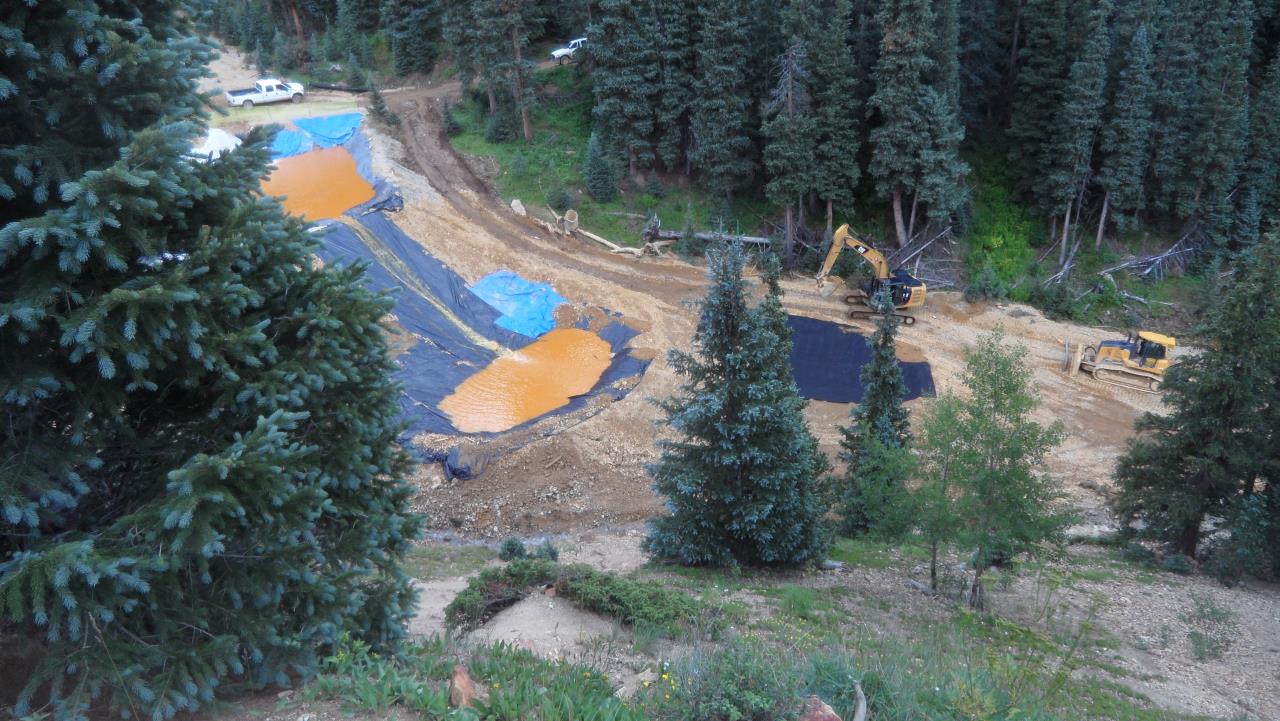
2015 Gold King Mine Waste Water Spill
The Animas River ran bright orange on August 5, 2015. Not from a natural flood or an industrial accident in the usual sense, but because the very agency tasked with protecting America's waterways -- the Environmental Protection Agency -- had just breached a tailings dam at the Gold King Mine near Silverton, Colorado, releasing millions of gallons of toxic waste water laced with arsenic, lead, cadmium, and iron into Cement Creek and the Animas River watershed. The irony was as thick as the mustard-colored plume snaking downstream: the EPA had been working to prevent exactly this kind of catastrophe.
A Century of Poison Underground
Gold mining shaped the hills around Silverton from the late 1800s until 1991, when the last mine closed. But the mountains never forgot. When subsurface mining exposes metal sulfide minerals like pyrite to water and air, acid mine drainage begins -- a slow, relentless chemical process that poisons watersheds for generations. The Upper Animas water basin had already lost its fish populations long before the 2015 disaster. The Sunnyside Mine's American Tunnel had once drained the area, but when it was sealed in 1996 as part of a reclamation plan, water began accumulating behind plugs throughout the interconnected mine system. By 2002, contaminated discharge was flowing from the Gold King Level 7 adit. A June 2014 work order warned that conditions could result in a blowout, releasing large volumes of contaminated water and heavy metals. A May 2015 action plan repeated the warning. The crew that arrived on August 5 did not know the mine tunnel behind the plug was already full of pressurized water. It burst through almost immediately after excavation began.
Three Hundred Miles of Orange Water
The toxic plume moved fast. By August 7, it reached Aztec, New Mexico. The next day, it hit Farmington, the largest municipality affected. By August 10, the waste had entered the San Juan River and reached Shiprock on the Navajo Nation. Testing upstream of Durango revealed lead at 100 times the safe limit and iron at 326 times the limit, with arsenic and cadmium also above thresholds. Colorado Governor John Hickenlooper declared a disaster zone on August 8. New Mexico Governor Susana Martinez declared a state of emergency on August 11 after viewing the devastated river from a helicopter. Multiple municipalities and the Navajo Nation stopped drawing drinking water from the Animas. County officials warned residents to keep themselves, their pets, and their livestock away from the water. The river was closed to recreation. The heavy metals appeared to be settling to the river bottom, but the long-term consequences remained unknown.
The Navajo Nation Bears the Weight
For the Navajo Nation, the spill struck at the foundation of daily life. An estimated 2,000 Navajo farmers and ranchers depended on the San Juan River for irrigation. When the canals were shut down on August 7, crops withered. While water trucks were dispatched to some areas, many home gardens and remote farms received no assistance and suffered widespread crop damage. Navajo farmers voted unanimously on August 22 to refrain from using river water for one full year. President Begaye warned his people against signing EPA liability release forms. As of April 2016, the Navajo Nation had received only $150,000 from the EPA -- just 8% of their costs. Senator John McCain estimated the Nation could face up to $335 million in total damages. The EPA, meanwhile, claimed sovereign immunity and moved to dismiss all lawsuits in 2018, arguing that the $29 million it spent on cleanup was sufficient.
A Legacy Still Flowing
The Gold King spill was not the end of the story. In July 2018, a truck hauling waste water from a temporary treatment plant crashed into a creek near the mine, spilling sludge back into the watershed. The Associated Press reported that more than 350 million gallons of contaminated water -- 150 times the volume of the original spill -- had flowed around the EPA's treatment plant into an Animas tributary since October 2015. The disaster did accomplish one thing the EPA had failed to achieve for decades: Silverton and San Juan County finally accepted Superfund designation. In the 1990s, community opposition had blocked the listing. Now, with their river scarred orange and their neighbors downstream suing, the political calculus had changed. The abandoned mines of the San Juans still drain their centuries of poison into the watershed, a reminder that the environmental costs of extraction outlast every boom and bust.
From the Air
Located at 37.89N, 107.64W near Silverton, Colorado in the San Juan Mountains. The mine sits at approximately 10,000 feet elevation in the upper Animas River valley. The Animas River is clearly visible from altitude, winding south through Durango (KDRO / Durango-La Plata County Airport) toward Aztec and Farmington, New Mexico. The Cement Creek confluence with the Animas is the point of discharge. Tailings ponds and reclamation earthworks are visible near the mine entrance along the Million Dollar Highway (US-550). Nearest airports: KDRO (Durango-La Plata County), K4V1 (Silverton).