2017 Payson Flash Floods
They heard the sound before they saw it. At around 3 p.m. on July 15, 2017, swimmers at the Cold Springs Swimming Hole along Ellison Creek looked upstream and saw a wall of black, muddy water rushing toward them. It was six feet tall and forty feet wide, carrying rocks and logs the size of cars. An extended family of fourteen had been celebrating a birthday party in the shallow waters of the Water Wheel Falls Hiking Trail. Within seconds, that celebration became a catastrophe.
A Hidden Fuse Already Lit
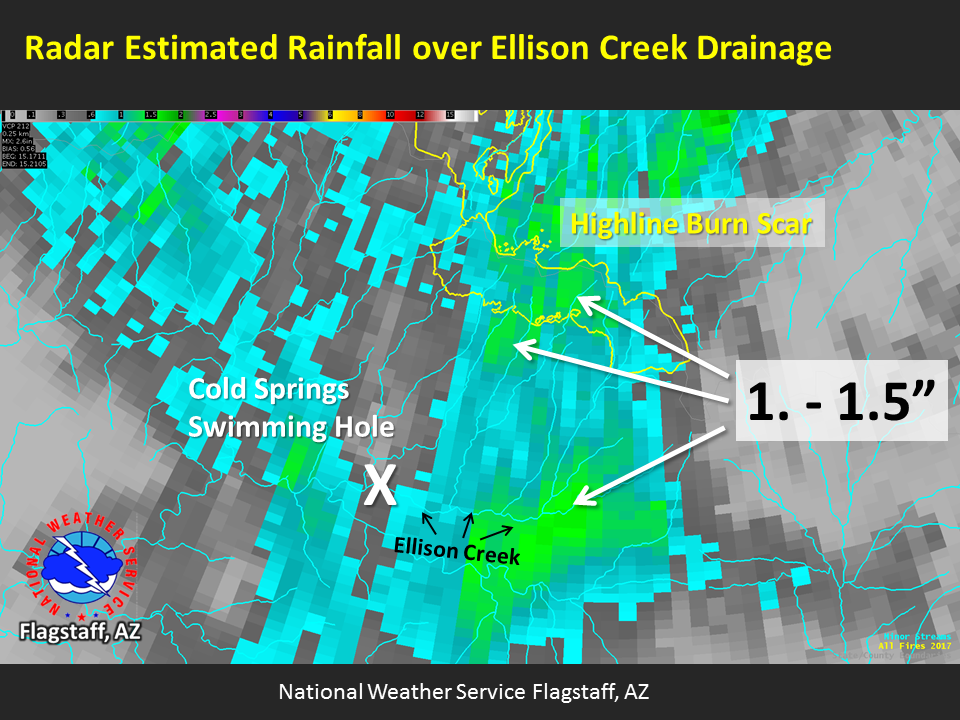
Two forces converged to create the deadly flood, and both were invisible to the swimmers that afternoon. A month earlier, the Highline Fire had burned more than 7,000 acres of land near Ellison Creek. Wildfire strips the ground of vegetation that normally absorbs rainfall, leaving behind a surface of ash and hardened soil that repels water like pavement. When the North American Monsoon arrived that July, as it does every year between June and mid-September across the southwestern United States, the burned landscape had no capacity to absorb the heavy rains that fell upstream. Water gathered with ferocious speed, collecting ash, mud, and debris from the fire-scarred terrain. The resulting torrent funneled down the narrow canyon toward Cold Springs with the accumulated force of thousands of acres of runoff.
The Warning That Never Arrived
A flash flood warning had been issued for the area. But the families swimming at Cold Springs were in a remote canyon with no cell phone reception, no posted warnings, and no alert system. The disconnect was absolute: meteorologists knew the danger, but the people in the path of the flood did not. When the water hit, many swimmers were swept downstream immediately. Others grabbed onto trees and rocks, clinging above the churning current and waiting for rescue. Children were among those carried away. Emergency dispatchers received 9-1-1 calls, and helicopters were deployed to extract survivors clinging to whatever they could hold. The floodwaters eventually poured into the East Verde River, carrying debris and victims far downstream.
Nine Bodies, One Still Missing
In the hours and days following the flood, search crews worked the creek and surrounding terrain looking for survivors and the missing. Family members gathered at the scene, waiting for news that grew worse with each passing hour. Rescue teams recovered nine bodies. The tenth victim, Hector Garnica, remained missing for days before his remains were found downstream. Of the ten dead, half were children. Four other people sustained injuries. The birthday party that brought fourteen family members together on a hot summer afternoon ended with the loss of the majority of them.
Accountability and Aftermath
A funeral was held for the victims, and the Cold Springs Swimming Hole was closed with posted signs warning of the danger. In the years following the disaster, family members of the victims filed a lawsuit against the U.S. Government, alleging wrongful death, negligence, and negligent infliction of emotional distress. The central question was whether more could have been done to warn visitors in the remote canyon about the flash flood risk, particularly given the recent wildfire that had dramatically increased the danger. The tragedy underscored a persistent vulnerability in the American Southwest: the intersection of wildfire, monsoon, and recreation in narrow canyons where flash floods can materialize with almost no warning. The remote beauty that draws people to these swimming holes is the same remoteness that cuts them off from the alerts that might save their lives.
From the Air
The Cold Springs Swimming Hole and Ellison Creek are located at approximately 34.351N, 111.285W, northeast of Payson, Arizona in the Tonto Basin region. From the air at 3,000 to 5,000 feet AGL, the narrow canyon and the drainage into the East Verde River are visible, though the swimming hole itself is tucked beneath tree cover. The nearest airport is Payson Airport (KPAN), approximately 10 nautical miles to the southwest. The area is part of the Mogollon Rim transition zone, where Arizona's high plateau drops sharply into lower desert terrain. During monsoon season (June through mid-September), afternoon thunderstorms build rapidly over the rim and can produce dangerous flash flooding in the canyons below with little visible warning from altitude.