2017 Tehran Attacks
For decades, Iran had positioned itself as a fortress against the Islamic State. The country's powerful security apparatus and its military interventions in Iraq and Syria had kept ISIL's violence at arm's length. Then, on the morning of June 7, 2017, that sense of invulnerability shattered. Five Iranian-born ISIL operatives launched simultaneous attacks on two of the most symbolically potent sites in the Islamic Republic: the Majlis, Iran's parliament building, and the mausoleum of Ayatollah Ruhollah Khomeini, the founder of the revolution itself.
Two Targets, One Morning
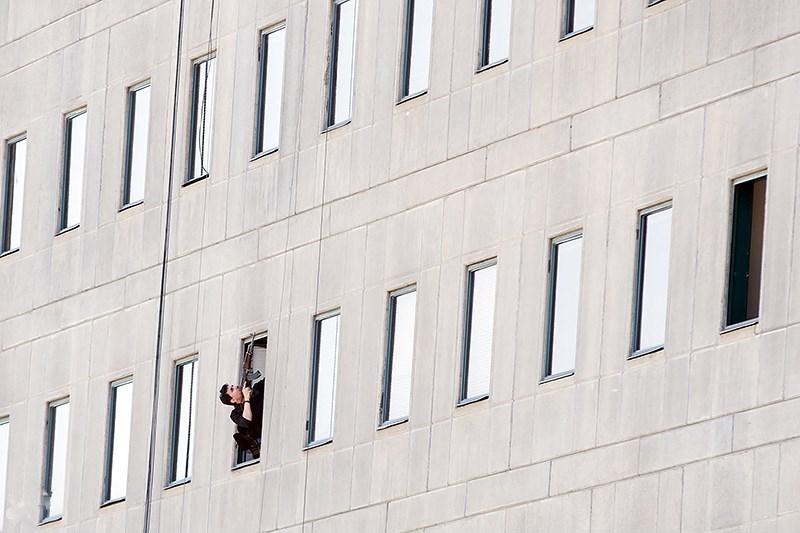
The attackers struck shortly after 10:30 a.m., splitting into two teams. At the parliament building in central Tehran, four gunmen entered disguised among visitors and opened fire in the corridors. They shot at security personnel and civilians indiscriminately, killing an MP's chief of staff and a visitor in his office. Three of the four attackers eventually detonated suicide vests inside the building. The siege lasted hours as IRGC special forces worked to neutralize the threat. Simultaneously, two attackers targeted Khomeini's mausoleum in southern Tehran, a sprawling complex that draws millions of pilgrims each year. One detonated a suicide vest near the shrine. The other was killed by security forces. By the time the violence ended, seventeen people lay dead and fifty-two were wounded. All the casualties, victims and attackers alike, were Iranian citizens.
The Attackers' Path
Iran's Intelligence Ministry identified the five assailants within days. All were Iranian nationals who had been recruited by ISIL and had traveled to Iraq and Syria, participating in the group's operations in Mosul and Raqqa. They re-entered Iran in August 2016, nearly ten months before the attacks. The ministry described them as having long-standing ties to extremist networks. ISIL claimed responsibility through its Amaq News Agency, even releasing footage shot from inside the parliament during the assault. It was a calculated provocation: striking at the heart of a state that had been one of the group's most formidable adversaries on the battlefield.
A Nation Responds
The reaction inside Iran was defiant. Supreme Leader Ayatollah Ali Khamenei dismissed the attacks as mere "firecrackers," declaring they were "too small to affect the will of the Iranian nation." President Hassan Rouhani vowed the assault would only strengthen national unity. Parliament Speaker Ali Larijani called it a "minor issue." Behind the bravado, however, the attacks exposed vulnerabilities. The fact that operatives had infiltrated the country nearly a year earlier and reached the parliament's inner corridors raised difficult questions about intelligence failures. The Iranian government quickly pointed fingers outward, with the IRGC accusing Saudi Arabia of sponsoring the attackers. Riyadh denied any involvement.
Missiles from Iranian Soil
Eleven days after the attacks, Iran's response crossed a new threshold. On June 18, 2017, the IRGC launched six medium-range ballistic missiles from the western provinces of Kermanshah and Kurdistan, striking ISIL positions in Deir ez-Zor, Syria, roughly six hundred kilometers away. It was the first time Iran publicly acknowledged launching missiles from its own territory against targets abroad. Drone footage released the following day showed the missiles hitting their targets. The strikes carried a message beyond the tactical: Iran would retaliate not just through proxy forces, but directly. The ambassador to the United Kingdom declared the launches "manifested the will and capacity of Iran to fight against terrorism."
What Remained
The 2017 Tehran attacks marked a turning point in Iran's relationship with terrorism on its own soil. The country had long experienced political violence, but an ISIL assault of this scale and symbolic precision was unprecedented. The attacks deepened Iran's involvement in the regional war against the Islamic State while simultaneously hardening domestic security measures. At the parliament and the mausoleum, the scars faded into repairs. The buildings still stand, still draw their daily crowds of legislators and pilgrims. But June 7, 2017, left its mark on Tehran's collective memory as the morning the war that Iran had been fighting abroad arrived at its most guarded doorsteps.
From the Air
The two attack sites are located in central and southern Tehran. The parliament building (Majlis) sits at approximately 35.696N, 51.423E in Tehran's governmental district. Khomeini's mausoleum lies roughly 10 km to the south. Tehran's primary airport is Imam Khomeini International (OIIE), located about 50 km southwest of the city center. Mehrabad International Airport (OIII) is closer, within the city itself. From cruising altitude, Tehran's urban sprawl is visible against the backdrop of the Alborz Mountains to the north. The golden dome of Khomeini's mausoleum is a notable landmark from lower altitudes.