2018 Winter Olympics
When the unified Korean team entered PyeongChang Olympic Stadium on February 9, 2018, carrying a flag showing an undivided Korean Peninsula, the cheers masked a geopolitical improbability. Less than 80 kilometers to the north lay the most heavily armed border on Earth. The two Koreas had fielded a joint women's ice hockey team -- the first combined team at an Olympics since 1936 Germany. Whatever happened on the ice (they lost all five games), the symbolism mattered. The XXIII Olympic Winter Games were about sport, but in PyeongChang, sport could not be separated from the peninsula's unfinished war.
Three Tries to Get Here
PyeongChang's Olympic moment was hard-won. The county had bid for the 2010 and 2014 Winter Games, losing narrowly both times -- by just three votes to Vancouver in 2007. On its third attempt, at the 123rd IOC Session in Durban, South Africa on July 6, 2011, PyeongChang won decisively in the first round of voting, beating Munich and Annecy. The victory made South Korea only the second Asian nation to host a Winter Olympics after Japan, which had hosted in Sapporo in 1972 and Nagano in 1998. More significantly, PyeongChang 2018 became the first Winter Olympics held in mainland Asia, launching three consecutive East Asian Games that continued with Tokyo 2020 and Beijing 2022.
Records in the Mountain Cold
The Games featured 102 medal events across 15 disciplines -- the first Winter Olympics to exceed 100 events. Four sports made their Olympic debut: big air snowboarding, mass start speed skating, mixed doubles curling, and mixed team alpine skiing. A total of 2,833 athletes from 92 National Olympic Committees competed, with six countries making their Winter Games debut, including Nigeria, Eritrea, and Malaysia. Norway dominated the medal table with 39 total medals, including 14 golds, setting a new record for most medals won at a single Winter Olympics. Germany matched Norway's gold count with 14. The host nation South Korea earned 17 medals, its best Winter Olympics performance ever, anchored by its traditional strength in short-track speed skating.
Two Koreas, One Flag
The most watched story at PyeongChang had little to do with times or scores. North Korea sent 22 athletes to compete in five sports, and the two Koreas marched together under a unification flag at the opening ceremony. The joint women's ice hockey team, assembled just weeks before the Games, drew global attention despite its lack of competitiveness -- the team included 12 North Korean players integrated into the South Korean roster. Behind the scenes, North Korean leader Kim Jong-un's sister, Kim Yo-jong, attended the opening ceremony, marking the first time a member of the ruling Kim family had visited South Korea. The diplomatic thaw continued through the spring, leading to a historic inter-Korean summit in April 2018, though the broader rapprochement eventually stalled.
Mountains Built for This
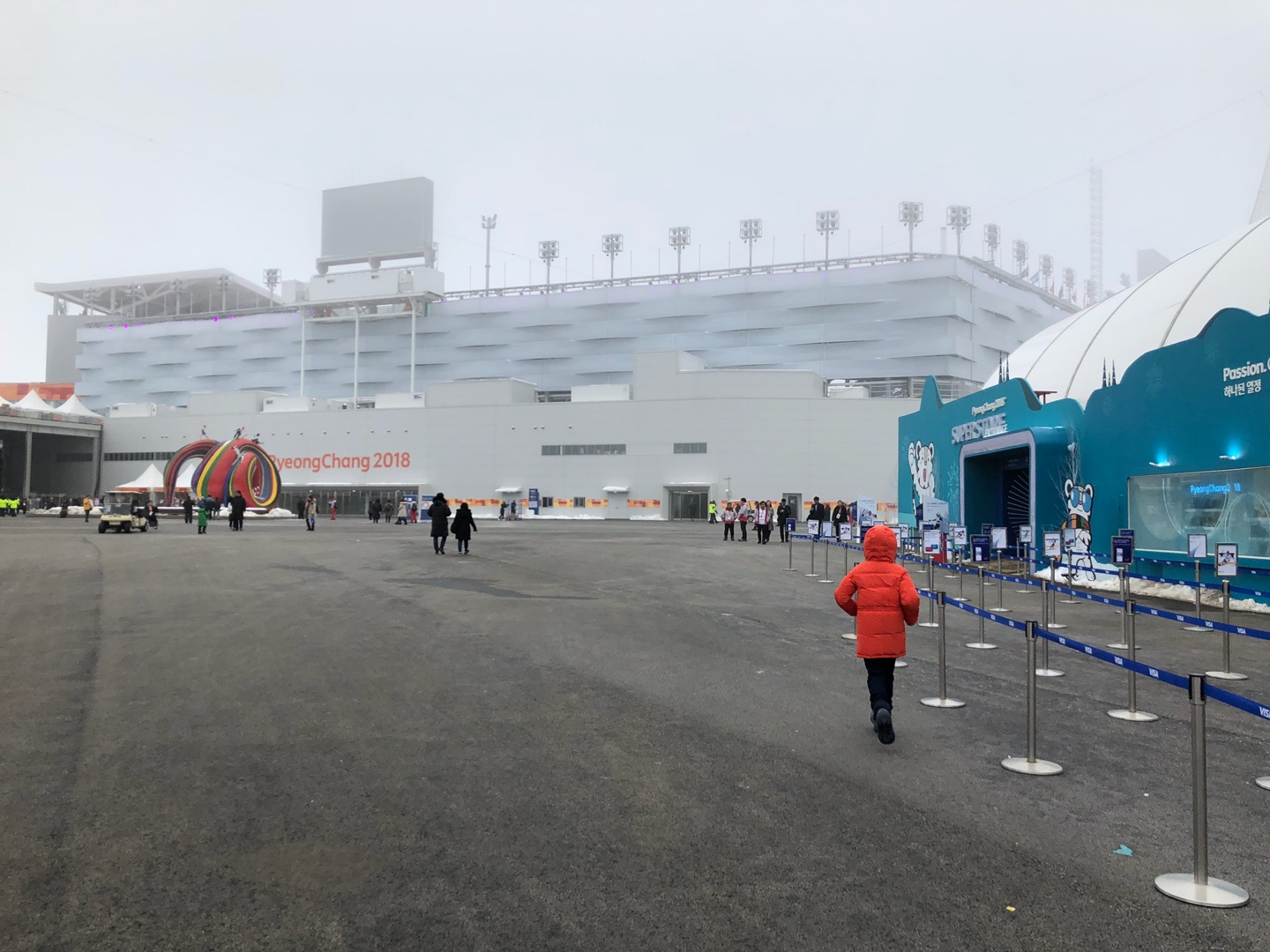
PyeongChang County sits in the Taebaek Mountains of Gangwon Province at elevations between 700 and 800 meters, with reliable snowfall and cold temperatures that had long made it a domestic ski destination. The Games used two main venue clusters: the PyeongChang Mountain Cluster for snow sports and the Gangneung Coastal Cluster, 30 kilometers east on the Sea of Japan coast, for ice sports. The PyeongChang Olympic Stadium, purpose-built as a temporary structure for the opening and closing ceremonies, seated 35,000 spectators in open-air stands where February temperatures dropped well below freezing. The new KTX high-speed rail line cut travel time from Seoul to under two hours, connecting the capital to the mountain venues for the first time by fast rail.
From the Air
Located at 37.63N, 128.68E in PyeongChang County, Gangwon Province, in the Taebaek Mountains of eastern South Korea. The venue area sits at 700-800 meters elevation with prominent ski jumps and sports facilities visible from altitude. The Gangneung Coastal Cluster lies 30 km to the east on the Sea of Japan coast. Nearest airports include Yangyang International Airport (RKNY) on the east coast and Wonju Airport (RKNW) to the southwest. The KTX rail line from Seoul is visible tracing through mountain valleys. Look for the distinctive curve of the Olympic Stadium and the ski jump towers against the mountain backdrop.