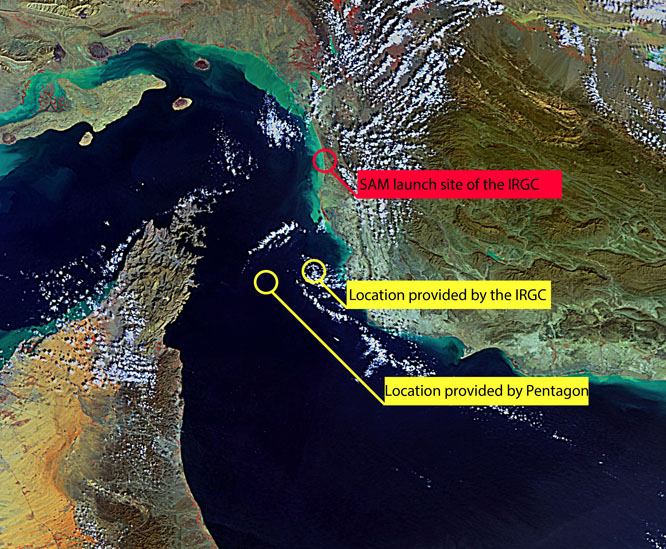
2019 Iranian shoot-down of American drone
At 4:05 a.m. local time on June 20, 2019, a surface-to-air missile launched by Iran's Revolutionary Guard Corps struck a United States Navy RQ-4 Global Hawk surveillance drone over the Strait of Hormuz. The drone, one of the largest unmanned aircraft in the American military's fleet, broke apart and its debris fell into the water. Within hours, the United States had ordered retaliatory strikes against Iranian radar and missile sites. Then, with planes reportedly in the air, the order was reversed. The world came as close to a new war as the gap between a command given and a command rescinded.
Contested Airspace
Iran and the United States never agreed on where the drone was when it was hit. Iranian Foreign Minister Mohammad Javad Zarif provided GPS coordinates placing the aircraft 15.3 kilometers off Iran's coast, within the 12-nautical-mile limit of claimed territorial waters. The Pentagon insisted the drone was in international airspace. Brigadier General Amir Ali Hajizadeh, commander of the IRGC Aerospace Force, said the United States had been warned twice before the missile was fired. He also revealed that an American P-8 Poseidon manned aircraft with 35 people aboard had been in the area. 'We could have shot it down,' he said, 'but we did not.' Russia later stated that its military intelligence showed the drone was in Iranian airspace.
Ten Minutes from War
President Donald Trump initially described Iran's action as a 'big mistake' and authorized military strikes against several IRGC radar and missile installations. Secretary of State Mike Pompeo, National Security Adviser John Bolton, and CIA Director Gina Haspel reportedly favored the response. According to the New York Times, citing senior administration officials, the strike order was issued and then withdrawn. Trump later said he reversed the decision after being told that an estimated 150 people would be killed -- a cost he judged disproportionate to the loss of an unmanned drone worth approximately $130 million. Leaked diplomatic cables from UK Ambassador Kim Darroch questioned this explanation, suggesting Trump may never have been fully committed to the strike.
Cyber Retaliation
Instead of missiles, the United States launched cyberattacks. On the same day as the aborted military strike, Trump approved cyber operations intended to disable IRGC computer systems used to control rocket and missile launches. The strikes were handled by U.S. Cyber Command in conjunction with Central Command and represented the first offensive use of force since Cyber Command was elevated to a full combatant command in May 2018. Iran's Information and Communications Technology Minister Mohammad-Javad Azari Jahromi dismissed the attacks, saying they had been firewalled: 'They try hard, but they have yet to carry out a successful attack.' The Department of Homeland Security separately warned American industries that Iran was stepping up its own cyberattacks on critical infrastructure, particularly oil and gas sectors.
Sanctions and Signals
On June 24, Trump announced new targeted sanctions against Iranian leadership, including Supreme Leader Ali Khamenei, under Executive Order 13876. IRGC commanders across the naval, aerospace, and ground forces were named individually. Treasury Secretary Steven Mnuchin said the sanctions would freeze 'literally billions' in assets. Foreign Minister Zarif was sanctioned on July 31. Meanwhile, U.S. Air Force Chief of Staff David Goldfein confirmed that American drone operations in the region were continuing without pause. The shoot-down had not changed operational patterns. The FAA warned commercial airlines of 'potential for miscalculation or misidentification' as flights were diverted from the Tehran flight information region.
The Strait Remembers
The Strait of Hormuz has been the site of confrontation between Iran and outside powers for decades. In 1988, the USS Vincennes shot down Iran Air Flight 655, killing 290 civilians. In 2011, Iran captured an American stealth drone that had entered its airspace. The June 2019 incident added another layer to this history of miscalculation and brinkmanship in one of the world's most strategically vital waterways. Roughly twenty percent of the global oil supply passes through the strait. Every military asset, every surveillance flight, every surface-to-air missile battery operates within a geography where the margin between routine and catastrophe is measured in nautical miles and minutes.
From the Air
Coordinates: 26.00N, 57.04E, over the Strait of Hormuz between Iran and the UAE/Oman. This is extremely sensitive restricted airspace -- the FAA issued warnings during the 2019 incident. The strait is approximately 30 nautical miles wide at its narrowest. Bandar Abbas Airport (OIKB) is on the Iranian side; Fujairah International (OMFJ) and Khasab (OOKB) on the southern side. Expect heavy maritime traffic visible from altitude.