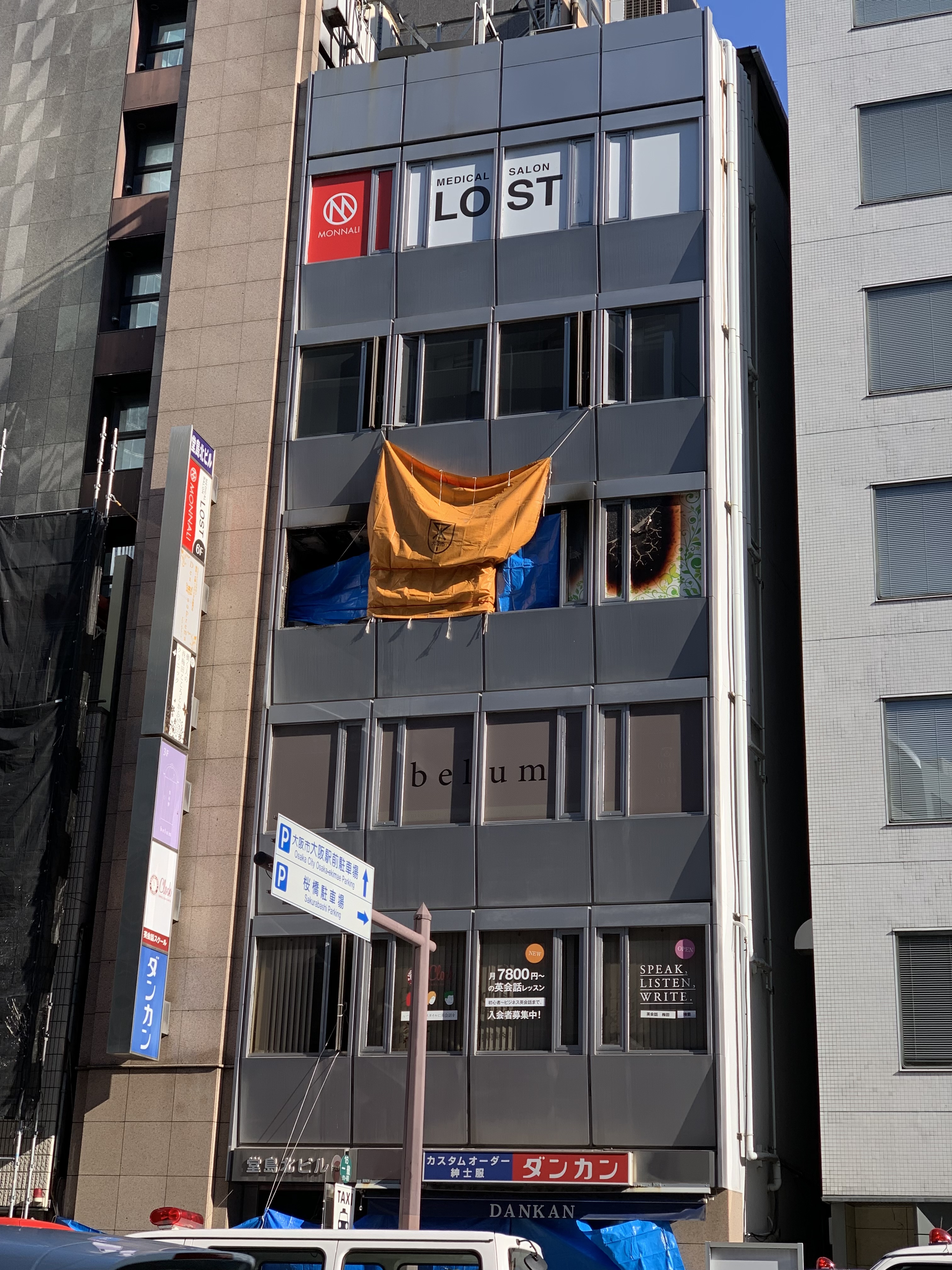
The 2021 Osaka Building Fire: A Clinic Meant for Healing
The clinic's name said everything about its purpose. Nishi Umeda Kokoro to Karada no Kurinikku -- the Nishi Umeda Clinic for the Mind and Body -- occupied the fourth floor of an eight-story building in Kita-ku, one of Osaka's busiest commercial districts. Patients came for psychiatric care, for conversations they could not have elsewhere, for prescriptions and reassurance. On the morning of December 17, 2021, at 10:18 a.m., a man walked through the door carrying a paper bag. He placed it next to a heater at the reception desk, kicked it over, and ignited the gasoline inside. Within minutes, the fourth floor was engulfed. Twenty-six people would die, almost all of them from carbon monoxide poisoning, trapped in windowless interior rooms with no second way out.
Twenty-Eight Minutes
The fire department received the alarm at 10:18 a.m. and had the blaze nearly extinguished by 10:46. In those twenty-eight minutes, the fire itself remained contained to a relatively small area on the fourth floor. The building's exterior showed little damage. But inside the clinic, the physics of combustion were lethal. Gasoline ignited at the reception area sent flames racing across the floor, blocking the only path to the building's emergency stairs and elevators, which were located outside the clinic's entrance. Two survivors near the reception desk managed to escape. The remaining patients and staff, cut off from the exit, retreated into the clinic's inner rooms -- treatment spaces with no windows and no alternative escape route. Smoke and carbon monoxide filled those sealed rooms in minutes. A doctor who later treated casualties confirmed that most victims showed minimal external burns. They had not died from flame. They had suffocated.
A Calculated Cruelty
The attacker was Morio Tanimoto, a 61-year-old Osaka resident who had been a patient at the clinic for two to three years. Investigators found that Tanimoto had purchased 10 liters of gasoline in November 2021. Following regulations enacted after the 2019 Kyoto Animation arson attack, gasoline buyers in Japan must present identification and explain the purchase's purpose. Tanimoto showed his ID and told the seller the fuel was for his motorcycle. Police discovered a newspaper clipping about the Kyoto Animation attack in Tanimoto's home, leading investigators to characterize the Osaka fire as a possible copycat. Tanimoto had a history of violence: in 2011, he had stabbed his own son in the head and served prison time for the act. On the morning of the attack, he carried a knife in addition to the gasoline, and witnesses reported he deliberately blocked a person attempting to reach the elevator. Tanimoto sustained severe burns in the fire he started and died on December 30, 2021, without ever being formally charged.
A Single Stairwell
The tragedy exposed a fundamental vulnerability in Japanese building design. The Dojima Kita Building had a single stairwell -- common in commercial buildings constructed under older codes -- and the clinic's interior layout funneled all foot traffic through one entrance. When that entrance became a wall of fire, there was no alternative path to safety. Prime Minister Fumio Kishida called the attack a tragic incident and pledged to investigate its causes. Osaka Governor Hirofumi Yoshimura confirmed that police were treating the fire as arson. The most consequential response came from Minister for Internal Affairs and Communications Yasushi Kaneko, who ordered inspections of approximately 30,000 buildings across Japan that have three or more floors but only a single stairwell. The order was an acknowledgment that the Dojima Kita Building was not unusual. Thousands of commercial buildings shared the same design flaw -- a layout where one blocked corridor could turn an entire floor into a sealed chamber.
A Place That Tried to Help
What makes the Osaka building fire especially painful is the nature of the target. This was not an office building or a commercial space. It was a clinic where people came at their most vulnerable -- seeking treatment for depression, anxiety, and other conditions that carry significant stigma in Japan. The victims, fourteen men and ten women ranging in age from their twenties to their sixties, were patients and staff. They were people who had taken the difficult step of asking for help. In the aftermath, mental health advocates in Japan spoke about the attack's chilling effect: the fear that people who already struggled to seek psychiatric care might now avoid clinics altogether. Memorials placed near the site in the weeks that followed reflected the community's grief for a place that had been, by every account, trying to do good work in a society that often leaves mental health struggles unspoken.
From the Air
Located at 34.6977N, 135.4957E in Kita-ku, central Osaka's commercial district near Nishi-Umeda Station. The Dojima Kita Building sits in the dense urban grid north of the Dojima River. Osaka International Airport at Itami (RJOO) is approximately 8 nautical miles to the northwest. Kansai International Airport (RJBB) is approximately 28 nautical miles to the southwest on its artificial island in Osaka Bay. The building is not visually distinctive from altitude, but the Kita-ku district is identifiable by its concentration of high-rise towers near Osaka Station and the Yodo River corridor.