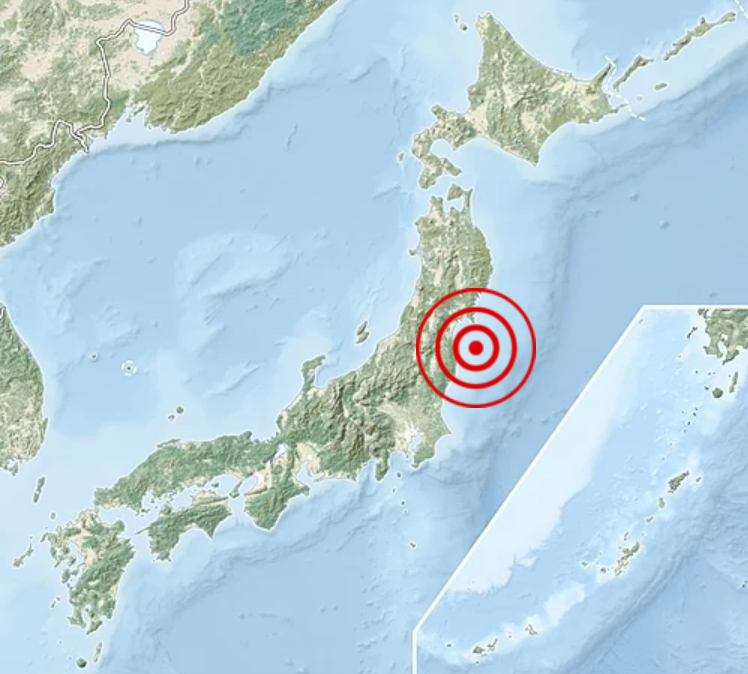
2022 Fukushima Earthquake
Residents of downtown Sendai saw the sky flash. Not lightning -- something stranger. A diffuse glow pulsed above the city at 23:36 on March 16, 2022, captured by CCTV cameras and later confirmed by researchers as an earthquake light, a rare electromagnetic phenomenon coinciding with a magnetic disturbance detected at the Kakioka geomagnetic observatory in Ibaraki Prefecture. Scientists checked maintenance reports for every nearby power station and transformer; none had malfunctioned. The light came from the earth itself, as a magnitude 7.4 earthquake ripped through a fault beneath the Pacific plate off the coast of Fukushima.
A Seismic Triplet
Seismologists would come to categorize this earthquake as the final member of a triplet sequence stretching back more than a decade. The first event was the April 2011 Miyagi earthquake, itself an aftershock of the catastrophic March 2011 Tohoku megathrust. The second was the February 2021 Fukushima earthquake, whose epicenter lay just 7 kilometers to the northeast. The 2022 rupture propagated northward along a fault twice the length of the 2021 break, and the two have been formally classified as a doublet earthquake. Between the northern edge of the 2022 rupture and the southern edge of the 2011 rupture, a seismic gap remains off the central Miyagi coast -- a zone that Coulomb stress calculations show has been increasingly loaded. Scientists warn it is the likely source of a future large earthquake.
Two Million Homes in the Dark
The earthquake struck at a depth of 57 kilometers, deep enough to shake the ground violently across the entire Tohoku and Kanto regions. A peak ground acceleration of 1,233 gals was recorded at Kawasaki, Miyagi. Across 13 prefectures and metropolitan Tokyo, an estimated 2.2 million households lost power after a safety mechanism at the Hirono Thermal Power Station triggered a cascading shutdown. In Tokyo alone, 120,000 homes went dark. TEPCO restored most service by sunrise on March 17, but over 33,000 households in Miyagi and Fukushima remained without electricity well into the day. Mobile phone networks across both prefectures went silent.
The Bullet Train and the Broken Road
A Tohoku Shinkansen train derailed near the epicenter, prompting JR East to suspend bullet train service between Nasushiobara and Morioka stations. At least 17 utility poles along the Tohoku line were severely deformed. On the Tohoku Expressway, a 100-meter-long crack opened between the Shiroishi interchange and Kunimi toll stop, with uplift reaching 50 centimeters -- two cars punctured their tires driving over it before the road was closed. In Date, the Tadamigawa Bridge over the Abukuma River was heaved upward by tens of centimeters, and a newly constructed bridge at Koori, scheduled to open just three days later, was so badly damaged that officials estimated repairs could take up to three years. Airlines stepped in where rails failed: ANA and JAL flew special routes from Sendai and Fukushima to Haneda Airport.
Icons Shaken
In Sendai's Aoba Ward, part of the stone wall of historic Aoba Castle collapsed, and the bronze equestrian statue of Date Masamune -- the 17th-century founder of the city -- tilted sideways when its horse's leg fractured. The White Cube concert hall in Shiroishi suffered a partial ceiling collapse, scattering shattered glass and debris across its seats. At the Inari Shrine in Fukushima City, three stone lanterns that had just been restored after the 2021 earthquake were destroyed again. Across the region, 217 buildings were completely destroyed, 4,556 were severely damaged, and over 52,000 sustained lesser damage.
The Toll and the Warning
Four people died. A man in his 60s in Soma jumped from a window to escape. In Tome, Miyagi, a man in his 70s died of a heart attack. Across the region, 247 people were injured. Workers at the crippled Fukushima Daiichi Nuclear Power Plant found no new anomalies, though pumps at the Fukushima Daini plant's spent fuel pools temporarily stopped. A Disaster Relief Act was declared across all municipalities in Fukushima and Miyagi. The USGS estimated a 35 percent chance that total economic damage would reach between 100 million and one billion US dollars. For the communities of northeast Japan, the 2022 earthquake was another chapter in a seismic story that shows no sign of ending -- one written by the relentless collision of the Pacific plate driving westward at 70 millimeters per year beneath the islands of Honshu.
From the Air
Epicenter located at 37.73N, 141.60E, in the Pacific Ocean off the Fukushima coast. The epicentral area is offshore but the affected region stretches from Sendai southward through Fukushima Prefecture. Key visual landmarks include the Fukushima Daiichi nuclear plant (identifiable by its massive decommissioning infrastructure), Sendai city, and the reconstructed seawalls lining the Tohoku coast. Nearest airports: Sendai Airport (RJSS) approximately 50km north-northwest, Fukushima Airport (RJSF) approximately 80km west-southwest. Best viewed at 10,000-20,000 feet along the Pacific coastline. The Tohoku Shinkansen rail corridor is visible as a linear feature running north-south through the coastal plain. Weather conditions are variable in March, with frequent cloud cover and occasional snow.