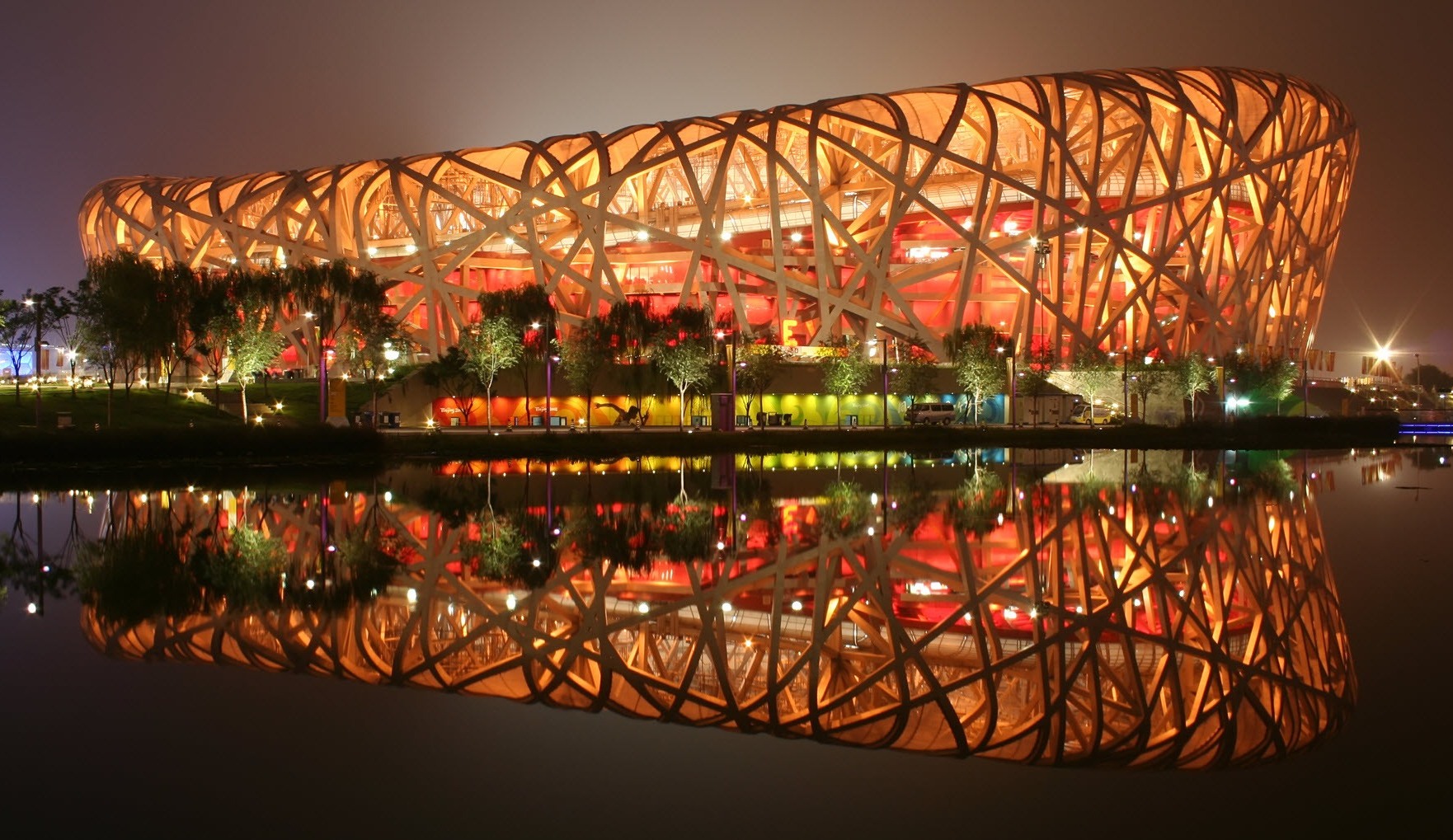
2022 Winter Olympics Opening Ceremony
The countdown began at twenty-four -- not an arbitrary number, but a deliberate echo. Twenty-four for the 24th Winter Olympics. Twenty-four for the solar terms of the Chinese calendar. And the date itself, February 4, 2022, fell on Lichun, the traditional "Beginning of Spring." Fireworks spelled out the characters for spring above Beijing National Stadium, and for a moment the Bird's Nest seemed to exist at a crossroads of time -- ancient agricultural rhythms meeting a spectacle powered by 40,000 LED modules forming the world's largest screen.
A Director Returns
Zhang Yimou had been here before. Fourteen years earlier, he had directed the 2008 Summer Olympics opening ceremony in the same stadium, a production remembered for its 2,008 drummers and massive scroll painting. For 2022, the filmmaker took a different approach entirely. Rather than separating the artistic performances from the formal Olympic protocols, Zhang merged them into a single continuous program -- an Olympic first. The result was leaner, more intimate, and threaded with recurring imagery. Snowflakes appeared everywhere: as the placards carried before each national delegation, as the motif connecting segment to segment, and finally as the structure that would hold the Olympic flame itself.
The Snowflake and the Flame
The most dramatic departure from tradition came at the ceremony's climax. For the first time in Olympic history, the final torchbearers did not ignite a massive cauldron. Instead, two young cross-country skiers -- 21-year-old Zhao Jiawen and 20-year-old Dinigeer Yilamujiang -- fitted the torch into the center of a large stylized snowflake assembled from the name placards of all participating delegations. The flame burned small, almost fragile, nested within the collective identity of 91 competing teams. It was a deliberate visual statement: the Olympic fire as a shared candle rather than a roaring beacon. The selection of Yilamujiang, a Uyghur athlete from Xinjiang, drew intense international attention given the widely documented persecution of Uyghurs in China.
Ceremony in a Pandemic
Like the Tokyo Summer Games six months earlier, Beijing 2022 unfolded under the shadow of COVID-19. The stadium held no general-public ticket holders; only invited guests filled a fraction of the 80,000 seats. A closed-loop biosecurity system confined athletes, officials, and media to a bubble of daily testing, dedicated transport, and quarantine protocols. Ten countries, including the United States, the United Kingdom, Australia, and Canada, mounted diplomatic boycotts, sending athletes but no government officials. The parade of nations reflected these tensions -- when the Chinese Taipei delegation marched, China's state broadcast cut to footage of President Xi Jinping rather than show the team. Yet 2,880 athletes from 91 nations still walked the stadium floor, and the IOC's Thomas Bach urged the world to "give peace a chance" during the traditional Olympic truce.
Ancient Roots, Modern Stage
Before the formal ceremony began, a pre-show featured residents of Beijing and Hebei Province in performances that culminated with the words "Happy Chinese New Year" appearing on the stadium floor, a nod to the lunar calendar's overlap with the Games. The ceremony's opening film traced the origins of skiing to Dundbulag rock carvings near Altay, in China's far northwest, where scholars from 18 countries had declared in 2015 that skiing likely originated. It was a characteristic move -- connecting a global winter sport to Chinese geography and deep history. The 24-solar-term countdown reinforced the theme, cycling through seasonal imagery from the coldest depths of winter to the promise of Lichun's spring, each term illustrated on the vast LED floor in a cascade of green shoots breaking through ice.
Double Olympic City
The ceremony confirmed Beijing's singular status in Olympic history. No other city has hosted both the Summer and Winter Games. The Bird's Nest itself embodied this duality -- originally built for the 2008 Summer Olympics at a cost of US$428 million, designed by Herzog and de Meuron with artistic consultation from Ai Weiwei, the stadium had spent the intervening years as a tourist attraction drawing 20,000 to 30,000 visitors daily at 50 yuan admission. Now it served a second Olympic purpose, its lattice-steel exterior unchanged but its interior transformed by technology that did not exist in 2008. The 10,552-square-meter LED floor could simulate rivers, forests, and star fields beneath the athletes' feet, making the ceremony as much a feat of engineering as of artistry.
From the Air
Located at 39.99°N, 116.39°E in northern Beijing at the Olympic Green complex. The Bird's Nest stadium is unmistakable from the air -- its lattice steel structure resembles woven branches. Best viewed at 3,000-5,000 feet AGL. Beijing Capital International Airport (ZBAA/PEK) lies 15 nm to the northeast; Beijing Daxing International Airport (ZBAD/PKX) is 30 nm to the south.