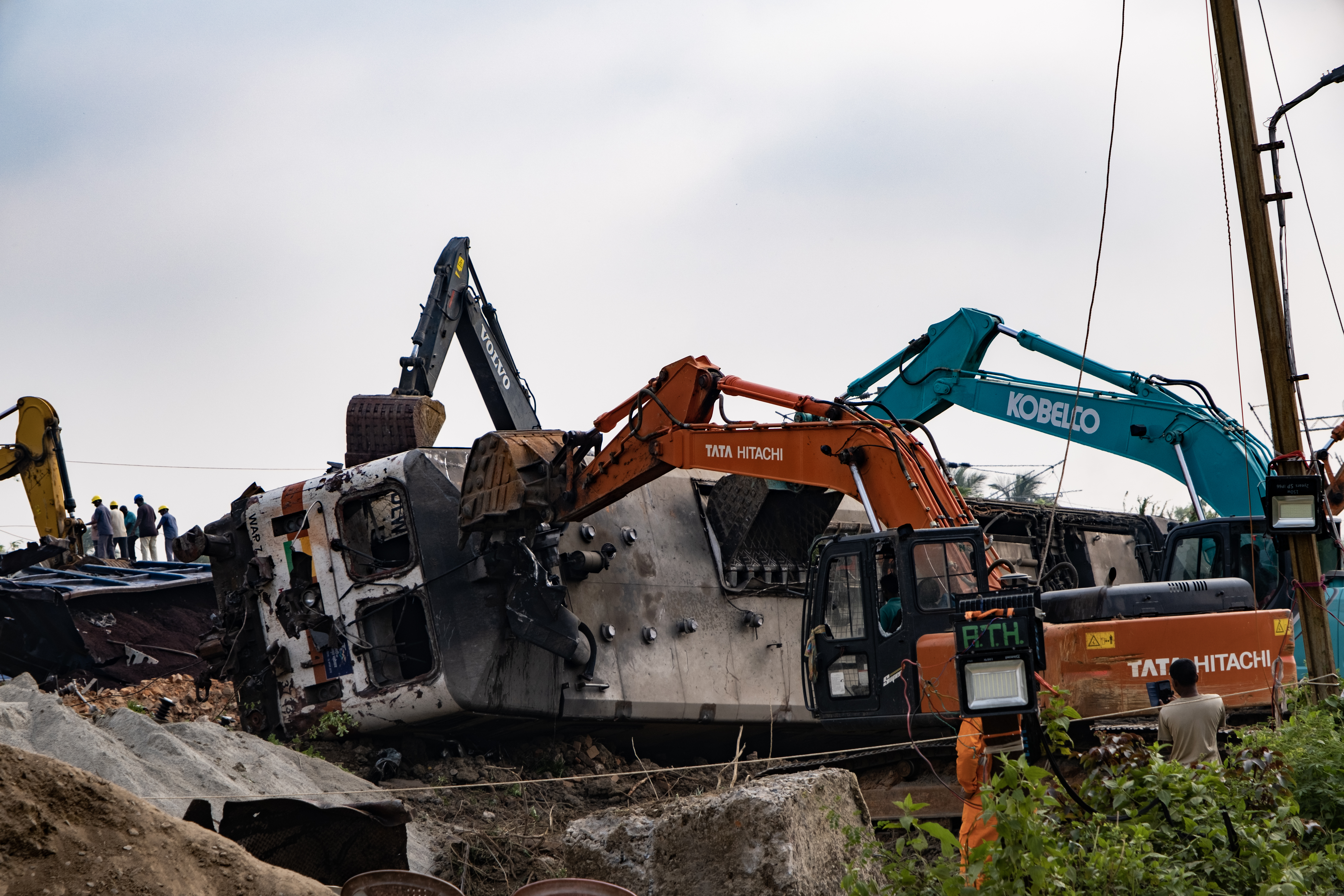
2023 Odisha Train Collision
At seven in the evening on June 2, 2023, the Coromandel Express was doing what it had done thousands of times before: running at near-maximum speed along the Howrah-Chennai main line, carrying passengers south from West Bengal toward Tamil Nadu. The train was not scheduled to stop at Bahanaga Bazar, a small station in Odisha's Balasore district. It received a green signal to continue on the main line. Somewhere in the electronic interlocking system, however, something had gone wrong. The signal directed the Coromandel Express not along the main track but onto a parallel loop line -- where a goods train laden with iron ore sat motionless in its path.
Seven Minutes of Catastrophe
The Coromandel Express struck the rear of the stationary goods train at close to full speed. The locomotive of the passenger train climbed over the ore wagons, and twenty-one of its coaches derailed in a chain reaction of twisting metal and shattered glass. At that same moment, the SMVT Bengaluru-Howrah Superfast Express was traveling in the opposite direction on the adjacent down line. Most of its coaches had already passed the collision point, but the rear of the train had not. Three derailed coaches from the Coromandel Express slammed into the last two coaches and brake van of the Bengaluru-Howrah train. Those five coaches -- caught between two collisions -- bore the heaviest toll. When the noise and motion finally stopped, 296 people were dead and more than 1,200 injured, making it one of the deadliest railway disasters in Indian history.
The Cheapest Seats
Most of the dead were riding in the first three coaches of the Coromandel Express, which included two unreserved general-category cars. These are the most affordable seats on Indian Railways -- they require no reservation, no assigned berth, just the cheapest ticket available. They are the coaches migrant workers fill, traveling between home villages and distant cities for wages that leave little room for the comfort of a reserved compartment. Because the railways had names only for passengers holding reserved tickets, identifying the dead in those general coaches proved agonizingly difficult. Families waited for news that, in many cases, took days to arrive. The locomotive pilot of the Coromandel Express and his assistant survived, despite being at the point of greatest impact, a detail that struck many observers as remarkable given the forces involved.
Warnings Unheeded
The investigation that followed traced the disaster to an error in the electronic interlocking system that controls signals and track switches at the station. Railway Minister Ashwini Vaishnaw confirmed the signaling failure on June 4 and initially raised the possibility of sabotage -- a claim that a signal inspector described as highly unlikely given the time constraints involved. The CBI arrested three railway officials on July 7, 2023, charging them with culpable homicide and destruction of evidence. But the systemic questions ran deeper than individual culpability. The tracks at Bahanaga Bazar were not equipped with Kavach, India's indigenous train protection system designed to automatically halt trains when signals are violated. A December 2022 report by the Comptroller and Auditor General had warned that the railway safety department lacked adequate staffing and that funds earmarked for safety had been diverted to other departments for four consecutive years. In February 2023 -- just four months before the crash -- a similar signaling error had been reported on the Karnataka Sampark Kranti Express, which narrowly avoided a collision. The warning was documented but not resolved.
After the Wreckage
Rescue operations mobilized with a speed that contrasted starkly with the system failures that caused the disaster. Three National Disaster Response Force units, four Odisha Disaster Rapid Action Force units, more than fifteen fire rescue teams, one hundred doctors, two hundred police personnel, and two hundred ambulances converged on the crash site. Local residents pulled survivors from mangled coaches before official teams arrived, and people from neighboring villages donated blood at overwhelmed hospitals. The governments of West Bengal and Tamil Nadu -- states from which many passengers had originated -- sent medical delegations. Rail service on the line resumed three days later, on June 5, after round-the-clock restoration work. Operations on more than 150 trains were disrupted, and at least 48 were cancelled entirely. The human aftermath stretched further: compensation was announced by the central government and multiple state governments, but for families who lost breadwinners in the unreserved coaches, no amount could replace what was taken by a signal that pointed the wrong way.
From the Air
The crash site is near Bahanaga Bazar railway station at approximately 21.34N, 86.76E in Balasore district, Odisha. The Howrah-Chennai main line runs roughly north-south through flat, agricultural terrain in this area. From altitude, the railway corridor is visible as a linear feature cutting through rice paddies and small settlements. The nearest airport is Biju Patnaik International Airport (VEBS) in Bhubaneswar, approximately 200 kilometers to the southwest. Balasore itself has no commercial airport.