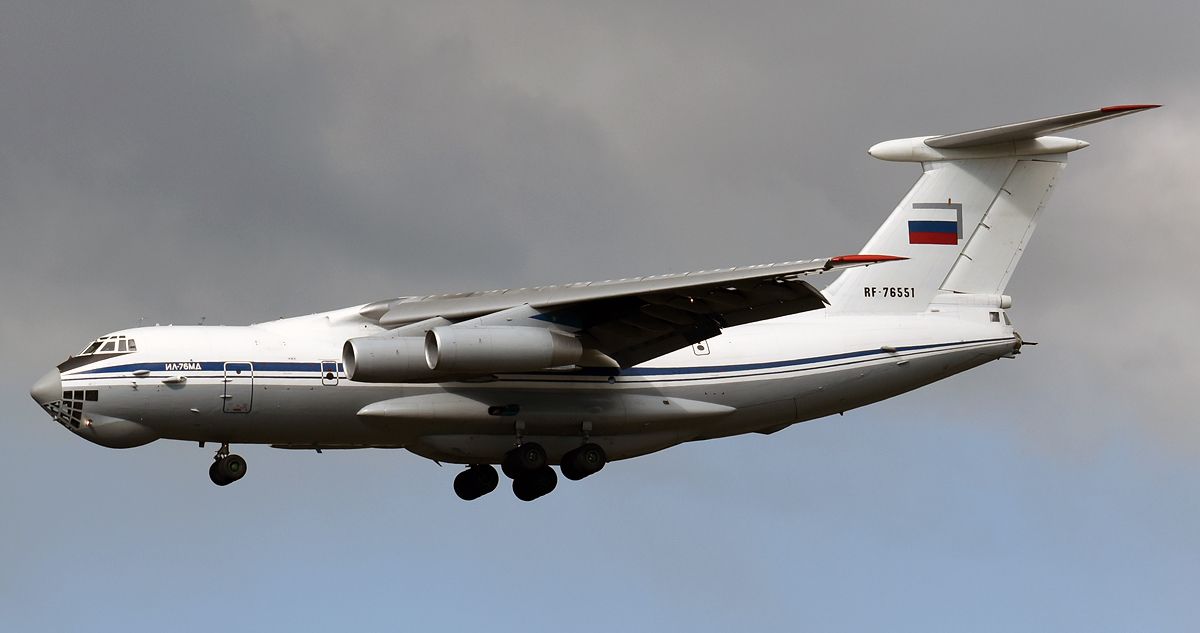
2024 Ivanovo Ilyushin Il-76 crash
The column of black smoke was visible for miles across the flat terrain of Ivanovo Oblast. At 13:00 Moscow time on March 12, 2024, an Ilyushin Il-76 military cargo aircraft crashed near Bogorodskoye District, barely minutes after takeoff from Ivanovo-Severny airfield. All fifteen people on board -- eight crew members and seven passengers -- were killed. Unconfirmed video footage captured the final moments: an engine burning, the aircraft descending steeply, a detached engine pod falling separately from the fuselage.
A Routine Flight
The Ilyushin Il-76 was a workhorse of Soviet and Russian military aviation, a four-engine heavy transport designed to carry troops and cargo across the vast distances of the Russian interior. First flown in 1971, the type became the backbone of Russia's Military Transport Aviation command, capable of operating from short and unpaved runways in conditions that would ground more delicate aircraft. The particular Il-76 that departed Ivanovo-Severny on March 12 was conducting what the Russian defense ministry described as a routine flight. Among those aboard were pilots from the 117th Military Transport Aviation Regiment, stationed at different bases across Russia. Denis Pasler, the governor of Orenburg Oblast, confirmed that some of the crew came from Orenburg. Igor Rudenya, the governor of Tver Oblast, said others were from Tver. The flight's passengers and crew had been drawn from across the military transport network, as was common for repositioning and training missions.
Fire on Climb-Out
During the initial climb after takeoff, one of the Il-76's four engines caught fire. What should have been a manageable emergency -- the Il-76 was designed to fly on three engines -- became fatal within minutes. Videos circulating on social media showed the aircraft in a steep descent with flames streaming from one engine nacelle. In at least one clip, the burning engine appeared to separate from the wing entirely. The crew attempted to return to Ivanovo-Severny airfield but never made it. The aircraft struck the ground near Bogorodskoye District, roughly 30 kilometers northeast of Ivanovo. A ministry source confirmed to the state news agency TASS that all fifteen people aboard had died.
The Investigation
Russia's defense ministry dispatched a board of the Russian Aerospace Forces to Ivanovo Oblast to investigate the crash. The ministry's preliminary assessment pointed to an engine fire as the most probable cause, though the sequence of events -- why the fire led to a loss of control rather than a successful single-engine return -- was not immediately explained. The Il-76 fleet had served the Soviet and then Russian military since the 1970s, and many airframes in active service had accumulated decades of flight hours. Aging infrastructure, maintenance pressures, and the demands of ongoing military operations all formed the backdrop against which the investigation proceeded. The search and rescue operation at the crash site concluded the same day, with TASS reporting that recovery teams found no survivors.
Ivanovo's Military Aviation Legacy
Ivanovo-Severny airfield has long been a hub for Russian military transport aviation, one of several bases that keep the country's enormous airlift network functioning. The oblast itself is a textile-manufacturing region roughly 250 kilometers northeast of Moscow, an industrial heartland that quietly hosts military installations far from the capital's attention. The March 2024 crash was not the first aviation disaster in the region, nor would it be the last. Barely twenty months later, in December 2025, the sole remaining operational Antonov An-22 would also crash near Ivanovo after an in-flight structural breakup, killing all seven aboard. Two catastrophic losses from the same airfield complex in less than two years spoke to pressures that no single investigation could fully address. For the families of the fifteen people who died on March 12, 2024, the broader questions of fleet age and maintenance were abstractions. Their loss was immediate and specific: crew members from Orenburg, from Tver, from across the military transport community, people whose routine flights kept the logistics of a continental military functioning.
From the Air
Crash site located at approximately 57.04N, 41.02E, near Bogorodskoye District in Ivanovo Oblast, roughly 30 km northeast of Ivanovo city. Ivanovo-Severny airfield (UUBI) is the departure point. The terrain is flat agricultural and forested land typical of central Russia. Best viewed at 3,000-5,000 ft AGL. The area is approximately 250 km northeast of Moscow. Nearby civil airports include Ivanovo Yuzhny.