2024 Solingen Stabbing
The stages were set up on the Fronhof, in the heart of Solingen, for the third night of the city's 650th anniversary celebration. Three stages, live music, food stalls, and a crowd of several thousand people on a warm evening in late August 2024. DJ Topic was on. The crowd was dancing. At about a quarter past nine, in a quieter pocket of the square near the church, a man with a kitchen knife walked into a group of strangers and stabbed eleven people in less than a minute. Three of them died. The attacker disappeared into the crowd, leaving behind the knife, the screaming, and a security guard already calling for help. DJ Topic was asked - and afterwards spoke openly about this - to keep playing, so that the larger crowd would not stampede.
The Three Who Did Not Go Home
The dead were two men and a woman: a 67-year-old retired civil servant, a 56-year-old teacher and father of two, and a 56-year-old woman who worked locally. They lived in or around Solingen. They had come down to the city center to listen to music and to see neighbors at the festival that the city had been planning for two years. Eight others were wounded; four of them gravely. One of the survivors was a pharmacist; another, an Iranian who had come to Germany years before, would later say in the press that he was afraid both of dying from his wounds and of being deported once he recovered. The medical staff at Solingen Klinik worked through the night. By the following weekend all of the gravely wounded were stable. None of this undid the three empty chairs in three Solingen homes.
The Festival That Was Supposed to Be a Birthday
Solingen had been planning the 650th-anniversary weekend for two years. The Klingenstadt, the City of Blades, has been a knife-making town since the medieval guilds; its great names - Wusthof, Henckels, Boker - still anchor a regional economy built on quality steel. The festival was meant to be a love letter to that history and to the multi-cultural city Solingen has become. A celebration mile, the brochure called it: three days, three stages, food from across the diaspora communities, performances on the squares between the church and the central market. There was an enormous, deliberate, gentle inclusiveness to the planning. That the attack happened at this festival, in this city - Solingen, which thirty-one years earlier had buried five people from the Genç family home after the 1993 arson - was a coincidence Solingen will live with for a long time.
The Day After
Within an hour the police had cordoned off the city center; by the next morning the Dusseldorf prosecutor's office had announced it was treating the attack as terrorism. Twenty-six hours after the stabbing, the suspect - a 26-year-old Syrian named Issa al Hassan, whose asylum application had been rejected in early 2023 but who had not been successfully deported - turned himself in at a Solingen police station with stains on his clothes that matched the victims. The Islamic State claimed the attack, the first such claim on German soil since the 2016 Berlin truck attack. The Friday and Saturday of the festival were cancelled. Chancellor Olaf Scholz came to Solingen on the 26th and laid flowers; so did the federal interior minister and the minister-president of North Rhine-Westphalia. The mayor, Tim Kurzbach, wrote a single sentence on the city's Facebook page that became the headline in the next day's papers: tonight, we are all in shock and great sadness in Solingen. We wanted to celebrate together, and now we have to mourn.
Solingen, Twice in a Lifetime
It is hard not to hear the echo. In 1993 a far-right arson took five lives from a Turkish family in this same city. In 2024 an Islamist attack took three lives from a multi-ethnic festival in this same city. The political reactions could not have been more different in their direction; both, in their way, were attempts to do something with rage. What does not change, in either case, are the people in the photographs that the local paper publishes: the teacher's children laying flowers, the elderly civil servant's widow, the pharmacist's coworkers wearing black armbands at the next month's pharmacy shift. The attacker received a life sentence in September 2025 followed by preventive detention, and Solingen continued to be Solingen - a working town that on its bad days is asked to carry more than one town's share of national arguments.
What the City Does With It
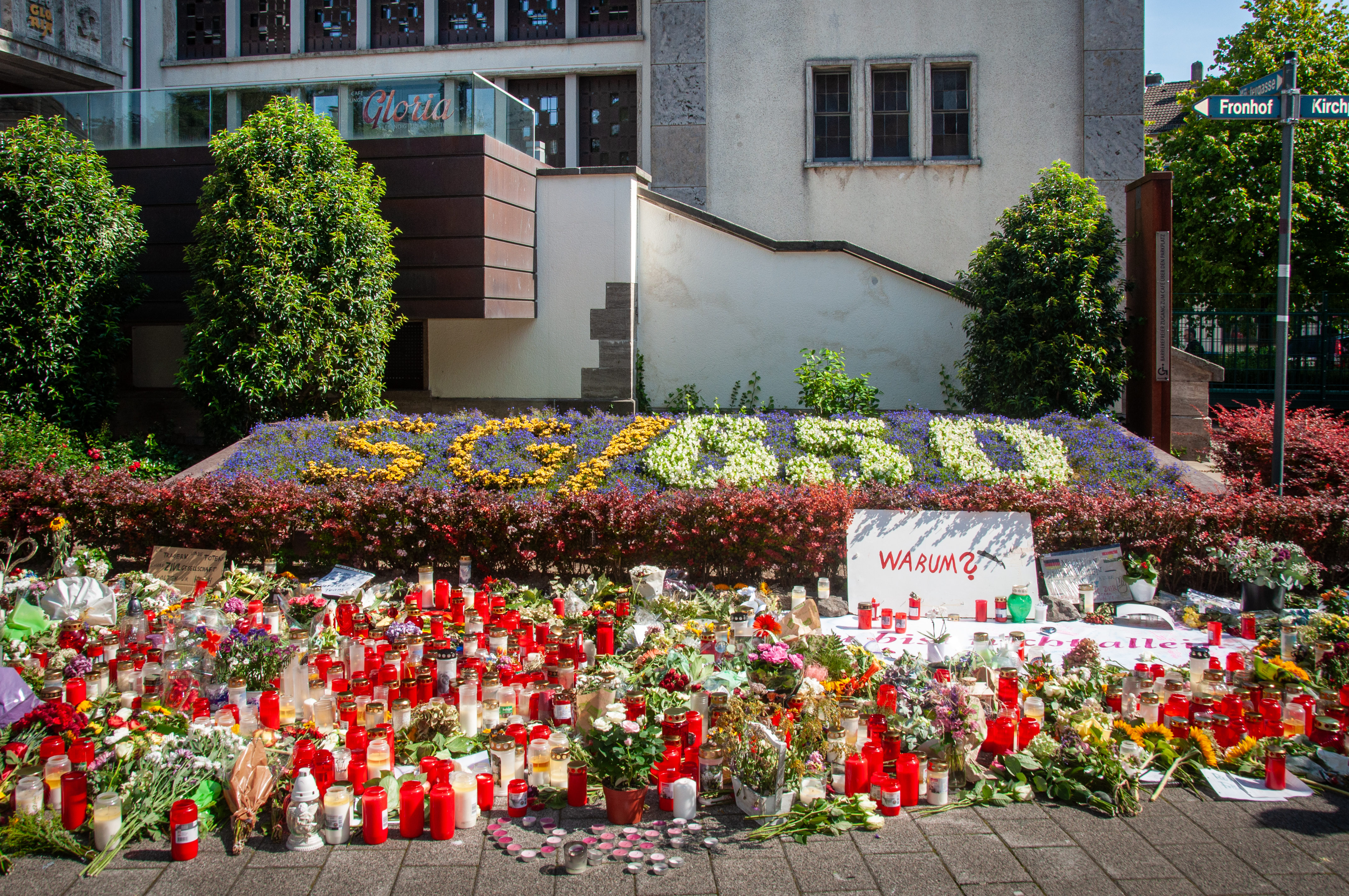
On the Fronhof now there is a small permanent memorial - a stone, a single line of text, candles that people still light. The city did not turn the spot into a shrine; people walk by it on the way to the bakery. The festival, in slightly different form, came back the following summer; the citizens insisted. There is a cleaving instinct, after attacks like this one, to make everything political. Solingen has resisted that more than most. The political fights happen in Berlin, in the Bundestag, in the talk shows. In Solingen, on the streets where the dead lived and walked, what mostly happens is the smaller, slower work of remembering: candles at the right times, names read aloud at the right moments, and a quiet refusal to let the worst night of August define everything else that the city is and has been for six hundred and fifty years.
From the Air
The attack site is on the Fronhof in central Solingen, near 51.17 degrees north and 7.08 degrees east. Solingen sits in the Bergisches Land hill country east of Dusseldorf, between Wuppertal to the north and Cologne to the southwest. Nearest airports are Dusseldorf (EDDL) about 30 km northwest and Cologne-Bonn (EDDK) about 30 km southwest.